
Why Payroll Outsourcing Is the Smartest Back-Office Decision You Can Make
Payroll outsourcing is the practice of hiring a third-party provider to handle your payroll processing, tax filings, and compliance — so you don’t have to.
Here’s what you need to know at a glance:
| Question | Quick Answer |
|---|---|
| What is it? | Delegating payroll tasks to an external specialist |
| Who is it for? | Businesses of any size struggling with payroll complexity or time |
| What does it cost? | $30–$200 per employee per month, depending on services |
| Key benefit | Saves time, reduces errors, ensures tax compliance |
| Key risk | Employer retains final legal liability for tax errors |
| How fast to switch? | Most businesses can transition within a few weeks |
Running a business is hard enough without spending a quarter of your workweek on HR paperwork.
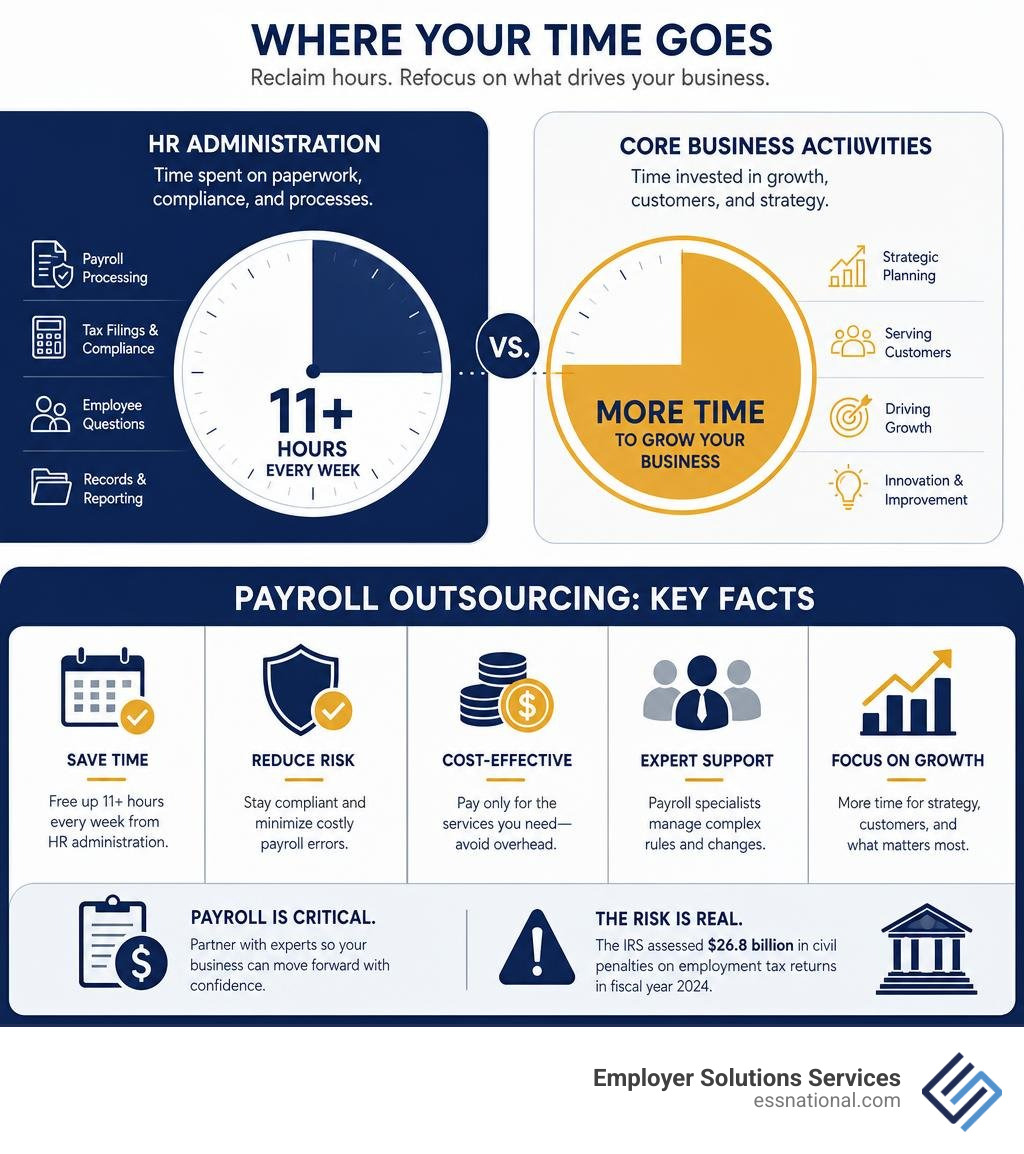
Yet that’s exactly what’s happening. According to recent business leadership studies, nearly two-thirds of business leaders spend at least 11 hours every week on HR administration. And 57% of HR professionals are already working beyond capacity — driving burnout and turnover.
Payroll sits at the center of that burden.
It looks simple on the surface. Pay people. File taxes. Repeat. But the reality involves gross-to-net calculations, multi-state withholding rules, garnishments, W-2s, benefit deductions, and an IRS that assessed $26.8 billion in civil penalties on employment tax returns in fiscal year 2024 alone.
That’s not a back-office problem. That’s a business risk.
For mid-sized businesses especially, the question isn’t really whether to consider outsourcing payroll. It’s how to compare your options so you choose the right fit.
This guide breaks it all down — what’s included, what it costs, how it compares to in-house management, and how to make the switch without disrupting your operations.
What is Payroll Outsourcing and How Does It Work?
At its core, payroll outsourcing is an operational partnership. Instead of tasking an internal employee with calculating hours, managing tax brackets, and cutting checks, you hand those duties over to a dedicated external specialist.
But how does it actually function on a week-to-week basis?
The process is remarkably straightforward and designed to keep you in control without the administrative headache:
- Data Submission: Your team tracks employee hours using integrated time-tracking software. At the end of the pay period, you review and submit these hours to your outsourcing partner.
- Calculation & Processing: We handle the complex math. This includes calculating gross wages, subtracting pre-tax and post-tax deductions (like healthcare or retirement), managing court-ordered garnishments, and determining net pay.
- Distribution: The outsourcing provider executes the payments. This is typically done via direct deposit, pay cards, or printed paper checks.
- Tax Filing and Compliance: The provider calculates, withholds, and deposits federal, state, and local taxes with the appropriate agencies, ensuring your business stays on the right side of the law.
Understanding Payroll Services And Why You Need Them is the first step toward reclaiming your calendar. While some businesses choose to use simple DIY software platforms, true outsourcing means you have human experts double-checking the data and running the processes.
For businesses managing contract workforces or temporary staff, this model can even scale into an Employer of Record (EOR) setup, where the provider handles the legal employment liabilities entirely, leaving you free to focus on day-to-day operations.
Core Services in a Payroll Outsourcing Package
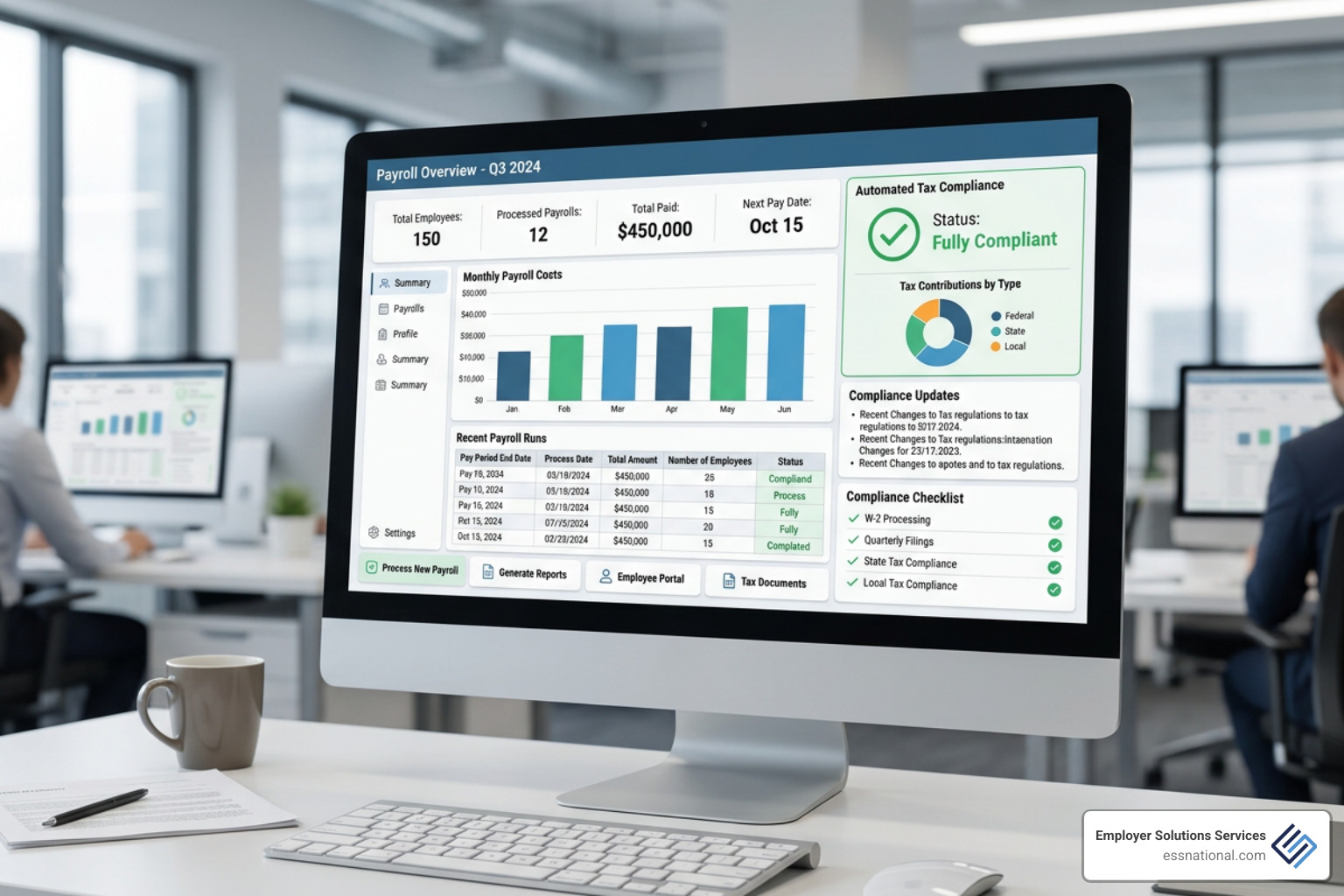
When you invest in a professional payroll package, you aren’t just paying for someone to print checks. A comprehensive service bundle acts as your complete back-office support system.
A standard outsourcing package generally includes:
- Direct Deposit & Flexible Payments: Setting up secure electronic transfers directly to your employees’ bank accounts.
- Full-Service Tax Management: Automatic withholding and quarterly/annual tax filings across federal, state, and local jurisdictions.
- Garnishment Administration: Managing court-ordered wage deductions to ensure you remain compliant with legal mandates.
- Year-End Reporting: Complete preparation and filing of W-2 and 1099 forms.
- PTO & Accrual Tracking: Seamlessly monitoring sick leave, vacation days, and personal time off.
- Benefits Integration: Coordinating with health insurance and retirement plans to automate premium deductions.
If your business relies on a mix of internal staff and external talent, learning how to handle payroll processing for direct hires like a pro is essential. A great provider will customize your package to cover both your standard W-2 employees and 1099 contractors under one unified roof.
In-House Payroll vs. Payroll Outsourcing: Key Differences
Many growing businesses start by managing payroll in-house, often using basic accounting software or manual spreadsheets. However, as your team grows, the hidden costs of this “free” or “cheap” method begin to compound.
To help you evaluate your current setup, let’s look at how in-house management stacks up against professional outsourcing:
| Comparison Factor | In-House Payroll Management | Outsourced Payroll Services |
|---|---|---|
| Administrative Burden | Heavy. Requires hours of manual data entry, reconciliation, and form filing. | Light. Your team only validates and signs off on the raw hours. |
| Technical Debt & Software | High. You must purchase, update, and maintain software licenses and security protocols. | None. The provider hosts and maintains the entire platform. |
| Compliance Expertise | Internal team must continuously study changing federal, state, and local tax laws. | Access to a dedicated team of legal and tax compliance experts. |
| Single-Point-of-Failure Risk | High. If your payroll clerk gets sick or leaves, payroll stops. | Zero. A full team guarantees uninterrupted service. |
| Cost Predictability | Variable. Hidden costs in labor, software updates, and potential penalty fees. | Highly predictable. Structured as a flat monthly or per-employee fee. |
Many businesses struggle to find the right balance between control and convenience. If you are currently in the decision-making phase, discovering how to pick the perfect small business payroll system will help you determine if your internal team has the capacity to keep up with the technical and legal demands of modern compensation.
If you aren’t ready to hand over 100% of the reins, you can also look into “co-outsourcing.” This hybrid model allows your internal team to handle basic data entry while leaving the complex tax filing and compliance reporting to the outsourcing professionals.
The Benefits and Risks of Outsourcing Your Payroll
Like any strategic business decision, moving your payroll off-site comes with a balance of advantages and potential challenges. Understanding both sides of the coin ensures you establish a partnership that protects your bottom line.
The Benefits: More Than Just Time Saved
- Drastic Error Reduction: According to industry data, 1 in 5 payrolls run in-house contain errors. Professional outsourcing leverages automated systems and expert oversight to drop error rates to near zero.
- Enhanced Data Security: Most small to mid-sized businesses do not have the resources to build enterprise-grade cybersecurity walls. Reputable payroll providers utilize advanced encryption, multi-factor authentication, and secure servers to safeguard sensitive employee banking details.
- Operational Continuity: If your sole internal payroll administrator takes a vacation, falls ill, or suddenly resigns, your business faces an immediate crisis. Outsourcing ensures your employees get paid on time, every time, regardless of internal staffing shifts.
- Strategic Focus: By offloading the administrative weight, your HR and leadership teams can redirect their energy toward recruitment, employee engagement, and revenue-generating projects.
To explore how modern technology makes this possible, check out our review of the best small business online payroll tools of 2026 to see how secure, cloud-based portals keep you connected to your data.
The Risks: What to Keep in Mind
- Retained Legal Liability: This is the most critical risk to understand. Even though you hire a third party to calculate and file your taxes, the IRS still holds your business legally responsible for any errors or late filings. This makes choosing a highly reputable, certified partner non-negotiable.
- Correction Turnaround Delays: If an employee notices an error on their pay stub, resolving it through an external provider can sometimes take longer than walking down the hall to an in-house accountant.
- Paying for Unused Services: Some large, national providers bundle dozens of HR features into their packages. If you only need basic payroll, you might end up paying for complex performance-management tools you never use.
Ensuring Tax Compliance and Mitigating Penalties
The financial stakes of payroll tax compliance have never been higher. In fiscal year 2024, the IRS assessed $26.8 billion in civil penalties on employment tax returns and another $20.2 billion on business tax returns. A single misclassified employee or late quarterly filing can result in penalties that quickly wipe out a small business’s profit margins.
This challenge is magnified if you employ remote workers or have operations across state lines. Every state plays by its own rules.
For instance, if your business operates in our primary service regions, you have to navigate vastly different tax landscapes:
- Florida & Nevada: No state income tax, but unique local reporting and workers’ compensation requirements.
- Texas: No state income tax, but complex local franchise and unemployment tax structures.
- Illinois, Massachusetts, Georgia, Pennsylvania, & New Jersey: Highly structured state income taxes with strict local withholding and municipal tax laws.
Navigating these differences requires localized expertise. For Illinois businesses, that means keeping current with state withholding, unemployment insurance, wage reporting, and local payroll requirements before every pay run. You can explore Illinois payroll compliance resources for additional guidance on state-specific regulations.
Similarly, for Garden State businesses, learning how to master New Jersey payroll without losing your mind is a must to keep up with some of the country’s most stringent family leave and state unemployment mandates.
To ensure comprehensive multi-state coverage, it helps to partner with a provider that has an established footprint across these key regions, ensuring your business remains fully compliant no matter where your employees are located.
Understanding the Cost of Payroll Outsourcing in 2026
How much should you actually expect to invest in payroll outsourcing?
In 2026, pricing models have become highly transparent, typically combining a fixed base fee with a variable per-employee rate. For small to medium enterprises, the average cost of payroll outsourcing falls between $50 and $200 per month per employee if you are utilizing a comprehensive, full-service HR and benefits package.
If you only require standalone, basic payroll processing, the cost generally drops to between $30 and $100 per person each month.
When calculating your budget, keep these pricing factors in mind:
- Pay Frequency: Running payroll weekly is generally more expensive than processing it bi-weekly or semi-monthly, as some providers charge per-run fees.
- Complexity: Having employees spread across multiple states or managing a mix of hourly, salaried, and contract workers will increase the base cost.
- Year-End Fees: Many providers charge an additional annual fee (often $5 to $15 per employee) to generate and mail W-2 and 1099 forms.
- Integration Add-ons: Syncing your payroll with external 401(k) plans or time-tracking software may carry nominal setup fees.
While these costs might seem like an added expense, they must be weighed against the cost of mistakes. According to a 2022 EY study, the average cost of correcting a single payroll error is around $291.
Furthermore, a Workforce Institute survey found that nearly half of all employees start job hunting after just two payroll mistakes. When you factor in the saved administrative hours and the mitigation of IRS penalties, outsourcing quickly transitions from a cost center to a high-return investment.
To see how these costs scale for smaller teams, read our guide on New Jersey payroll services for every small business to find budget-friendly, scalable options.
How to Choose and Transition to the Right Provider
Choosing a payroll partner is a major decision. You are handing over your company’s financial data and your employees’ livelihoods.
When vetting potential providers, look beyond the price tag and evaluate their operational track record. Ask about their security certifications, their history of handling state tax audits, and whether they assign a dedicated specialist to your account or route your calls to a generic help center.
Once you select a provider, the transition process must be handled carefully to avoid disrupting your operations.
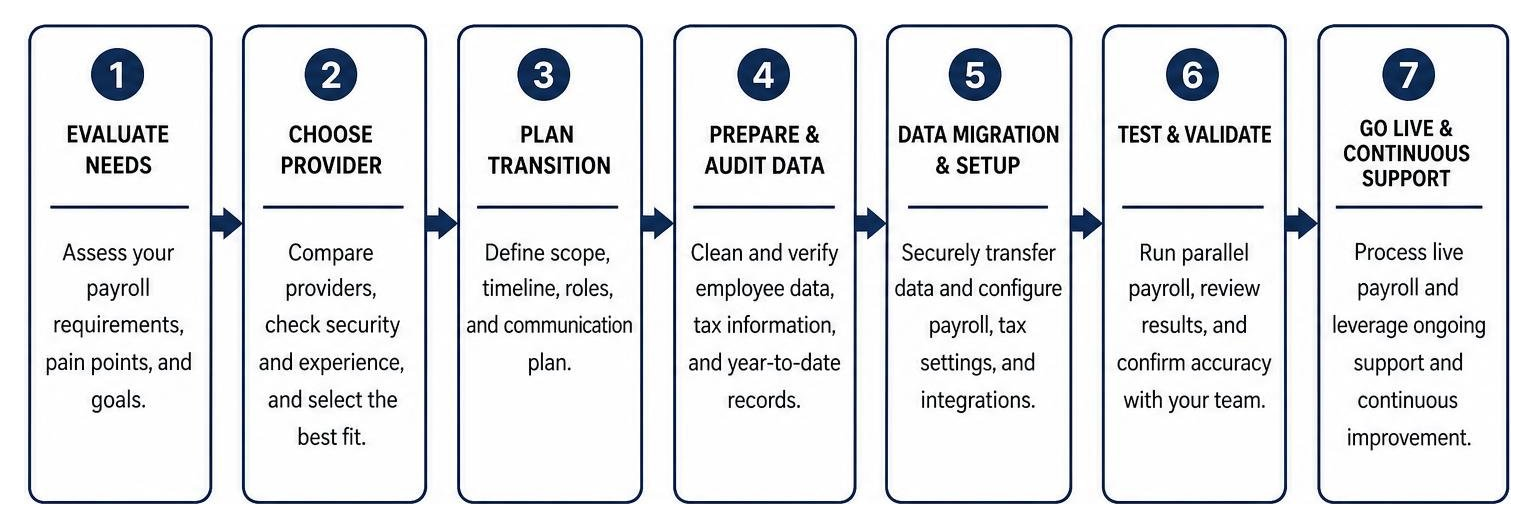
To ensure a smooth transition, we recommend:
- Auditing Your Historical Data: Before migrating any information, verify that all employee classifications, tax IDs, and year-to-date earnings are 100% accurate.
- Securing Stakeholder Buy-In: Ensure your HR, finance, and department managers understand their roles in the new system (such as approving timecards by a set deadline).
- Planning the Implementation Timeline: Transitioning at the start of a new quarter or fiscal year is ideal, as it simplifies tax reporting.
For businesses with complex staffing needs, learning how to build customized payroll staffing solutions ensures your transition accommodates temporary, contract, and permanent staff without a hitch.
Integrating Payroll Outsourcing with Existing HR Systems
Your payroll shouldn’t live on an island. To maximize efficiency, your payroll platform must integrate seamlessly with your existing back-office ecosystem.
When your payroll, time tracking, and accounting systems talk to one another, manual data entry is eliminated, and errors disappear.
For example, real-time general ledger integration automatically syncs payroll expenses with accounting platforms like QuickBooks, saving your finance team hours of manual reconciliation.
Additionally, automating retirement contributions by syncing your payroll with your 401(k) provider ensures compliance with ERISA guidelines.
For businesses in specialized fields like construction, integration is even more critical. Managing union rates, prevailing wages, and certified payroll reports requires specialized workflows.
Discovering how payroll outsourcing for construction heavy lifting handed over to the pros can streamline these complex integrations will save your team massive administrative friction.
Additionally, if you manage temporary workforces, achieving back office bliss mastering temp payroll and admin relies heavily on having automated onboarding workflows that feed directly into your payroll engine.
Frequently Asked Questions About Payroll Outsourcing
How quickly can my business transition to an outsourced payroll provider?
Most small to mid-sized businesses can complete the transition to an outsourced provider within two to four weeks.
The timeline depends on how quickly you can gather historical tax records, employee W-4s, and direct deposit details. During this onboarding period, we highly recommend running a “parallel payroll” — processing payroll on both your old and new systems simultaneously for one pay cycle — to ensure the new platform is calibrated perfectly before going live.
Who is legally liable for payroll tax errors when outsourcing?
Legally, the employer retains ultimate liability for tax accuracy and compliance under IRS regulations. Even if your provider makes a calculation error or files late, any penalties assessed will be billed to your business.
However, reputable payroll providers mitigate this risk by offering accuracy guarantees. Under these agreements, if the provider makes an administrative error, they will cover the cost of any resulting IRS or state penalties. Always review your contract to ensure your provider stands behind their work.
Can payroll outsourcing handle multi-state tax compliance?
Yes, this is one of the primary reasons businesses choose to outsource. A professional payroll provider stays up to date with changing tax brackets, local withholding mandates, and unemployment insurance rates across all 50 states.
If you have a distributed remote workforce, the system automatically calculates and routes the correct taxes to each employee’s local municipality.
For businesses expanding into the southeastern US, reading the ultimate guide to payroll companies in florida provides excellent insight into managing regional compliance.
If you operate in the northeast, staying on top of local regulations with the no drama guide to payroll administration Pennsylvania will help keep your multi-state operations running smoothly.
Conclusion
Managing payroll doesn’t have to feel like a second full-time job.
At Employer Solutions Services (ESS), we bring over 30 years of staffing and back-office administration experience to your business. Whether you operate in Florida, Georgia, Illinois, Massachusetts, Nevada, New Jersey, Pennsylvania, or Texas, we build customized programs tailored to your unique industry demands.
From screening and training top-tier talent to managing your weekly payroll runs and complex tax filings, we handle the administrative heavy lifting so you can focus on growing your business.
Ready to reclaim your workweek and protect your business from costly compliance errors?
Read more about Why Payroll Outsourcing Nj Is A Smart Move For Small Biz and contact our team today to build your customized back-office solution.