
New Jersey Payroll: What Every Business Owner Needs to Know
New Jersey payroll is one of the most complex state payroll systems in the country — and getting it wrong can cost you real money.
Here’s a quick snapshot of what NJ employers need to manage in 2025:
| Payroll Element | 2025 Key Detail |
|---|---|
| State income tax | 1.4% to 10.75% (progressive brackets) |
| Minimum wage (6+ employees) | $15.49/hour |
| Minimum wage (small/seasonal) | $14.53/hour |
| SUI wage base | $43,300 (new employers pay 3.1%) |
| SDI employee rate | 0.23% (wage base $165,400) |
| FLI employee rate | 0.33% (wage base $165,400) |
| Pay frequency required | At least twice per month |
| Weekly tax remittance threshold | Prior year liability of $10,000+ |
New Jersey requires employers to navigate multiple state agencies, tax rates, and filing deadlines — all at once. You’re dealing with the Division of Taxation, the Department of Labor, unemployment insurance, disability insurance, family leave insurance, and more.
For a mid-sized business already stretched thin, that’s a lot of moving parts.
This guide walks you through every step — from registration to year-end filing — so you can stay compliant without it taking over your week.
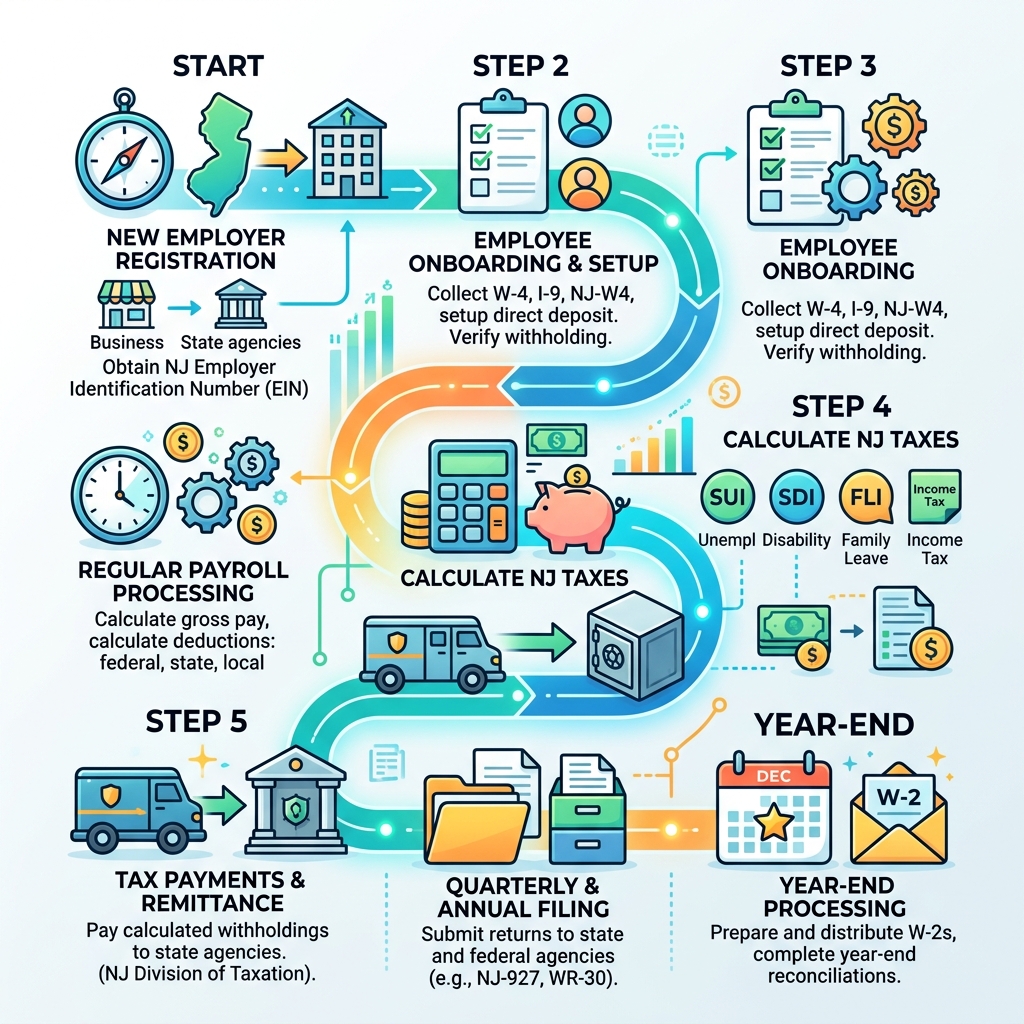
Getting Started: Registering for New Jersey Payroll
Before you can write your first check in the Garden State, you have to make it official with the state government. Navigating the registration process is the first hurdle in mastering new jersey payroll. Unlike some states where one ID covers everything, New Jersey requires coordination between the Division of Revenue and Enterprise Services, the Division of Taxation, and the Department of Labor and Workforce Development.

Step 1: Obtain Your IDs
Every employer needs a Federal Employer Identification Number (FEIN) from the IRS. Once you have that, you must register with the State of New Jersey to receive your 12-digit NJ Taxpayer ID. This ID typically consists of your 9-digit FEIN followed by a 3-digit suffix (usually “000” if you don’t have multiple locations or branches).
Step 2: The Online Portal
New Jersey has moved almost exclusively to electronic systems. You will primarily interact with the NJ Division of Taxation – Employer Payroll Tax portal. To get full access to filing history and payment options, you’ll need a PIN, which is usually sent in your “Welcome Letter” after registration.
Step 3: Premier Business Services
For a more streamlined experience, we recommend signing up for Premier Business Services (PBS). This allows you to create a custom Login ID and password to manage multiple tax types and reporting services in one place. If you’re looking for the right tech stack to handle this, check out our guide on The Best Small Business Online Payroll Tools of 2026 to see which platforms integrate best with NJ’s systems.
2025 Wage Standards and State Requirements
New Jersey is known for having some of the most progressive labor laws in the country. Staying compliant means keeping a close eye on the calendar, as minimum wage rates often adjust annually.
2025 Minimum Wage Breakdown
As of January 1, 2025, the state has different tiers based on the type of business you run:
- Standard Employers (6+ employees): $15.49 per hour.
- Small Employers (<6 employees): $14.53 per hour.
- Seasonal Employers: $14.53 per hour.
- Tipped Employees: $5.62 per hour (cash wage), though the total with tips must reach the applicable minimum wage.
Pay Frequency and Overtime
New Jersey law is strict about how and when you pay your team. Most employees must be paid at least twice per month on regular paydays designated in advance. You cannot arbitrarily withhold wages or change pay cycles without proper notice.
Regarding overtime, the rule is standard but firm: non-exempt employees must receive 1.5 times their regular rate for any hours worked over 40 in a workweek. If you find these calculations becoming a headache, exploring New Jersey Payroll Services for Every Small Business can help automate these triggers so you never miss a compliance beat.
Managing New Jersey Payroll for Remote and Nonresident Workers
The rise of remote work has introduced a “fun” new wrinkle: the Convenience of the Employer rule. If you have an employee who lives in a state like Florida or Texas but works for your NJ-based company for their own convenience (rather than your necessity), New Jersey may still require you to withhold NJ income tax.
You can find more specifics on how this sourcing rule works via the Convenience of the Employer Sourcing Rule FAQ – NJ.gov.
One major exception is the Pennsylvania Reciprocity Agreement. If an employee lives in PA and works in NJ, they can file form NJ-165 (Employee’s Certificate of Nonresidence) to be exempt from NJ withholding. In this case, you would withhold PA income tax instead.
Understanding State Withholding and Tax Rates
Calculating new jersey payroll isn’t just about the hourly rate; it’s about the “alphabet soup” of state withholdings: SUI, SDI, FLI, and the Workforce Fund.
State Income Tax
New Jersey uses a progressive income tax system. Rates range from 1.4% to 10.75%. Employers should use the official “Percentage Method” tables to calculate exact amounts based on the employee’s NJ-W4. The state provides different rate schedules (A through E) depending on the allowances claimed.
Employer and Employee Taxes for 2025
- State Unemployment Insurance (SUI): The wage base for 2025 is $43,300. New employers typically start at a rate of 3.1%. For employees, the SUI rate is 0.425%.
- State Disability Insurance (SDI): The employee rate is 0.23% on a wage base of $165,400. New employers pay a temporary rate of 0.5% on the first $43,300.
- Family Leave Insurance (FLI): This is 100% employee-funded at a rate of 0.33% on a wage base of $165,400.
- Workforce Development Fund: Both employers and employees contribute a small percentage (typically around 0.1175% for employees) to support state training programs.
For detailed instructions on how to remit these specific amounts, the NJ Division of Taxation – Income Tax – Reporting and Remitting page is your go-to resource.
Key Forms for New Jersey Payroll Compliance
To keep the state happy, you’ll need to become very familiar with these four forms:
- NJ-W4: Collected from every employee at hire to determine withholding.
- NJ-927 (Quarterly): This is the Employer’s Quarterly Report. It combines your UI, DI, and FLI reporting. It must be filed by the 30th day following the end of the quarter.
- WR-30 (Quarterly): The Employer Report of Wages Paid, used to track individual employee earnings for benefit eligibility.
- NJ-W-3 (Annual): The State’s annual reconciliation form, due by February 15, which must match the totals of your W-2s.
Reporting Obligations and Final Paycheck Rules
Compliance doesn’t end with the tax return. There are administrative hurdles that start the moment you hire someone and continue until the day they leave.
New Hire Reporting
You must report all new hires or rehired employees within 20 days of their start date to the New Jersey New Hire Operations Center. This is primarily used to enforce child support orders. If an employee does have a child support obligation, you will receive a notice to withhold and remit those payments to the New Jersey Family Support Payment Center.
Termination and Final Pay
Whether an employee is fired or quits, New Jersey law is simple: the final paycheck is due no later than the next regular payday. You cannot withhold a final check because they haven’t returned a laptop or uniform — those are separate civil matters.
Earned Sick Leave
New Jersey’s Earned Sick Leave Law requires almost all employers to provide up to 40 hours of earned sick leave per year. Employees accrue 1 hour of sick leave for every 30 hours worked. You must allow them to carry over up to 40 hours to the next benefit year, though you are not required to pay out unused sick leave upon termination unless your company policy states otherwise.
Frequently Asked Questions about New Jersey Payroll
Does New Jersey have a reciprocal tax agreement with other states?
Yes, but only with Pennsylvania. If your employee lives in PA, they only pay PA income tax. For any other state (like NY or DE), the employee usually pays tax where the work is performed and then claims a NJ Division of Taxation – Credit for Taxes Paid to Other Jurisdictions on their resident return.
How often must I remit payroll tax payments?
This depends on your “lookback period.” If your total NJ withholding liability was $10,000 or more in the prior year, you are a weekly payer. Weekly payments are generally due the Wednesday following the payday. If you fall below that threshold, you likely remit monthly (using Form NJ-500) or quarterly.
What are the penalties for payroll non-compliance?
New Jersey doesn’t play around with payroll taxes. Since you are “holding” the employees’ money in trust for the state, failure to remit can result in:
- Late filing penalties (usually 5% per month).
- Late payment penalties.
- Interest charges that compound.
- Personal Liability: In some cases, business owners can be held personally responsible for unpaid payroll taxes, meaning the state can come after your personal assets.
Conclusion
Mastering new jersey payroll is a marathon, not a sprint. Between the 10.75% top tax bracket and the specific 2025 wage bases for SUI and SDI, there is a lot of room for error. However, with the right registration steps and a firm grasp of the quarterly filing requirements, you can keep your business running smoothly and your employees happy.
At Employer Solutions Services, we’ve spent over 30 years helping businesses navigate these exact complexities. We don’t just offer “one-size-fits-all” software; we provide customized programs that handle everything from staffing and talent screening to full-scale back-office administration.
If you’d rather focus on growing your business than calculating the Workforce Development Fund contribution for the third time this week, we’re here to help. Explore Our Services to see how we can take the weight of NJ payroll off your shoulders.