
Why Payroll for Temporary Employees Is More Complex Than You Think
Payroll for temporary employees requires the same rigor as payroll for your full-time staff — and in some ways, it’s even more demanding.
Here’s a quick breakdown of what managing temp payroll actually involves:
| Task | What’s Required |
|---|---|
| Worker classification | Determine W-2 employee vs. 1099 contractor status |
| Tax withholding | Collect Form W-4; withhold federal income tax, Social Security, Medicare |
| Overtime tracking | Apply FLSA rules — 1.5x pay for hours over 40 per week |
| Year-end reporting | Issue W-2s by January 31; send 1099-NEC for contractors paid $600+ |
| Benefits monitoring | Track hours for ACA compliance (30+ hrs/week for employers with 50+ staff) |
| Recordkeeping | Maintain accurate wage, hour, and tax records throughout the assignment |
Temporary workers aren’t a payroll shortcut. They’re subject to nearly all the same federal and state rules as permanent employees.
For mid-sized businesses, this is where things get complicated fast. You’re juggling rotating staff, variable hours, short assignment windows, and the ever-present risk of misclassification. Add multi-state operations or industry-specific rules — healthcare certifications, construction safety training, retail holiday surges — and the administrative load compounds quickly.
In 2025, roughly 2.5 million people worked in temporary roles across the U.S. That’s a massive workforce operating under rules that many employers still don’t fully understand.
This guide breaks down everything you need to manage temp payroll correctly — from classification and tax forms to onboarding, compliance, and year-end reporting.
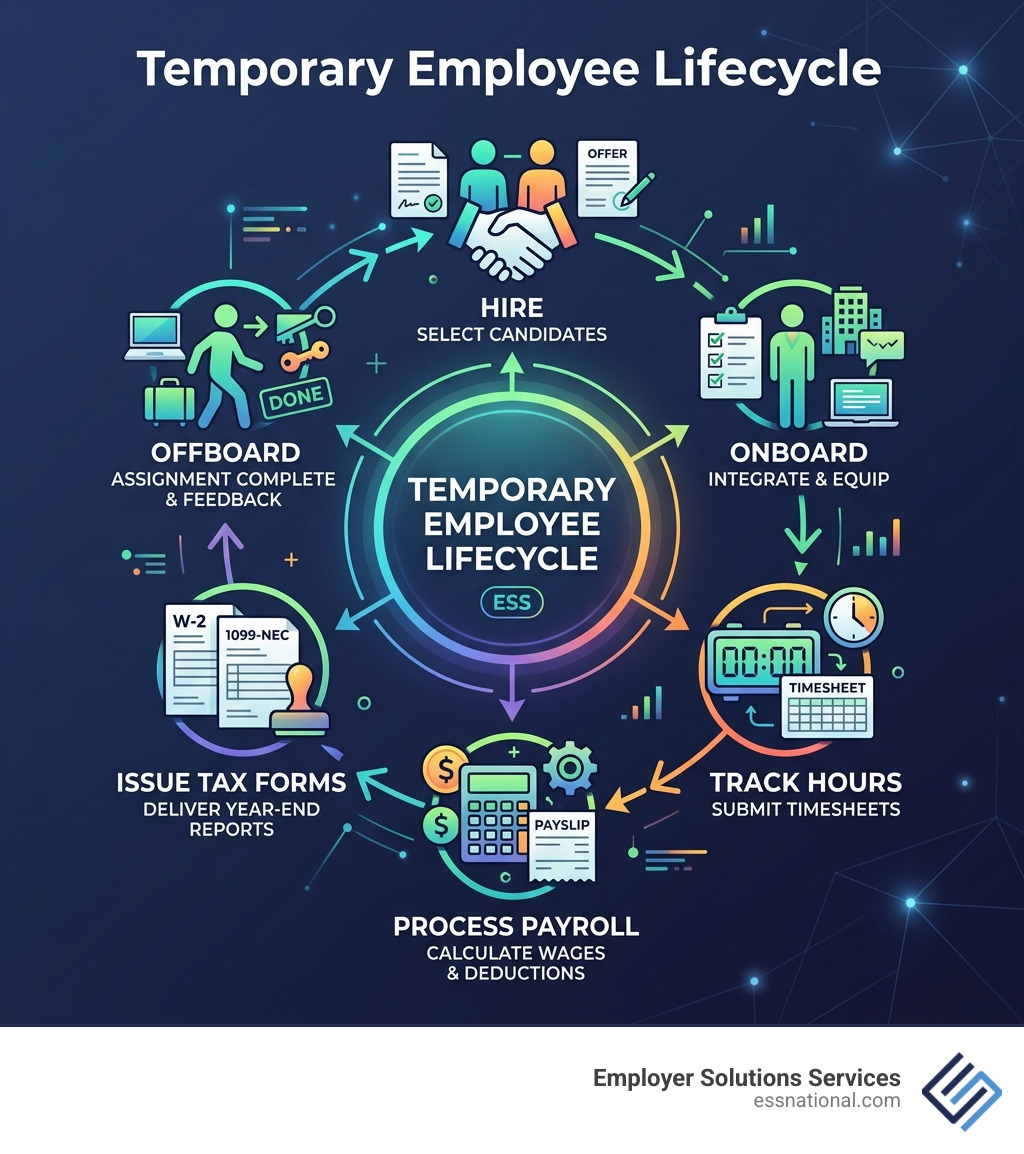
Quick payroll for temporary employees definitions:
Understanding Worker Classifications and Payroll for Temporary Employees
When we bring new faces into our workspace, the first hurdle isn’t showing them where the coffee machine is—it’s deciding how they fit into our payroll system. Mislabeling a worker is one of the easiest ways to land in hot water with the Department of Labor (DOL) or the IRS.
To keep your back office in a state of “bliss,” you must distinguish between temporary employees, seasonal workers, and independent contractors. While they all might be helping you during a busy stretch, their tax treatment is vastly different.
| Worker Type | Definition | Tax Form | Key Characteristic |
|---|---|---|---|
| Temporary Employee | Hired for a specific period (usually <1 year) to cover leaves or spikes. | W-2 | You control when, where, and how they work. |
| Seasonal Employee | Hired for a specific time of year (holidays, summer, harvest). | W-2 | Tied to a recurring calendar event or season. |
| Independent Contractor | Self-employed individuals providing a specific service. | 1099-NEC | They control the methods; you only control the result. |
In states like New Jersey, worker protections for temporary staff are strictly enforced to ensure these individuals receive the same dignity and legal coverage as their permanent counterparts.
Determining W-2 vs. 1099 Status
How do we decide if someone is an employee or a contractor? We use the “Control Test.” If we provide the equipment, set the specific hours, and supervise the daily tasks, they are almost certainly a W-2 employee. If they bring their own laptop, work from their own office, and simply send us a finished project by a deadline, they are likely a contractor.
The IRS looks at three main categories:
- Behavioral Control: Do we have the right to direct and control how the work is done?
- Financial Control: Do we control the business aspects of the worker’s job (e.g., how they are paid, whether expenses are reimbursed)?
- Relationship Type: Is there a written contract? Do they receive employee-type benefits?
The Impact of Misclassification Penalties
We’ve seen it happen: a business tries to save on payroll taxes by calling everyone a “contractor.” This is a dangerous game. Misclassification can lead to massive bills for back taxes, unpaid overtime, and workers’ compensation premiums. Beyond the financial hit, the legal disputes and DOL audits can paralyze your operations for months. Understanding payroll services and why you need them is the first step in avoiding these costly traps.
Tax Withholding and Compliance Requirements
Once we’ve correctly identified our temporary staff as W-2 employees, we have to treat them like the tax-paying citizens they are. This means collecting the right paperwork before they even start their first shift.
Every temporary employee must fill out a Form W-4 so we know how much federal income tax to withhold. We also have to verify their identity and employment eligibility using Form I-9. Don’t forget the “payroll tax trifecta”: Social Security, Medicare, and FICA taxes. Even if someone is only working for us for three weeks in July, we are responsible for withholding and matching these taxes.
State-specific rules also apply. For example, if you are operating in the Bay State, you must be aware of specific temporary worker rights in Massachusetts that may dictate how and when pay is delivered.
Essential Tax Forms for Short-Term Staff
The paperwork doesn’t end when the assignment does. At the end of the year, we must issue W-2s to all temporary employees by January 31. If we used independent contractors and paid them $600 or more during the year, we must issue a Form 1099-NEC.
Managing these forms for a rotating door of workers is a logistical mountain. That’s why many businesses look for New Jersey payroll services for every small business or similar localized experts to handle the heavy lifting.
Overtime Rules and Payroll for Temporary Employees
A common myth is that temporary or seasonal workers don’t get overtime. Let’s bust that right now: The Fair Labor Standards Act (FLSA) protects temporary workers.
If a non-exempt temporary employee works more than 40 hours in a single workweek, we must pay them 1.5 times their regular hourly rate. There are no “probationary periods” where overtime doesn’t count. From day one, the 40-hour rule is in effect. Accurate recordkeeping is your only defense against wage and hour claims, so every minute must be tracked.
Onboarding and Time Tracking Best Practices
Onboarding a temp should be fast, but it shouldn’t be sloppy. Because these workers are with us for a limited time, we need to get them integrated into our system with surgical precision.

Streamlining the Onboarding Workflow
The goal is “one and done.” By using digital documentation, we can collect W-4s, I-9s, and direct deposit info in a single session. This creates “persistent data”—information that stays in our system so if that seasonal worker comes back next year, we aren’t starting from scratch.
In high-growth regions, finding the ultimate guide to payroll companies in Florida can help you identify partners who specialize in these high-speed onboarding workflows.
Cloud-Based Software for Payroll for Temporary Employees
In April 2026, manual spreadsheets are a relic of the past. Modern payroll for temporary employees relies on cloud-based solutions. These platforms offer:
- Self-Service Portals: Temps can download their own pay stubs and W-2s.
- Real-Time Analytics: See exactly how much your temporary labor is costing you this week.
- Multi-State Compliance: Automatically adjust tax withholdings if you have workers in Illinois, Texas, and Georgia.
For those looking to upgrade their tech stack, reviewing the best small business online payroll tools of 2026 is a great place to start.
Legal Protections and Youth Employment
Summer often brings a wave of younger workers into the fold. While hiring teens is a great way to support the community and fill seasonal gaps, the legal stakes are incredibly high.
Violators of youth employment provisions can face civil penalties of up to $11,000 per minor. If a violation leads to a serious injury or death, those penalties can skyrocket to $50,000 or even $100,000 for willful or repeated offenses.
Hiring Seasonal Teen Workers
If you’re hiring 14 and 15-year-olds, remember they have strict limits on when they can work (not during school hours, and limited hours on school nights). Furthermore, 16 and 17-year-olds are prohibited from “hazardous occupations.” This includes operating certain power-driven machines, trash compactors, or meat slicers. Safety training isn’t just a good idea; it’s a legal requirement.
Benefits Eligibility for Temporary Staff
Does a temp get health insurance? Under the Affordable Care Act (ACA), if you have 50 or more full-time equivalent employees, you must offer health insurance to anyone working 30+ hours per week after a certain period.
Furthermore, some states have “equal benefits” provisions. For instance, the Illinois Day and Temporary Labor Services Act has specific requirements regarding equal pay and benefits for long-term temporary workers compared to permanent staff.
Industry-Specific Considerations and Final Pay
Every industry has its own “payroll personality.” We can’t treat a temporary nurse in Nevada the same way we treat a seasonal retail associate in Illinois.

- Healthcare: Requires meticulous tracking of certifications, licenses, and immunizations alongside shift differentials for night and weekend work.
- Construction: Focuses heavily on OSHA safety training records and potentially prevailing wage calculations.
- Retail: Deals with massive volume during holiday peaks, requiring rapid-fire onboarding and termination processing.
Handling End-of-Term Payroll
When an assignment ends, the clock starts ticking on the final paycheck. State laws vary wildly here. Some states require immediate payment upon termination, while others allow you to wait until the next regular payday. You must also account for any unused vacation pay if your company policy or state law requires it to be paid out.
Managing Multi-State Payroll for Temporary Employees
If your business spans across our service areas—like handling payroll in Georgia while managing a team in Florida—you have to deal with reciprocal tax agreements. This ensures workers aren’t double-taxed and that your business is remitting the correct local taxes to the right jurisdictions.
Frequently Asked Questions about Temp Payroll
Do temporary employees get a W-2 or 1099?
If you direct their work, provide their tools, and set their schedule, they are employees and should receive a W-2. Only independent, self-employed contractors should receive a 1099-NEC.
Are seasonal workers entitled to overtime pay?
Yes. Under the FLSA, seasonal and temporary workers must be paid 1.5x their regular rate for any hours worked over 40 in a workweek, unless they fall into a specific (and rare) exempt category.
What are the penalties for misclassifying a temporary worker?
The penalties include paying back all unpaid employer taxes (Social Security, Medicare, FUTA), unpaid overtime, workers’ compensation premiums, and potential civil fines from the DOL that can reach thousands of dollars per worker.
Conclusion
Mastering payroll for temporary employees is about more than just cutting checks; it’s about building a compliant, scalable engine that powers your business growth. Whether you are navigating the payroll policies in Pennsylvania, managing central payroll in Nevada, or looking for staffing services in Texas, the principles remain the same: classify correctly, track accurately, and pay on time.
At Employer Solutions Services (ESS), we have spent over 30 years helping businesses find that “back office bliss.” We don’t just provide screened and trained talent; we handle the complex administrative web that comes with them. From customized staffing programs to full-service payroll administration, we ensure your temporary workforce is an asset, not a liability.
Ready to simplify your administration and focus on your core mission? Master your back office with ESS and let us handle the complexities of your temporary payroll.