
Construction Payroll Is Costing You More Than You Think
Payroll outsourcing for construction is the practice of handing off your company’s payroll processing, tax filing, compliance reporting, and workforce administration to a specialized third-party provider — so you can focus on running your projects instead of chasing paperwork.
Here’s what the right outsourced payroll partner handles for construction companies:
- Certified payroll reporting (Form WH-347 and state equivalents) for government-funded projects
- Prevailing wage and Davis-Bacon compliance across federal and state contracts
- Union fringe calculations and multi-collective bargaining agreement support
- Multi-state tax filing based on where workers actually perform the work
- Worker classification (W-2 vs. 1099) to reduce misclassification risk
- Job costing and labor allocation by project, trade, and cost code
- Workers’ compensation management with trade-specific classification codes
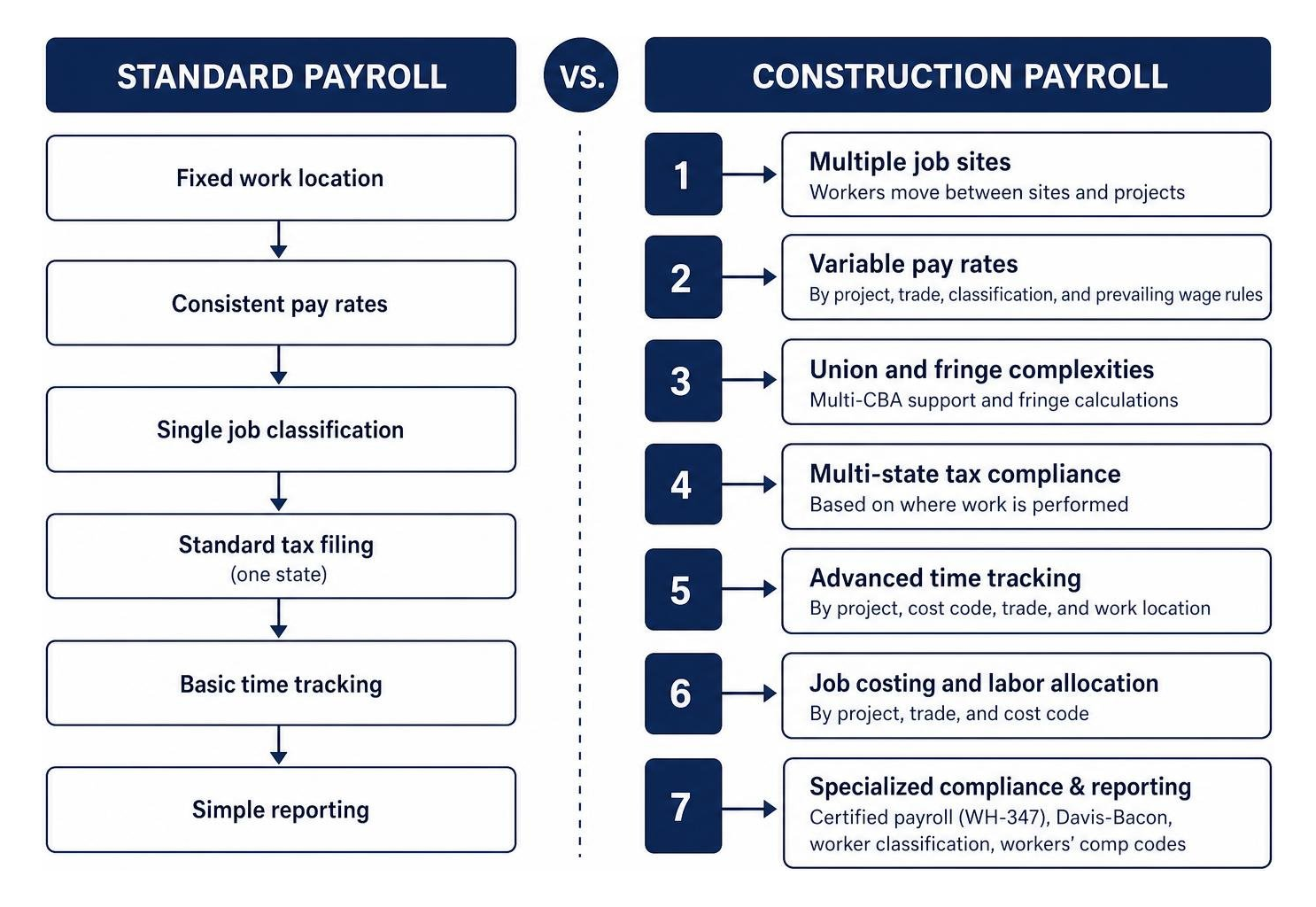
Construction payroll is not like payroll in other industries. Your crews move between job sites mid-week. Pay rates shift based on the project, the trade, and whether prevailing wage rules apply. A framing crew crossing county lines can trigger entirely different tax and workers’ comp requirements before Friday’s paycheck is cut.
Most generic payroll systems were built for stable, salaried workforces. They were not built for this.
The result? Contractors end up absorbing the administrative weight themselves — or making costly compliance mistakes that attract IRS audits, DOL investigations, and penalty exposure.
Why Construction Payroll is Uniquely Complex
If you run a retail store or a consulting firm, payroll is relatively straightforward. Your employees show up to the same building every day, work a set number of hours, and get paid a consistent hourly rate or salary.
In construction, that level of simplicity is a pipe dream. On any given Tuesday, you might have a worker who spends four hours hanging drywall on a private commercial job and another four hours doing specialized carpentry on a state-funded public works project. Those two tasks require different pay rates, different workers’ compensation codes, and entirely different tax reporting protocols.
When you add union fringe benefits, multi-state tax compliance, and job costing into the mix, managing payroll in-house becomes a full-time headache. It is a high-risk administrative function where a single oversight can lead to delayed project draws, union grievances, or devastating audits. For many scaling contractors, realizing they need specialized support is the first step toward reclaiming their week. More info about payroll services reveals just how much administrative strain can be lifted when you transition to a dedicated partner.
The Burden of Certified Payroll and Prevailing Wage
For contractors bidding on public works, federal contracts over $2,000 trigger the Davis-Bacon Act. This legislation mandates that contractors pay their field crews no less than the locally prevailing wages and fringe benefits for corresponding work on similar projects in the area.
To prove you are doing this, you cannot just hand over a standard payroll summary. You must submit weekly certified payroll reports—most commonly using the federal Form WH-347—along with a signed Statement of Compliance.
Failing to submit these reports accurately and on time does not just risk a slap on the wrist. It can halt your project payments, result in contract termination, and even get your business debarred from bidding on future government contracts. Because states have their own distinct rules, contractors in places like Massachusetts must pay close attention to specific state-level requirements. Navigating these regional nuances is much easier when you follow established Certified payroll reporting guidelines to keep your public projects running smoothly.
Managing Multi-State Tax Compliance and Job Costing
Construction crews are highly mobile. If your business operates near state borders—such as managing projects across New Jersey, Pennsylvania, or Massachusetts—your employees may cross state lines multiple times a week.
General payroll systems often default to withholding taxes based on where the employee lives. However, tax compliance dictates that payroll taxes must be calculated and withheld based on where the work is physically performed. If a crew member works three days in Cherry Hill, New Jersey, and two days in Philadelphia, Pennsylvania, their paycheck must reflect those exact geographical allocations.
Simultaneously, you need accurate job costing to keep your business profitable. You must be able to track labor costs down to the penny for every project, phase, and cost code. Without this granular data, you are bidding in the dark on your next project. For those operating in highly regulated states, keeping up with local databases—like the New Jersey certified payroll database—is vital to maintaining compliance and verifying that your public wage rates are perfectly aligned with state mandates.
The Strategic Benefits of Payroll Outsourcing for Construction
Outsourcing your construction payroll is not just about offloading data entry; it is a strategic business decision that directly impacts your bottom line. By partnering with a specialized back-office administrator, you instantly gain access to industry-specific experts who understand the difference between a rough carpenter and a finish carpenter.
The immediate benefit is time. Owners and project managers can stop spending their Thursday nights wrestling with spreadsheets and start focusing on project delivery, client relationships, and business growth. Furthermore, outsourcing provides a buffer of protection against costly compliance errors. If you are trying to figure out how to scale your business while keeping your overhead low, learning How to pick the perfect payroll system is an essential step in building a resilient operational foundation.
Mitigating Worker Misclassification and Audit Risks
Worker misclassification is one of the most heavily scrutinized areas in the construction industry today. The temptation to classify workers as 1099 independent contractors to save on payroll taxes and workers’ compensation premiums is high, but the regulatory penalties are even higher.
The Department of Labor (DOL) and the IRS have cracked down on the construction sector because of historically high rates of misclassification. Under federal laws like the Copeland Anti-Kickback Act, severe wage violations and misclassification schemes can even carry criminal prosecution risks.
In states like New Jersey and Massachusetts, the legal standards for worker classification are exceptionally strict. A specialized payroll outsourcing partner mitigates this risk by evaluating your workforce structure and ensuring that your field crews are classified correctly as W-2 employees from day one. This proactive approach ensures all tax withholdings, FICA contributions, and unemployment insurances are handled legally, keeping your business safe from ruinous audit penalties.
Streamlining Workers’ Compensation and Trade Codes
Workers’ compensation insurance is one of the largest expenses a contractor faces. Because construction is a high-risk industry, insurance premiums are tied directly to the specific trade codes of your workers.
For instance, the premium rate for a worker performing roofing tasks is significantly higher than the rate for someone doing interior trim work. If your payroll system does not accurately track and assign these trade-specific codes, you might end up paying the higher roofing rate for your entire crew—or worse, misclassifying workers and facing massive surcharges during your annual workers’ comp audit.

An outsourced construction payroll provider solves this by utilizing “Pay-As-You-Go” workers’ compensation programs. Instead of paying a massive, estimated lump-sum premium at the beginning of the year, your premiums are calculated and deducted automatically during each payroll cycle based on actual, real-time hours worked under each specific trade code. This dramatically improves your cash flow and eliminates the dread of year-end audit surprises. For contractors looking to optimize their labor costs in high-risk regions, leveraging specialized payroll services for construction and skilled trades can provide the targeted risk management and trade-code accuracy required to keep insurance costs under control.
Software vs. Full-Service Outsourcing: Making the Right Choice
Many contractors mistake payroll software for a complete payroll solution. While modern software platforms are excellent tools, they are still just tools. They require someone in your office to input the data, set up the tax rates, monitor the compliance updates, and resolve errors when the system flags a discrepancy.
If your internal team does not have deep expertise in construction compliance, a software-only approach can leave you vulnerable. Full-service payroll outsourcing, on the other hand, shifts the administrative burden and the compliance liability off your plate entirely.
| Operational Feature | Self-Service Construction Payroll Software | Full-Service Payroll Outsourcing (ESS) |
|---|---|---|
| Data Entry & Processing | Done in-house by your staff | Handled entirely by your dedicated provider |
| Certified Payroll (WH-347) | Generated by software, but must be reviewed and submitted by you | Fully prepared, verified, and submitted by experts |
| Workers’ Comp Management | You manually calculate and report codes | Pay-As-You-Go integration with automatic code auditing |
| Tax Filing & Liability | You are responsible for setup and errors | Provider assumes tax filing responsibilities and guarantees accuracy |
| Onboarding & HR Support | Self-service templates; you manage compliance | Full-service onboarding, I-9 verification, and E-Verify support |
While software can help organize your internal records, it cannot replace the peace of mind that comes with human experts auditing your payroll for compliance. If you are currently evaluating your options, exploring The best online payroll tools of 2026 can help you understand where software limitations end and where full-service administration needs to step in.
What to Look For in a Partner for Payroll Outsourcing for Construction
When you decide to transition to an outsourced partner, you should not settle for a generic payroll bureau. You need a partner that speaks the language of construction.
Look for a provider that offers dedicated account management, meaning you have a direct line to a real human who knows your business, rather than a generic call center. Your partner must have native capabilities to handle certified payroll, prevailing wages, and complex union structures without relying on clunky third-party software add-ons.
Additionally, they should seamlessly integrate with your existing construction accounting and project management tools. If you want to build a highly resilient business model that scales effortlessly, learning How to build customized payroll staffing solutions will give you a blueprint for combining staffing flexibility with bulletproof payroll administration.
Mobile Time Tracking and Geo-Fencing in Payroll Outsourcing for Construction
One of the biggest leaks in a contractor’s budget is inaccurate time tracking. Paper timesheets are notoriously prone to errors, legibility issues, and “buddy punching.”
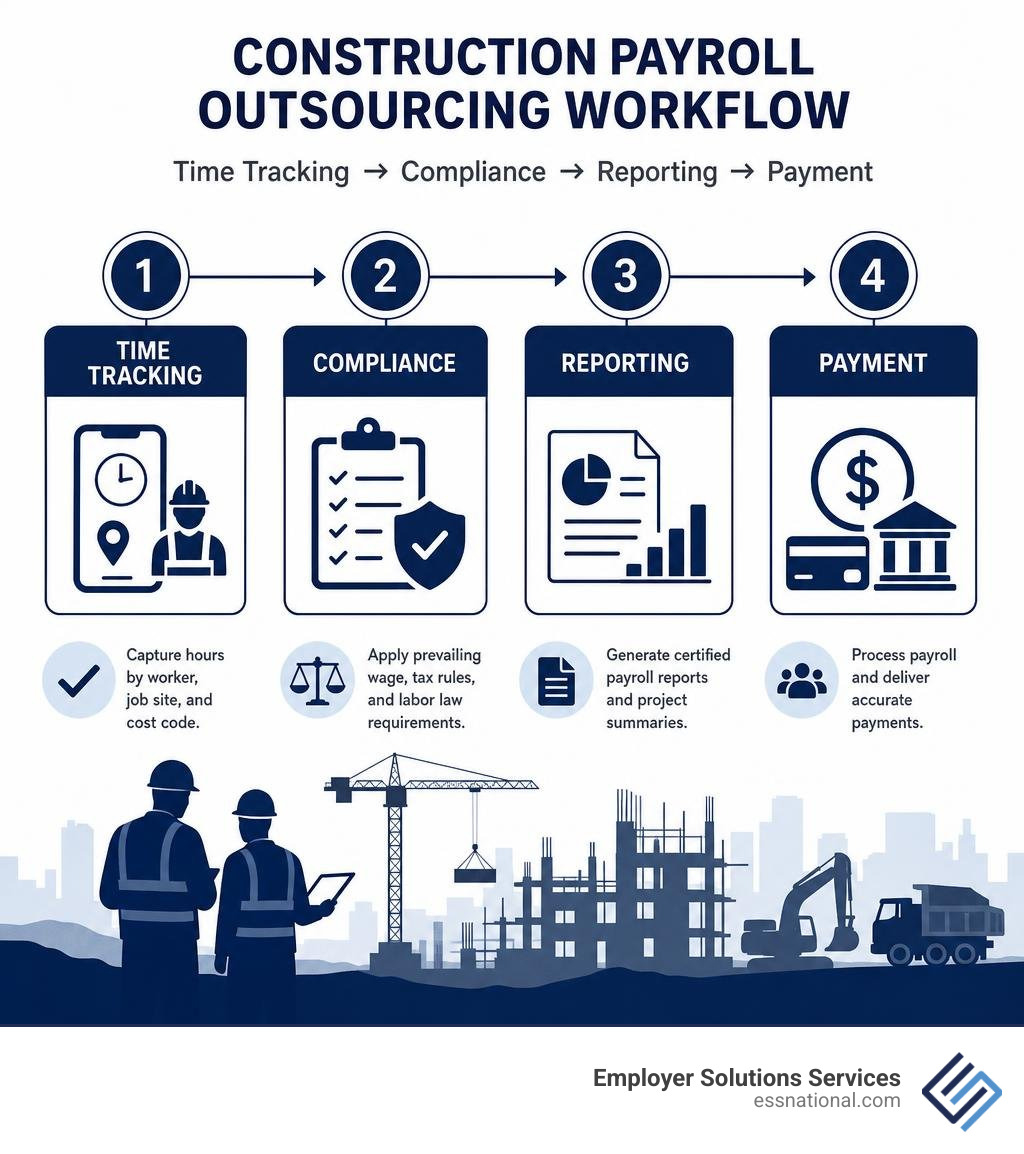
Advanced construction payroll outsourcing services solve this by providing integrated mobile time tracking apps equipped with GPS geo-fencing.

With geo-fencing, your field crews can only clock in when they are physically within the designated boundaries of the active job site. The app automatically tracks their hours, assigns them to the correct job and cost code, and syncs the data directly with the payroll system. This eliminates manual data entry, prevents time theft, and ensures your job costing reports are updated with real-time labor data.
Frequently Asked Questions about Construction Payroll
What is certified payroll in construction?
Certified payroll is a weekly report required for contractors working on government-funded public works projects. It typically utilizes federal Form WH-347 (or state-specific equivalents) to document the name, address, job classification, hourly rate, hours worked, and fringe benefits paid to every worker on the job site. It must be accompanied by a signed Statement of Compliance verifying that all workers have been paid no less than the prevailing wage rates determined by the Department of Labor.
How does multi-state payroll work for mobile crews?
When your crews move between states, payroll taxes must be calculated and withheld based on the physical location where the work was performed, not where your company is headquartered or where the employee resides. A specialized construction payroll provider tracks these multi-state shifts, manages reciprocal tax agreements between neighboring states, and ensures your business remains compliant with local tax withholding and state unemployment insurance (SUI) regulations in every jurisdiction.
Can outsourced payroll handle both union and non-union workers?
Yes. A specialized construction payroll partner can manage mixed workforces seamlessly. For your union workers, the system automatically calculates complex fringe benefit packages, tracks union dues, and generates monthly union remittance reports across multiple collective bargaining agreements. For non-union workers on the same project, it ensures standard withholding and prevailing wage compliance are met without cross-contaminating your payroll records.
Conclusion
Managing construction payroll in-house is a high-wire act where the cost of a fall is incredibly steep. Between certified payroll demands, fluctuating trade-specific workers’ comp codes, and the absolute necessity of accurate job costing, the administrative burden can quickly overwhelm even the most organized contracting business.
By handing the heavy lifting over to the pros at Employer Solutions Services (ESS), you gain a dedicated partner with over 30 years of experience in providing customized staffing, HR, and back-office payroll administration.
Whether you are operating in Florida, Georgia, Illinois, Massachusetts, Nevada, New Jersey, Pennsylvania, or Texas, we tailor our programs to fit your specific trade, crew size, and compliance environment. Let us handle the paperwork so you can focus on building the future. Discover Why payroll outsourcing is a smart move and take the first step toward streamlining your back office today.