Why Every Manufacturer Needs a Reliable Manufacturing Staffing Agency Right Now
A manufacturing staffing agency is one of the fastest ways to hire pre-screened, job-ready workers for temporary, temp-to-hire, or direct placement roles in production, assembly, warehousing, and skilled trades.
Quick answer — here’s what a manufacturing staffing agency does for you:
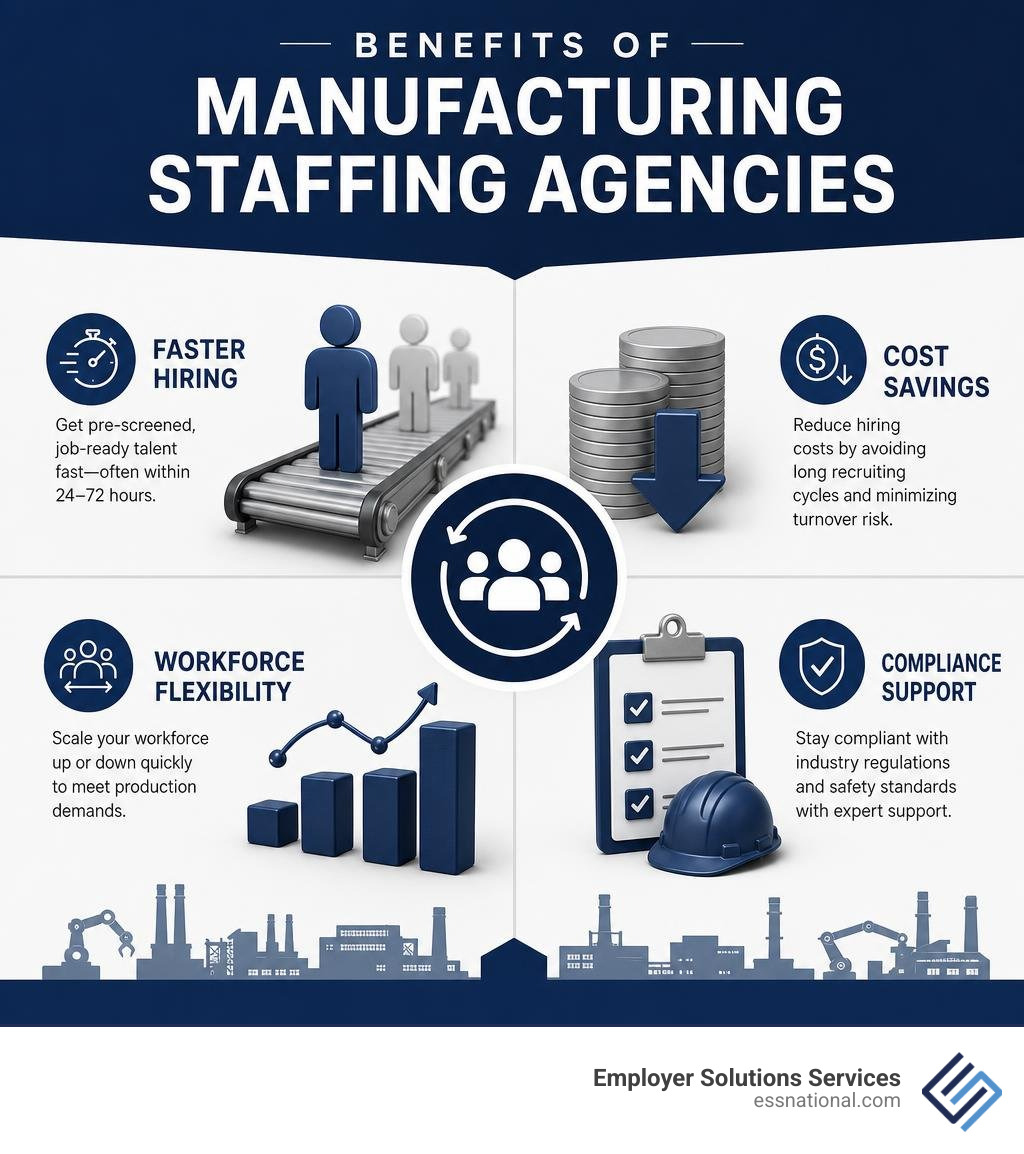
- Supplies vetted workers fast — often within 24–72 hours of your request
- Handles screening and compliance — background checks, skills testing, and safety orientation included
- Scales your workforce up or down — ideal for seasonal spikes or sudden production surges
- Reduces hiring costs — typically 15–20% lower cost-per-hire than recruiting in-house
- Offers temp-to-hire options — so you can evaluate workers before committing full-time
Manufacturing is under serious pressure right now. The sector is projected to need 4.6 million workers by 2028 — and nearly 2.4 million of those positions are expected to go unfilled due to the ongoing skills gap. On top of that, 77% of manufacturers report real difficulty attracting and keeping quality workers.
That’s not a minor hiring headache. That’s a production risk.
For mid-sized manufacturers, the challenge is even sharper. You need reliable workers quickly, but you don’t always have the HR bandwidth or budget to run a full recruiting operation. Temporary staffing in manufacturing already accounts for roughly 30% of all temporary help employment in the U.S. — because it works.
This guide walks you through exactly how a manufacturing staffing agency can solve your workforce challenges, what it costs, and how to pick the right partner.
Manufacturing staffing agency further reading:
The Strategic Benefits of Partnering with a Manufacturing Staffing Agency

In the current industrial landscape of July 2026, operational agility is no longer just a buzzword; it is a baseline requirement for survival. When a machine sits idle or an assembly line runs at half-capacity, the financial consequences are immediate. Partnering with a specialized manufacturing staffing agency offers a strategic shield against these disruptions, providing your business with unparalleled workforce flexibility.
With 77% of manufacturers reporting difficulty in attracting and retaining quality talent, traditional hiring methods are failing to keep pace. When you rely solely on your internal HR team, you are limited by their bandwidth and local reach. A dedicated agency, however, maintains an active, pre-screened pipeline of candidates who are ready to step onto your plant floor at a moment’s notice.
This model is so effective that temporary staffing in manufacturing accounts for approximately 30% of all temporary help employment in the United States. Businesses are realizing that keeping a massive, fixed payroll during slow periods is an unnecessary financial strain. By shifting to a flexible labor model, you can match your labor costs directly to your actual production output. To understand why this shift has become permanent across the industrial landscape, read more about Why Temporary Staffing Across Industries Is the New Normal.
Furthermore, working with a localized partner gives you access to regional talent pools that are otherwise difficult to tap into. Local agencies understand the specific commuter patterns, wage expectations, and competitive dynamics of your immediate area. This localized intelligence is why many industrial businesses consider Local Temporary Services and Why They Are Your Secret Hiring Weapon.
Streamlining the Temp-to-Perm Transition in Your Factory
One of the greatest risks in hiring is the “bad fit.” A candidate may look stellar on a resume and perform beautifully in a brief interview, but once they are on the factory floor, their attendance slips, or they struggle to keep pace with the physical demands of the job.
The temp-to-hire (or temp-to-perm) model completely eliminates this risk by acting as an extended, real-world trial period. During this period, the worker remains on the staffing agency’s payroll. You get to evaluate their:
- Punctuality and reliability
- Technical aptitude and speed
- Ability to work safely and follow instructions
- Cultural fit within your existing teams
If the worker excels over a 90-day period, you can seamlessly transition them to your permanent payroll. If they do not meet expectations, you simply request a replacement from the agency—without dealing with the administrative headaches, unemployment claims, or potential legal liabilities of a termination. This approach dramatically improves long-term retention rates because both you and the worker have already proven that the match works. For businesses looking to strengthen their workforce foundation, exploring how to leverage PA Industrial Staffing: Putting the Muscle in Your Manufacturing can provide a blueprint for long-term success.
Scaling Operations to Meet Fluctuating Production Demands
Manufacturing demands are rarely static. A sudden influx of holiday orders, a new client contract, or seasonal production cycles can suddenly require you to double your headcount. Conversely, when those peaks subside, you cannot afford to carry the overhead of an oversized workforce.
Staffing agencies provide the ultimate “accordion” workforce. They allow you to scale up rapidly during production spikes and scale back down just as quickly when things normalize. This agility ensures you never have to turn down a major order due to a lack of hands, nor do you have to face the painful and costly process of laying off permanent staff when demand dips.
To manage these fluctuations successfully, smart managers rely on proven temporary staffing frameworks. You can read about 5 Smart Strategies for Temporary Staffing Services to optimize this process. Additionally, for manufacturers requiring specialized, on-demand scheduling, understanding How to Scale Your Workforce Using a PRN Staffing Company can offer innovative ways to keep your lines moving without inflating your fixed overhead.
Sourcing, Vetting, and Compliance in Modern Industrial Staffing

Finding warm bodies to fill seats is easy; finding qualified, reliable, and safety-conscious operators for specialized manufacturing roles is incredibly difficult. Modern industrial staffing requires a meticulous, multi-layered approach to sourcing and vetting to ensure that every worker sent to a client site is fully capable of doing the job safely and efficiently.
Staffing agencies utilize advanced recruiting technology, localized networks, and industry-specific job boards to source candidates. However, the real value lies in their vetting process. This involves rigorous skills assessments, comprehensive background checks, and drug screenings. According to the Bureau of Labor Statistics manufacturing data, the cost of workplace injuries and operational downtime due to unqualified labor continues to rise, making professional vetting more critical than ever.
How a Manufacturing Staffing Agency Vets Specialized Talent
When a client needs a specialized worker—such as a CNC machinist, a certified welder, or a quality assurance technician—a generalist approach will not suffice. A reliable manufacturing staffing agency utilizes targeted technical testing and verification protocols, including:
- Certifications Verification: Double-checking AWS welding certifications, forklift licenses, and OSHA cards.
- Technical Testing: Using specialized software and hands-on assessments to measure mechanical aptitude, spatial reasoning, and math skills.
- Reference Checks: Speaking directly with previous supervisors to verify hands-on experience and reliability on similar equipment.
By outsourcing this heavy administrative lifting, you ensure that only highly qualified candidates make it to your floor. To discover how specialized screening processes protect your operational integrity, review our guide on Finding the Best Screened Staffing Solutions for Your Business.
Ensuring Safety and Regulatory Compliance on the Factory Floor
In manufacturing, safety is not optional. A single OSHA violation or workplace injury can cost tens of thousands of dollars and devastate team morale. Staffing agencies play a pivotal role in maintaining a safe work environment by ensuring that all placed workers undergo comprehensive safety orientations before they ever touch a machine.
This compliance framework includes:
- OSHA Standards Alignment: Ensuring all candidates understand basic OSHA safety standards regarding lockout/tagout, personal protective equipment (PPE), and hazard communication.
- Site-Specific Orientations: Collaborating with your safety managers to brief workers on your facility’s specific layout, emergency exits, and safety protocols.
- Workers’ Compensation Management: Because the staffing agency is the employer of record for temporary staff, they handle the workers’ compensation insurance and claims management, significantly reducing your direct liability.
Key Positions Filled and the Economics of Industrial Staffing
To understand why so many companies partner with a manufacturing staffing agency, it helps to look at the financial and operational comparison between in-house hiring and agency staffing.
| Expense / Metric | In-House Recruiting | Staffing Agency Partnership |
|---|---|---|
| Time-to-Hire | 30 to 45 Days | 24 to 72 Hours |
| Upfront Advertising Costs | High (Job boards, social ads) | Included in Agency Fee |
| Background & Drug Screening | $50–$150 per candidate | Included in Agency Fee |
| Workplace Injury Liability | 100% Employer Responsibility | Managed by Agency (Employer of Record) |
| Payroll & Tax Administration | Handled by internal HR | Handled by Agency |
| Overall Cost-Per-Hire | Baseline (100%) | 15% to 20% Lower |
Common Roles Managed by a Manufacturing Staffing Agency
A specialized agency can fill roles across your entire facility, from entry-level light industrial support to highly skilled technical positions. Common roles include:
- Machine Operators: Staff trained to run, monitor, and maintain production machinery safely.
- Assemblers: Workers skilled in precision manual assembly, reading blueprints, and quality checks.
- Warehouse & Logistics Staff: Forklift drivers, material handlers, shipping/receiving clerks, and order selectors.
- Quality Control Inspectors: Technicians who ensure that finished goods meet strict tolerance and quality specifications.
Managing these roles effectively requires targeted strategies. For warehouse-specific operations, implementing Warehouse Staffing Strategies That Actually Deliver the Goods can optimize your logistics flow. If you are operating in specific regional hubs, such as New Jersey, you can find localized solutions by reading about how to get un-Boxed In: How to Solve Your Warehouse Staffing Needs in Cherry Hill.
Understanding Fee Structures and Cost-Per-Hire Savings
Staffing agency pricing is typically structured in one of two ways:
- Markup Rates (for Temporary & Temp-to-Hire): The agency charges a percentage markup on top of the worker’s hourly pay rate. For example, if the worker is paid $18/hour and the markup is 35%, the bill rate to the manufacturer is $24.30/hour. This markup covers the worker’s wages, payroll taxes, workers’ compensation insurance, general liability insurance, and the agency’s operational costs.
- Direct Hire Fees: If you hire a permanent employee directly through the agency, you typically pay a one-time fee calculated as a percentage of the employee’s starting annual salary (usually 15% to 25%).
While some manufacturers hesitate at the markup rate, the math proves that agencies save money. Companies that use staffing agencies report a 20-30% reduction in time-to-hire compared to internal efforts. Furthermore, the average cost-per-hire is 15-20% lower due to the elimination of advertising costs, screening expenses, and the administrative burden on your internal HR team.
Overcoming Modern Recruitment Challenges and Choosing the Right Partner
As we navigate the mid-2020s, the manufacturing landscape is undergoing a massive transformation. Rapid automation, retiring baby boomers, and shifting career preferences among younger generations have combined to create a perfect storm of recruitment challenges.
Navigating the Skills Gap and Labor Shortages
The skills gap is the defining challenge of modern manufacturing. With 4.6 million jobs needing to be filled by 2028 and up to 2.4 million projected to remain vacant, manufacturers must find creative ways to attract and develop talent.
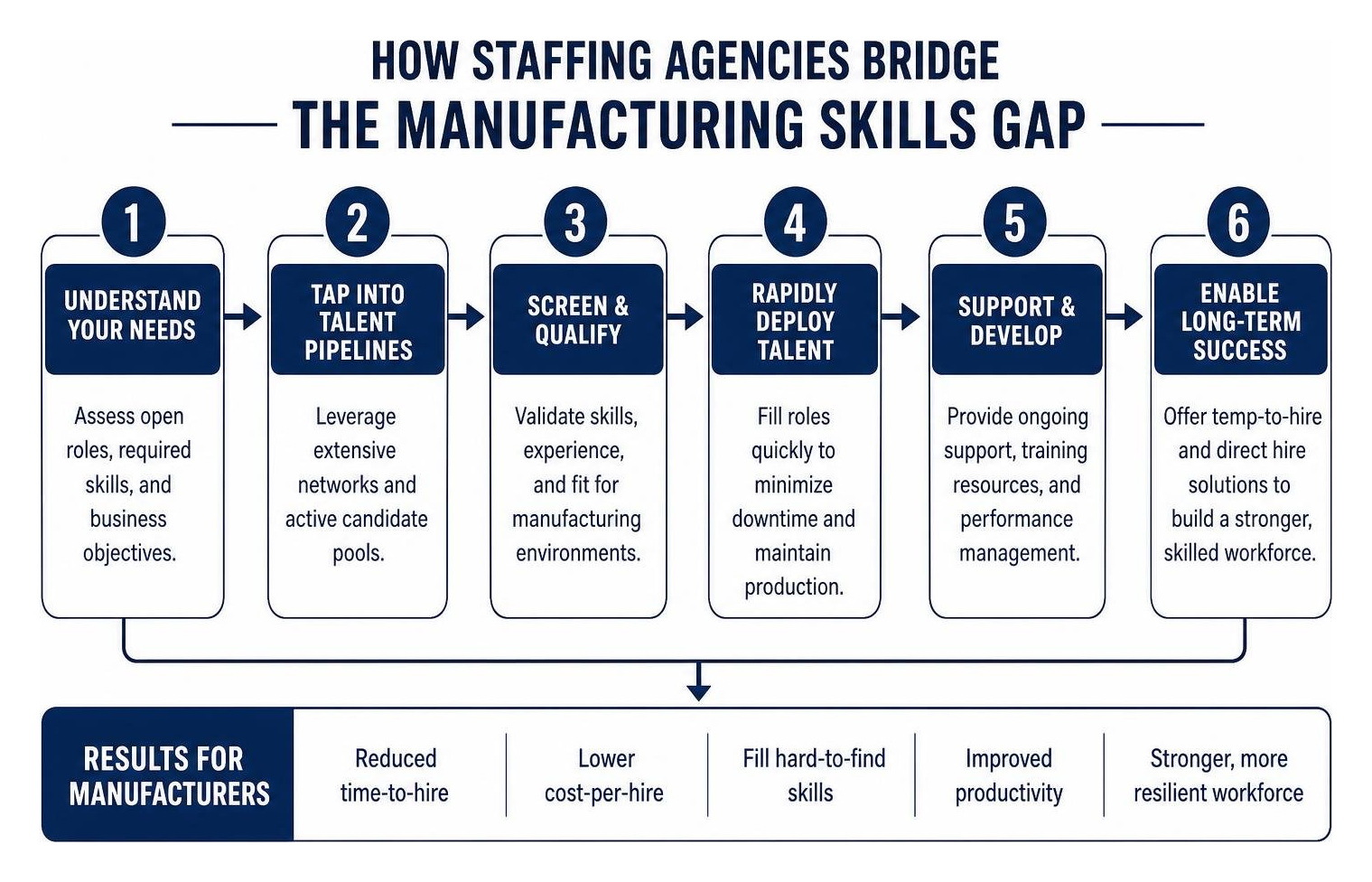
A progressive manufacturing staffing agency helps you overcome this gap by:
- Upskilling Initiatives: Partnering with local trade schools and training programs to prepare workers for modern, tech-enabled manufacturing environments.
- Building Active Pipelines: Constantly recruiting and nurturing relationships with passive candidates who possess specialized technical skills.
- Creating Career Paths: Highlighting the long-term career potential of manufacturing roles to attract younger, tech-savvy workers who can adapt to automated systems.
Key Criteria for Selecting Your Staffing Partner
Not all staffing agencies are created equal. To find a partner that can truly support your production goals, look for agencies with a deep footprint in your specific geographic region and industry.
When evaluating potential partners, consider their expertise in your local market. For instance, if you operate in the Northeast or Mid-Atlantic, you will want an agency that understands those specific corridors. You can learn what to look for by reading How to Pick the Best Light Industrial Temp Agencies for Your Warehouse or consulting The Keystone to Better Hiring: PA Staffing Agency Guide. For general operational excellence, review these invaluable Staffing Agency Insider Tips for Success.
If your operations are based in the South, you should seek out partners with deep roots in the Lone Star State. Explore resources like The Best Staffing Agencies in Texas and The Best Texas Staffing Agencies for Your Needs to find a partner that matches your regional scale.
For localized New Jersey operations, targeted regional expertise is vital. Check out these specific local guides to find the perfect fit for your plant:
- Finding the Right Staffing Agency in Pennsauken
- Willingboro Staffing Solutions for Growing Businesses
- Hiring Made Easy in Burlington New Jersey
You want an agency with physical offices near your facilities. To find local teams that can respond immediately to your needs, check out May the Tempforce Be With You: Finding Local Staffing Offices.
Frequently Asked Questions about Manufacturing Staffing
What are the typical markup rates for manufacturing staffing agencies?
Markup rates generally range from 30% to 45% of the employee’s hourly wage. This percentage covers mandatory employer payroll taxes (FICA, FUTA, SUTA), workers’ compensation insurance, general liability insurance, recruiting costs, and the agency’s operating margin.
How do staffing agencies ensure temporary workers are trained in safety?
Reputable agencies conduct mandatory general safety orientations before dispatching any worker. This includes training on proper lifting techniques, PPE requirements, hazard communication, and basic OSHA guidelines. They also collaborate with your team to integrate your plant’s specific safety protocols.
Can a manufacturing staffing agency help fill highly specialized technical roles?
Yes. Specialized agencies maintain active networks of skilled tradespeople, including CNC programmers, industrial maintenance technicians, certified welders, and PLC programmers. Because these roles are highly sought after, agencies utilize targeted sourcing strategies to find and vet this specialized talent.
Conclusion
In the , high-stakes world of modern manufacturing, your workforce is your most critical asset. When labor shortages, skills gaps, or sudden production surges threaten to disrupt your operations, you cannot afford to wait weeks to find the right people.
At Employer Solutions Services (ESS), we bring over 30 years of industry-leading experience to the table. We provide customized staffing programs—spanning temporary, temp-to-hire, and direct-hire solutions—along with comprehensive back-office administration like payroll services across Florida, Georgia, Illinois, Massachusetts, Nevada, New Jersey, Pennsylvania, and Texas. Our commitment to delivering thoroughly screened and trained talent ensures your production lines keep moving safely and efficiently.
Ready to build a stronger, more flexible workforce? Learn more About Us and explore our full suite of customized workforce solutions on Our Services page today.