
What a PRN Staffing Agency Does — and Why It Matters for Scaling Your Workforce
A PRN staffing agency gives healthcare facilities access to qualified clinical professionals on an as-needed basis — without the cost and commitment of permanent hires.
Quick answer: What does a PRN staffing agency do?
| Need | How a PRN Agency Helps |
|---|---|
| Short-term coverage gaps | Supplies per diem staff for single shifts or busy periods |
| Long-term shortages | Places contract or travel clinicians for weeks or months |
| Permanent hiring | Recruits and pre-screens candidates for direct hire |
| Cost control | Reduces reliance on full-time staff during slow periods |
| Compliance | Verifies licenses, credentials, and background checks |
PRN stands for pro re nata — a Latin phrase meaning “as needed.” In healthcare staffing, it describes professionals who work flexible, on-call schedules rather than fixed positions.
For mid-sized healthcare operations, staffing gaps are a constant pressure. A vacancy in a nursing unit or clinic doesn’t just affect scheduling — it affects patient care, staff morale, and your bottom line.
That’s exactly where a PRN staffing agency steps in. These agencies maintain a ready bench of vetted clinicians — RNs, CNAs, LPNs, and allied health professionals — who can be deployed quickly when your internal team falls short.
The model has grown significantly. Established agencies have built decades of relationships with facilities nationwide. And newer technology platforms are pushing the model even further, giving facilities real-time access to independent professionals with verified credentials.
This guide walks you through how to use PRN staffing strategically — to scale your workforce, control costs, and keep care quality high.
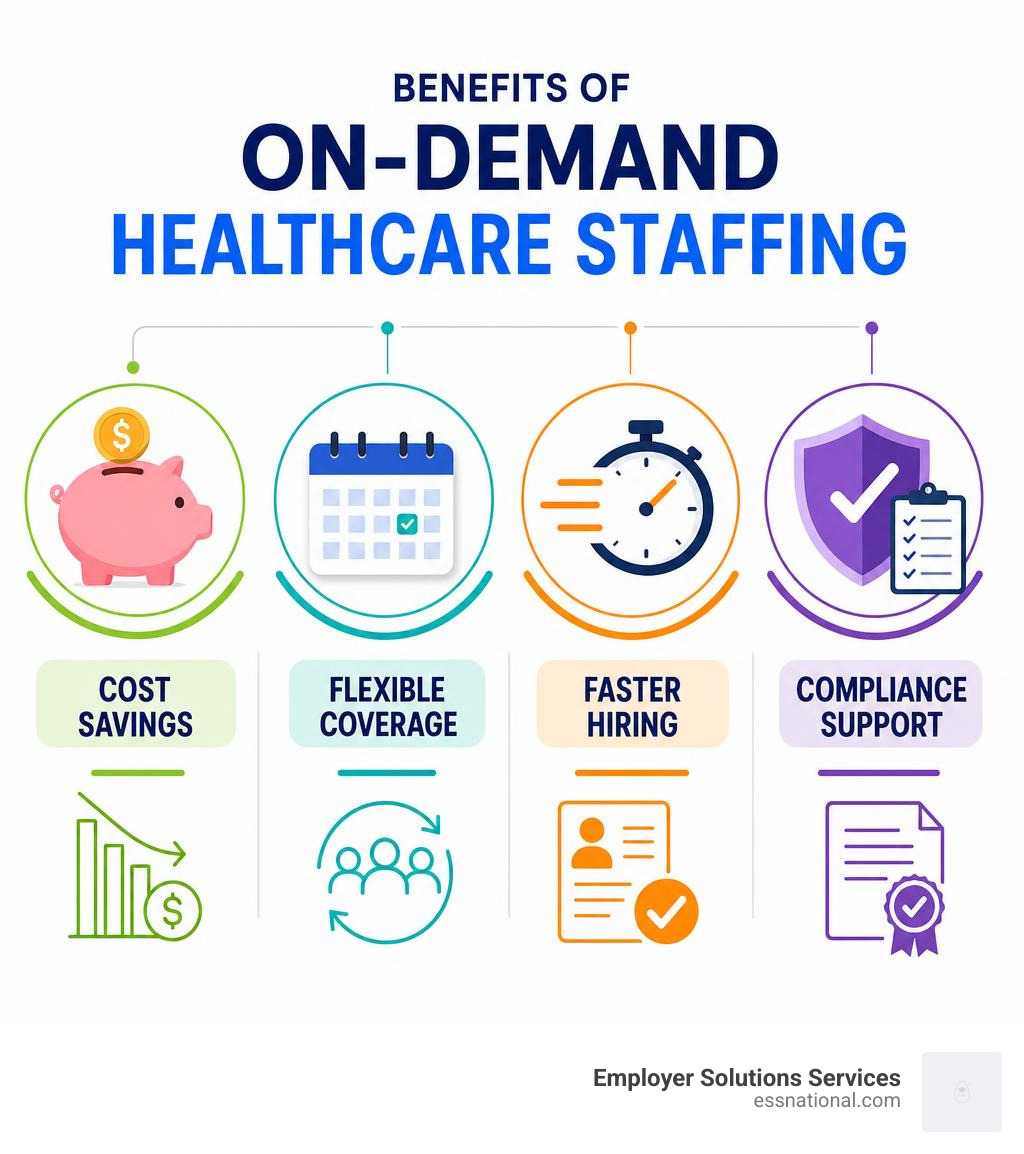
Essential prn staffing agency terms:
Understanding PRN Staffing and Its Core Solutions

In the modern healthcare landscape of 2026, administrative teams face unprecedented pressure to balance patient-to-staff ratios while keeping operational costs under control. To achieve this, it helps to understand how a dedicated prn staffing agency operates and what specific tools it brings to your workforce strategy.
When you partner with an agency, you are not just getting “temp help.” You are accessing a highly structured workforce model designed to flex in real-time with your patient census. Understanding the fundamentals of this model is the first step toward optimizing your clinical environment. To get a broader overview of how these organizations function, you can read Everything You Need to Know About Medical Staffing Agencies.
What is a PRN Staffing Agency?
A prn staffing agency is a specialized recruitment and placement firm that connects healthcare facilities with licensed clinical professionals who prefer to work on an as-needed, flexible basis.
Unlike traditional staffing agencies that focus primarily on permanent placements or standard 40-hour workweeks, a PRN agency manages a fluid pool of professionals who are ready to step in at a moment’s notice. The term pro re nata translates to “as the circumstance arises,” which perfectly describes the relationship.
For facilities, the primary differentiator is operational elasticity. Instead of carrying the heavy financial overhead of permanent, full-time employees during low-census periods, you can leverage PRN staff to fill sudden vacancies, weekend gaps, or seasonal surges. The agency handles the recruiting, onboarding, payroll, and credentialing, allowing your internal leadership team to focus entirely on patient care.
Key Staffing Solutions Offered by PRN Providers
To build a resilient workforce, facilities must match their specific vacancy types with the correct staffing solutions. Most established PRN providers offer a spectrum of placement options to address both short-term emergencies and strategic long-term gaps:
- Per Diem Staffing: This is the purest form of PRN work. Per diem professionals are scheduled shift-by-shift to cover last-minute call-outs, sudden spikes in patient volume, or short-term vacation leaves. Because they are employees of the agency (or vetted independent contractors on modern digital platforms), you only pay for the exact hours worked.
- Local and Travel Contracts: When facing a predictable, mid-term vacancy—such as a parental leave, a family medical leave, or a system-wide software upgrade—local or travel contracts are the ideal solution. These assignments typically range from 4 to 13 weeks. For example, a facility might seek a specialized contract nurse to find professionals willing to commit to a multi-week local contract.
- Permanent Placement: Many top-tier PRN agencies also offer direct-hire services. This allows you to evaluate a clinician’s skills and cultural fit in real-time before extending a permanent offer, significantly reducing your long-term hiring risk.
By blending these options, you can maintain seamless operations. For instance, if you are looking to support your clinical support staff, you might consider Staffing Your Practice with a Medical Assistant Temp Agency to ensure your front-and-back-office clinical assistants are always fully staffed.
How PRN Staffing Benefits Healthcare Facilities

The primary reason healthcare administrators turn to a prn staffing agency is simple: it directly protects both patient care quality and the facility’s financial health. When a nursing unit or clinical department is short-staffed, the remaining team members must take on additional patients. This leads to rapid burnout, increased clinical errors, and ultimately, higher turnover rates.
By utilizing on-demand staffing, facilities can inject immediate support into overworked units. This “relief valve” keeps your permanent staff happy and prevents them from seeking employment elsewhere. Furthermore, it allows you to scale your labor costs directly in line with your actual patient census. During low-volume months, you simply reduce your PRN requests, avoiding the painful and costly process of layoffs.
Supporting Specialized Settings and Long-Term Care
While acute care hospitals are major users of temporary staffing, specialized healthcare settings and long-term care (LTC) facilities face some of the most severe staffing challenges. Nursing homes, assisted living communities, behavioral health centers, and schools require highly specific clinical skill sets that can be difficult to source locally.
Specialized agencies and programs are designed to meet these exact needs. For example:
- In the long-term care sector, specialized networks connect CNAs, LPNs, and RNs with senior care communities to maintain regulatory compliance and high clinical standards.
- For regional support in specific states, facilities utilize localized networks to find professionals familiar with state-specific long-term care regulations.
- Educational and municipal settings often look for specialized placements. Specialized placement organizations help bridge the gap by placing school nurses, therapists, and social workers in public and charter school systems.
If your facility is struggling to source niche support roles, finding specialized clinical partners is crucial. For detailed guidance on sourcing these specific clinical professionals, check out Finding the Right Temporary Agency for Medical Assistants.
Pros and Cons of PRN Work for Healthcare Professionals
To successfully manage a PRN workforce, administrators must understand what motivates clinicians to choose this career path. Working through a prn staffing agency is highly attractive to a large segment of the modern healthcare workforce, but it also comes with distinct trade-offs.
| Benefit/Challenge | PRN Agency Work | Direct Facility Employment |
|---|---|---|
| Schedule Control | Complete autonomy; choose when and where to work | Fixed schedules; required holiday/weekend rotations |
| Compensation | Typically higher hourly rates and next-day pay options | Stable salary with standard bi-weekly payroll |
| Benefits | Highly variable; some agencies offer 401(k) and medical, others do not | Comprehensive, stable health and retirement packages |
| Workplace Familiarity | Must adapt quickly to new units, policies, and teams | Deep familiarity with facility culture, staff, and systems |
| Job Security | Shifts can be cancelled if patient census drops | High job security and predictable clinical hours |
Advantages of the PRN Model for Clinicians
The most significant draw for PRN professionals is flexibility. Clinicians can build their work schedules around family commitments, continuing education, or personal passions. For example, a nurse looking for travel opportunities might explore assignments in Illinois or Texas to experience new clinical environments without committing to a permanent move.
Additionally, PRN roles often command premium hourly rates to compensate for the lack of guaranteed hours. Many modern agencies and digital platforms have also introduced next-day pay, allowing clinicians to access their earnings immediately after completing a shift. This rapid compensation model is a powerful recruitment tool that keeps the PRN talent pool active and motivated. If you are a clinician looking to enter this space, you can read about The Quickest Way to Find Jobs via Medical Temp Agencies.
Challenges and Drawbacks of PRN Roles
Despite the high pay and freedom, PRN work is not without its difficulties. The most common complaint among temporary clinicians is the practice of “floating.” When a PRN nurse arrives at a hospital, they are often assigned to whichever unit has the highest acuity or the deepest shortage, requiring them to adapt instantly to unfamiliar layouts, electronic health record (EHR) systems, and team dynamics.
Furthermore, PRN workers are usually the first to have their shifts cancelled if the patient census suddenly drops. This lack of guaranteed hours can lead to financial unpredictability. Clinicians must also manage their own professional credentials and deal with potential communication gaps if their staffing agency does not offer 24/7 support.
Ensuring Quality, Compliance, and Credentialing
When bringing temporary staff into your clinical environment, there is zero room for compromise on quality. A single unverified license or missed background check can result in severe regulatory penalties, lawsuits, and—most importantly—compromised patient safety.
A reputable prn staffing agency acts as your first line of defense. They must maintain a rigorous, continuous credentialing process that meets or exceeds state and federal guidelines.
The Importance of Rigorous Vetting
To protect your patients and your facility’s reputation, any staffing partner you select must perform comprehensive screening before a professional ever steps onto your floor. This vetting process should include:
- Primary Source Verification: Confirming active, unencumbered licenses directly with state nursing boards for regional placements.
- Clinical Competency Assessments: Administering specialty-specific skills checklists and exams to ensure the professional can perform high-level clinical tasks immediately.
- Comprehensive Background Checks: Conducting federal, state, and county criminal searches, along with OIG/GSA exclusion list screenings.
- Health and Immunization Tracking: Verifying up-to-date vaccinations, TB screenings, and physical exams.
For highly specialized technical roles, this level of vetting is even more critical. If you are sourcing technical laboratory staff, you can learn how we handle this by reading How to Find a Medical Laboratory Technician Recruitment Agency That Delivers.
Choosing the Right PRN Staffing Partner for Your Facility
With so many staffing options available in 2026, selecting the right partner requires careful evaluation. You should look for agencies that hold prestigious industry certifications, such as the Joint Commission Gold Seal of Approval, which demonstrates an ongoing commitment to healthcare staffing excellence.
Additionally, look for providers that offer transparent, all-inclusive pricing with no hidden administrative fees, and ensure they provide 24/7 real-person support to handle last-minute schedule changes or clinical emergencies.
Traditional Agencies vs. Modern PRN Staffing Agency Technology
The healthcare staffing industry has experienced a massive technological shift. Facilities now have two primary pathways for sourcing temporary talent:
- Traditional Staffing Agencies: These agencies rely on personalized, high-touch recruiter relationships. A dedicated account manager works directly with your scheduler to understand your facility’s culture and hand-pick clinicians who match your needs. This model is highly reliable and provides excellent support for complex clinical settings.
- Digital Staffing Marketplaces: These are self-service platforms where facilities post open shifts directly to an app, and local independent professionals bid on them in real-time. These platforms often feature reliability scores and peer reviews, offering maximum speed and direct budget control.
Many progressive facilities find that a hybrid approach works best. They utilize digital marketplaces for quick, local per diem shiftssuch as using digital platforms for rapid local coveragewhile partnering with established, full-service agencies for specialized contract roles, travel clinicians, and critical back-office support.
If you are currently evaluating your overall clinical administrative needs, including medical coding and billing vacancies, you can read Why You Need a Medical Coder Temporary Agency Right Now.
Frequently Asked Questions about PRN Staffing
How does a PRN staffing agency differ from a traditional agency?
While traditional agencies focus on placing long-term contract workers or permanent employees, a prn staffing agency specializes in on-demand, flexible, and short-term per diem shifts. PRN agencies maintain a highly responsive, local pool of talent that can be deployed quickly to cover sudden daily vacancies, whereas traditional agencies typically require longer lead times and structured contract terms.
What credentials do PRN agencies verify?
Top-tier agencies verify active professional licenses, clinical certifications (such as BLS, ACLS, or PALS), physical health clearances, drug screens, and comprehensive criminal background checks. They also perform primary source verification with state boards and maintain strict compliance with Joint Commission standards to ensure patient safety.
How do facilities manage costs when using PRN staff?
Facilities manage costs by using PRN staff strategically to eliminate unnecessary overtime pay for permanent staff and to avoid carrying permanent salary overhead during low-census periods. By aligning your temporary staffing requests directly with real-time patient volume, you pay only for the clinical hours you actually need.
Conclusion
Scaling your clinical workforce does not have to mean taking on massive financial overhead or risking staff burnout. By partnering with a trusted prn staffing agency, you gain the operational flexibility needed to handle any scheduling challenge—from sudden weekend call-outs to long-term specialty vacancies.
At Employer Solutions Services (ESS), we bring over 30 years of experience to the table, providing customized staffing programs and rigorously screened, trained talent across key regions including Florida, Georgia, Illinois, Massachusetts, Nevada, New Jersey, Pennsylvania, and Texas. Whether you need immediate temporary coverage, temp-to-hire flexibility, direct permanent placements, or reliable back-office administration like payroll services, we are here to support your mission.
Ready to build a more resilient, cost-effective clinical team? Explore our comprehensive staffing services today and let us handle the logistics so you can focus on what matters most: delivering exceptional patient care.