Pennsylvania Manufacturers: Your Workforce Shortage Has a Solution
Industrial staffing Pennsylvania is one of the fastest ways for mid-sized manufacturers to close workforce gaps, scale production, and stop losing money to empty shifts.
Here’s a quick snapshot of what PA industrial staffing delivers:
| What You Need | What Staffing Solves |
|---|---|
| Workers fast | Pre-screened candidates, rapid placement |
| Flexible headcount | Temp, temp-to-hire, and direct hire options |
| Reliable talent | Behavioral screening and skills evaluation |
| Compliance support | E-Verify, OSHA, background checks handled |
| Seasonal surges | Scalable workforce on short notice |
Pennsylvania has a deep manufacturing base. Cities like Lancaster, Harrisburg, Philadelphia, Allentown, Reading, and York all run on industrial labor — warehouse workers, machine operators, forklift drivers, assemblers, and welders.
But finding reliable people is getting harder.
Labor shortages are squeezing production schedules. Turnover is burning through HR budgets. And posting jobs yourself rarely gets you the quality — or the speed — you need to keep the floor moving.
That’s exactly where a strong industrial staffing partner earns its keep.
This guide breaks down how PA industrial staffing works, what roles get filled, how agencies screen workers, and how to choose the right partner for your facility.
Industrial Staffing Pennsylvania: Navigating the Local Market

Pennsylvania isn’t just the Keystone State; it’s the industrial backbone of the Northeast. From the massive distribution centers lining the I-81 corridor to the specialized fabrication shops in the Lehigh Valley, the demand for industrial staffing pennsylvania is relentless.
The market here is unique because of its geographic diversity. In the east, Philadelphia and Allentown serve as massive logistics and pharmaceutical hubs. In Central PA, cities like Lancaster, York, and Harrisburg are home to a dense concentration of food processing, electronics assembly, and heavy machinery manufacturing.
To navigate this market, you first have to understand the two primary “flavors” of industrial labor. While the terms are often used interchangeably, the requirements for a light industrial packer are worlds apart from a heavy industrial welder.
Light vs. Heavy Industrial Staffing Pennsylvania
The distinction between light and heavy industrial roles usually comes down to the environment, the equipment used, and the physical intensity of the work.
| Feature | Light Industrial | Heavy Industrial |
|---|---|---|
| Typical Roles | Assembly, Packing, Sorting, Forklift Ops | Welding, Machining, Millwrights, Rigging |
| Environment | Climate-controlled warehouses, clean rooms | Foundries, shipyards, large-scale construction |
| Equipment | Hand tools, pallet jacks, light machinery | CNC machines, cranes, high-heat furnaces |
| Skill Level | Entry-level to semi-skilled | Highly skilled trades, certifications required |
| Physical Demand | Moderate (standing, lifting up to 30-50 lbs) | High (extreme heat, heavy lifting, high-risk) |
In the current PA market, light industrial roles—such as warehouse associates and assembly line workers—see the highest volume of placements. However, the “heavy” side, including skilled trades like CNC programming and industrial maintenance, faces the most acute talent shortages.
Strategic Advantages of Industrial Staffing Pennsylvania
Why do Pennsylvania manufacturers lean so heavily on staffing agencies? It isn’t just about “getting bodies.” It’s about agility.
- Rapid Placement: When a production line goes down or a new contract is signed, you don’t have three weeks to wait for a job board post to gain traction. We maintain deep databases of pre-screened talent ready to start within 24 to 48 hours.
- Local Expertise: A recruiter in Reading knows the local commute patterns and wage expectations better than a national job site. This local “intel” helps prevent high turnover caused by mismatched expectations.
- Scalability for Seasonal Surges: Many PA businesses, especially in food production and retail distribution, face massive spikes in Q4. Staffing allows you to double your workforce for three months without the long-term liability of permanent hires.
If you are struggling to keep your warehouse fully staffed, it might be time to look at how you select your partners. You can find more info about picking the best agency for your warehouse to ensure you are getting the quality you deserve.
Essential Roles and Flexible Hiring Models
The beauty of industrial staffing pennsylvania lies in its flexibility. No two facilities have the same workflow. One plant might need 50 general laborers for a one-week teardown, while another needs two expert machinists for a permanent, high-stakes project.
Common roles we fill across the state include:
- Forklift Operators & Material Handlers: The “engine” of the warehouse.
- Pickers & Packers: Essential for the booming e-commerce and fulfillment sectors in the Lehigh Valley.
- Machine Operators: From simple press operation to complex automated lines.
- Welders & Fabricators: Skilled professionals who keep the heavy manufacturing sector moving.
- Quality Control Inspectors: Ensuring that “Made in PA” remains a mark of excellence.
To fill these roles, we utilize three primary hiring models designed to fit your specific business goals.
Customizing Your Workforce Strategy
We don’t believe in a one-size-fits-all approach. Depending on your turnover rates and growth plans, you may need a mix of the following:
- Temporary Staffing: Best for short-term projects, seasonal peaks, or covering for leaves of absence. This keeps your overhead low while maintaining productivity.
- Temp-to-Hire: This is essentially a “working interview.” You get to see the candidate’s attendance, attitude, and skill level on the job before making a permanent offer. It’s the most effective way to stop the revolving door with direct placement staffing because it eliminates the guesswork.
- Direct Hire: For specialized, high-skill roles like Plant Managers or Senior Engineers, we handle the intensive headhunting and present you with the top 2% of candidates for immediate permanent placement.
- Payroll Transfer: If you’ve found a great worker but aren’t ready to take on the administrative burden of workers’ comp, taxes, and benefits, we can put them on our payroll while they work for you.
For a deeper dive into how these models can be tailored to your specific plant floor, check out more info about our services.
Screening, Safety, and Compliance Standards
In the industrial world, a “bad hire” is more than just a productivity drain—it’s a safety risk. When we talk about industrial staffing pennsylvania, the “staffing” part is only half the job. The other half is risk management.
Pennsylvania has strict standards, and the manufacturing sector is under constant OSHA scrutiny. A reputable agency acts as a shield, ensuring that every worker walking onto your floor is prepared, documented, and safe.
Ensuring Rapid Placement and Safety
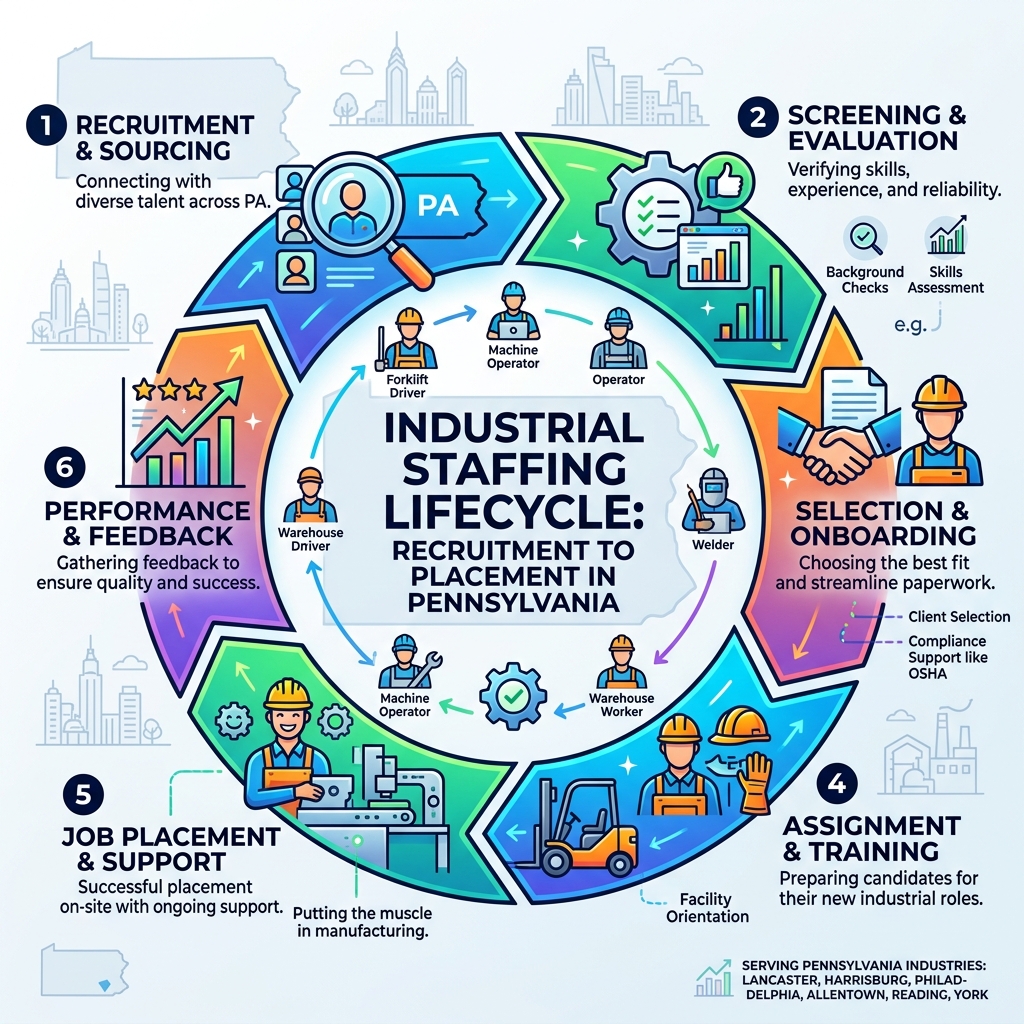
Our screening process is designed to be rigorous yet fast. We know you need people now, but “now” shouldn’t mean “unqualified.” Our process includes:
- Behavioral Evaluations: We don’t just look at resumes; we look at reliability. We ask the tough questions to gauge how a candidate handles pressure and follows instructions.
- Skills Testing: Whether it’s a basic math test for packers or a practical forklift operation check, we verify skills before they arrive at your gate.
- Safety Orientation: Before their first shift, candidates receive training on general industrial safety, PPE requirements, and hazard communication.
- Compliance & Eligibility: We utilize E-Verify to confirm employment eligibility and conduct thorough background checks and drug screenings according to your company’s specific requirements.
By handling these “back-office” hurdles, we ensure you are ready to hire without the administrative headache. This proactive approach to safety and compliance reduces your EMR (Experience Modification Rate) and keeps your insurance premiums manageable.
Future Trends and Technology in PA Staffing
The days of a recruiter sitting by a landline phone waiting for people to walk into an office are over. The future of industrial staffing pennsylvania is high-tech and high-touch.
As we look toward 2026, several trends are reshaping how we find and manage industrial talent:
- AI-Powered Matching: We use advanced algorithms to scan our database of millions of job seekers. This allows us to match specific technical skills (like experience with a particular brand of CNC controller) to your job order in seconds.
- Mobile-First Onboarding: Today’s workers live on their phones. By using mobile apps for applications, timecards, and safety training, we reduce the “friction” of hiring, leading to faster fill rates.
- SXM (Staffing Experience Management): This is a shift from treating staffing as a transaction to treating it as an experience. By focusing on worker satisfaction and communication, we improve retention rates for our clients.
- Automation Gaps: As PA factories become more automated, the demand for “unskilled” labor is shifting toward “semi-skilled” workers who can troubleshoot and maintain robotic systems.
Emerging Industrial Technologies in Staffing
- Predictive Analytics: Using data to forecast when a client will need more staff based on historical production cycles.
- Digital Onboarding Portals: Allowing workers to complete all federal and state paperwork remotely before day one.
- Real-time Performance Tracking: Feedback loops between supervisors and recruiters to optimize the workforce daily.
- Remote Site Support: Using localized recruiting “pods” to support facilities in rural parts of Pennsylvania where talent is scarce.
Frequently Asked Questions about Industrial Staffing Pennsylvania
What is the difference between light and heavy industrial staffing?
Light industrial staffing focuses on roles like assembly, packaging, and warehouse work that typically require moderate physical effort and can be learned quickly. Heavy industrial staffing involves highly skilled trades, such as welding or industrial machining, often in more hazardous environments like foundries or large-scale construction sites, requiring specialized certifications.
Which cities in Pennsylvania have the highest demand for industrial workers?
The highest demand is currently centered in the “Central PA Hub” (Lancaster, Harrisburg, York) due to its proximity to major East Coast shipping lanes. However, the Lehigh Valley (Allentown, Bethlehem) and the Greater Philadelphia area remain massive markets for logistics, packaging, and pharmaceutical manufacturing.
How do staffing agencies ensure the safety of placed industrial workers?
Top agencies provide comprehensive safety orientations, verify that candidates have the necessary PPE, and conduct site visits to ensure the working environment meets OSHA standards. They also handle the workers’ compensation risk, which incentivizes them to place only the most safety-conscious candidates.
Conclusion
At Employer Solutions Services (ESS), we know that your manufacturing facility is only as strong as the people on the floor. With over 30 years of experience, we’ve seen the Pennsylvania industrial landscape evolve, and we’ve grown alongside it.
We don’t just send you resumes; we provide customized workforce programs that include everything from screened talent to full back-office administration and payroll services. Whether you are in Lancaster, Philadelphia, or anywhere in between, we have the local expertise to put the “muscle” back into your manufacturing operations.
Stop letting empty shifts drain your bottom line. Explore our comprehensive industrial staffing services and let’s get your production back to 100%.