
The Real Reason Local Businesses Turn to Personnel Temporary Services
Personnel temporary services connect businesses with pre-screened workers on a flexible basis — without the long hiring timelines or overhead of traditional employment.
If you’re a business owner dealing with workforce gaps, here’s what you need to know right now:
- What they do: Staffing agencies recruit, screen, and place workers on your behalf — handling payroll, compliance, and benefits in the process.
- Who they serve: Businesses of all sizes across manufacturing, logistics, administrative, healthcare, and more.
- How fast they work: Many agencies can place qualified workers within 24–48 hours of a request.
- What it costs you: You pay a bill rate to the agency; they handle wages, taxes, and workers’ comp.
- Hiring options available: Temporary, temp-to-hire, and direct-hire placements are all common offerings.
The U.S. staffing industry puts millions of people to work every year, connecting hundreds of thousands of workers with jobs and serving tens of thousands of businesses. That scale exists because the need is real.
For mid-sized businesses, the pressure is especially sharp. You need staff fast, you need them screened, and you don’t have time to build a full recruiting operation in-house. Local temporary staffing exists precisely to solve that problem.
This guide breaks down how it all works — and why partnering with a local staffing agency may be the smartest workforce move you make this year.
Personnel temporary services word roundup:
Why Personnel Temporary Services Are the Ultimate Business Asset

In the economy of 2026, agility isn’t just a buzzword—it is a survival mechanism. Business owners and HR managers from Boston to Dallas face the exact same headache: consumer demand can spike overnight, but the traditional hiring process still drags on for weeks.
When you partner with local personnel temporary services, you are not just outsourcing your stack of resumes. You are building an elastic workforce that expands and contracts as your business demands. This operational agility directly impacts your bottom line, transforming fixed labor costs into variable expenses.
Instead of committing to a permanent salary, benefits package, and onboarding overhead for a projected peak that might only last three months, temporary staffing allows you to bring in specialized talent exactly when you need it. Once the project wraps up or the seasonal rush subsides, the contract ends cleanly, leaving your core team focused on what they do best. To understand why this strategy has taken off across so many sectors, explore Why Temporary Staffing Across Industries Is the New Normal.
Defining Personnel Temporary Services in the Modern Economy
At its core, temporary staffing is a tri-party employment arrangement. The staffing agency acts as the primary employer, recruiting, vetting, hiring, and paying the worker. The worker is then placed at your business (the client company) to perform services under your daily supervision.
This is fundamentally different from traditional hiring, where your business assumes all administrative, legal, and financial responsibilities from day one. In the modern economy, temporary services have evolved far beyond the old “temp-to-type” clerical pools of the 20th century. Today, they encompass highly specialized technical roles, skilled trades, logistics management, and professional administrative support. According to National staffing industry insights, millions of temporary and contract employees are working in the United States daily, proving that businesses rely on this model to maintain operational continuity.
Key Differences in the Modern Hiring Landscape
To truly appreciate the value of personnel temporary services, it helps to compare them side-by-side with traditional direct hiring. The primary differentiator is the distribution of risk and administrative burden.
| Feature | Personnel Temporary Services | Traditional Direct Hiring |
|---|---|---|
| Primary Employer | The Staffing Agency (Employer of Record) | Your Business |
| Time-to-Hire | Often 24 to 48 hours | Average of 30 to 45 days |
| Payroll & Tax Admin | Handled entirely by the agency | Handled in-house by your HR/finance team |
| Workers’ Comp & UI | Covered under the agency’s policy | Your business assumes all policy risks |
| Trial Period | Built-in (evaluate performance on the job) | Risky (severance or UI claims if it fails) |
| Scalability | Extremely high (scale up or down weekly) | Low (layoffs are costly and damage morale) |
In a co-employment relationship, the staffing agency manages the legal and financial compliance of the workforce, acting as the Employer of Record. This model provides substantial risk mitigation for your business. If a temporary worker isn’t a great fit, you don’t have to navigate complex termination procedures or worry about rising unemployment insurance premiums. You simply contact your agency partner, and they will handle the transition and provide a replacement.
Maximizing ROI with Personnel Temporary Services
Traditional recruiting has a massive hidden price tag. When you factor in job board postings, recruiter hours, skills testing platforms, background check fees, and the productivity lost while a position sits vacant, the true cost of hiring can easily exceed several thousand dollars per role.
Local temporary staffing agencies dramatically lower these upfront overhead costs. Because we maintain deep, pre-vetted talent pipelines, we can deploy workers immediately, cutting down vacancy times that stall production. During seasonal surges—whether you are a manufacturer in Illinois preparing for Q4 distribution or a hospitality business in Florida gearing up for winter tourists—temporary staffing ensures you only pay for labor when it is actively generating revenue. If you are operating in the Mid-Atlantic, utilizing resources like the Pennsylvania workforce development resources can help you understand local labor trends, but a dedicated staffing partner remains the fastest vehicle to convert those insights into actual on-site workers.
Handling Payroll, Benefits, and Compliance
Managing the back-office administration of a growing team is a full-time job in itself. When you utilize temporary staffing, the agency handles the heavy lifting, including:
- W-2 payroll processing and tax withholding.
- Affordable Care Act (ACA) compliance and health benefits administration.
- Workers’ compensation insurance and claims management.
- E-Verify and regulatory compliance.
This back-office relief is a game-changer for mid-sized businesses that want to scale without bloating their internal HR departments. By handing off these time-consuming administrative tasks, you can keep your internal teams focused on strategic growth. For a deeper dive into streamlining these operations, check out these 5 Smart Strategies for Temporary Staffing Services.
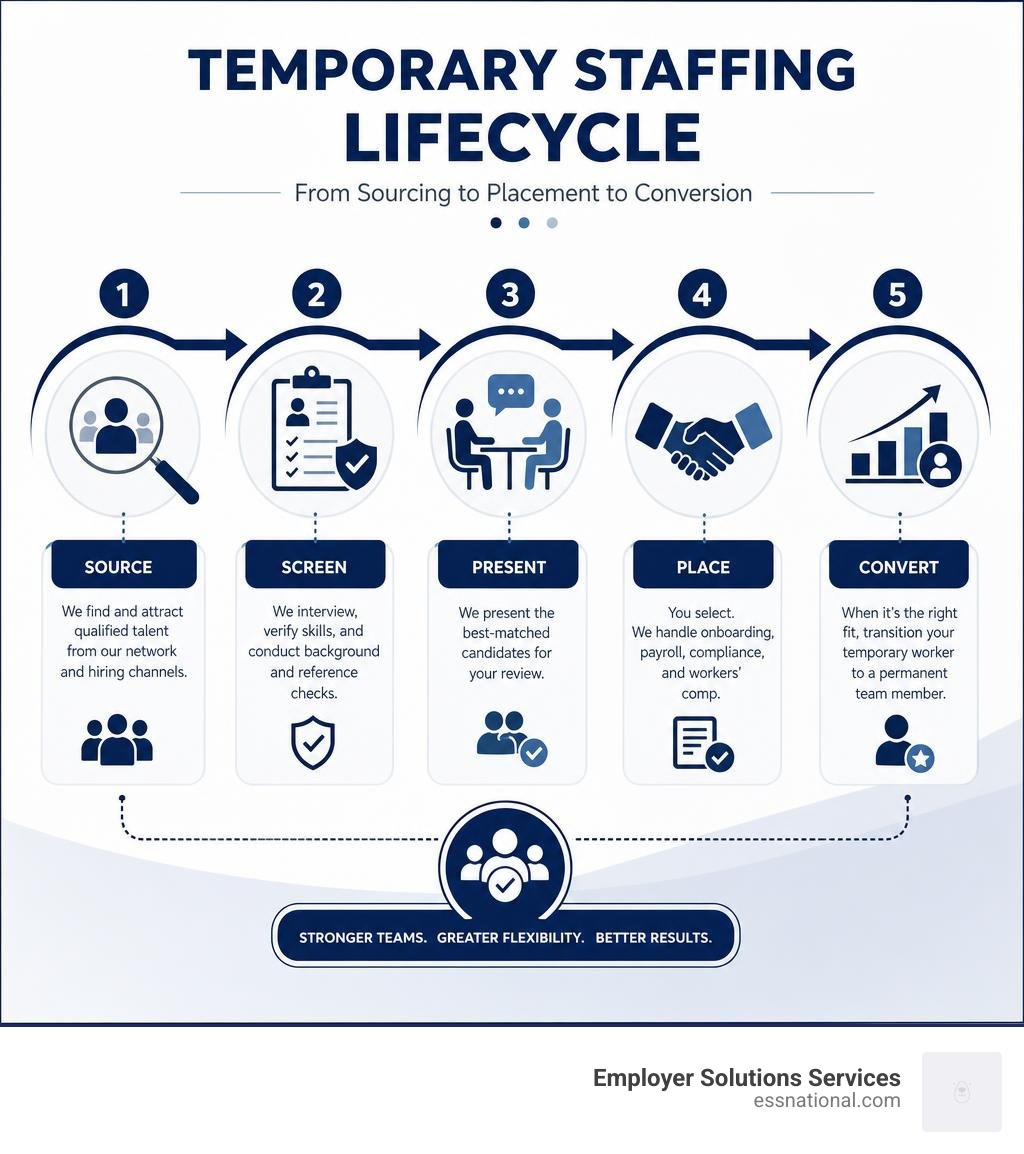
Sourcing, Screening, and Placing Top Talent

How do staffing agencies consistently find qualified talent when internal HR departments are struggling to get a single qualified applicant? The secret lies in proactive sourcing and rigorous, multi-step screening protocols.
While a typical business only recruits when a position opens up, professional staffing agencies recruit 24/7/365. We build vast talent pipelines long before our clients ever send over a job order. This continuous talent cultivation is particularly vital in competitive state economies. For example, staying aligned with Texas workforce and employment trends allows us to anticipate labor shortages in key industrial hubs and adjust our recruiting strategies accordingly.
Sourcing and Screening Procedures
Our selection process is designed to filter out the noise and identify reliable, capable professionals. A standard sourcing and screening protocol includes:
- AI-Enhanced Database Sourcing: Scanning regional databases to match candidates’ certified skills with specific job descriptions.
- Behavioral Interviews: Conducting structured interviews to assess soft skills, reliability, and cultural alignment.
- Skills Assessments: Utilizing specialized testing platforms to verify technical proficiency, whether in warehouse safety, administrative software, or light industrial machinery.
- Rigorous Compliance Checks: Running comprehensive background checks, drug screenings, and verifying employment eligibility via E-Verify.
In highly regulated markets, understanding local employment laws is critical. By staying ahead of local guidelines—such as the regulatory standards tracked by the Massachusetts labor market information portal—we ensure that every candidate placed on your job site is fully compliant with state and federal laws.
The Timeline for Filling Open Positions
When a key team member walks out the door or a sudden order comes in, you don’t have 30 days to post a job and wait for applications. You need someone on the floor immediately.
Because we maintain active benches of pre-screened talent, our typical time-to-hire for standard light industrial, logistics, and administrative roles is just 24 to 48 hours.
This rapid placement timeline is supported by digital onboarding platforms that allow candidates to complete tax documents, safety orientations, and company policies before they ever step foot in your facility. The result? A worker who arrives ready to contribute on day one.
Navigating Temp-to-Hire and Direct-Hire Options
Every business has unique talent needs. Sometimes you need a temporary hand to get through a busy month; other times, you are looking for a permanent leader to guide a department for the next decade. Modern staffing agencies offer a spectrum of hiring models to accommodate these diverse goals.
For many employers, the “try-before-you-buy” approach is the most appealing aspect of staffing. It allows you to evaluate a worker’s actual on-the-job performance, attendance, and team compatibility before making a long-term financial commitment. To separate the myths from reality regarding this popular model, take a look at The Truth About Temp to Hire Positions.
The Temp-to-Hire Transition Process
The temp-to-hire (or temp-to-perm) model serves as an extended, real-world job interview. Typically, a candidate works on the staffing agency’s payroll for a set transition period—often between 90 and 180 days.
During this trial period, your management team can evaluate key performance indicators:
- Reliability: Do they show up on time, every day, with a positive attitude?
- Skill Competency: Can they handle the actual day-to-day tasks of the role?
- Cultural Fit: How well do they collaborate with your existing staff?
If the worker excels, you can seamlessly transition them onto your direct payroll at the end of the contract period. If they don’t meet expectations, you can end the assignment without the legal complications or unemployment liabilities associated with firing a direct hire. To learn how to navigate this transition smoothly, read about Making the Leap with Temp to Perm Employment Agencies.
Direct-Hire Placements for Specialized Roles
While temporary staffing is perfect for scaling labor, direct-hire placement is often the preferred strategy for highly specialized, technical, or executive positions. In a direct-hire arrangement, the staffing agency handles the sourcing, screening, and initial interviewing, but the candidate is hired directly onto your payroll from day one.
This model is highly effective for roles requiring specific certifications, engineering degrees, or niche management experience. Because top-tier specialists are rarely browsing active job boards, our recruiters use direct-outreach strategies to headhunt passive candidates who are already succeeding in their fields. If you are ready to bring in high-level specialists, explore our guide on Navigating the World of Professional Temp to Hire Specialists.
Frequently Asked Questions About Temporary Staffing
What industries do temporary staffing agencies typically serve?
Temporary staffing agencies support a broad range of sectors, adjusting their talent pools to match regional economic demands. The most common industries we serve include:
- Light Industrial & Manufacturing: Machine operators, assembly line workers, quality control inspectors, and packers.
- Logistics & Warehouse Distribution: Forklift drivers, shipping/receiving clerks, order selectors, and inventory specialists.
- Administrative & Clerical Support: Receptionists, data entry specialists, customer service agents, and executive assistants.
- Professional & Technical: Accounting clerks, HR coordinators, and IT support technicians.
To see how these labor demands shift across different parts of the country, you can consult regional resources like the Midwest regional economic and employment data. If your business is located in our key operating states, you can partner directly with Employer Solutions Services (ESS) to access localized talent networks across:
- Florida: Localized light industrial and hospitality staffing.
- Georgia: Regional warehouse and administrative support.
- Illinois: Statewide light industrial talent networks.
- Massachusetts: Professional and technical specialists in the New England area.
- Nevada: Warehousing, logistics, and administrative teams.
- New Jersey & Pennsylvania: Light industrial and clerical staffing.
- Texas: Manufacturing, trades, and office operations.
What are the advantages for job seekers working with staffing agencies?
Working with a staffing agency isn’t just a win for employers—it offers incredible career advantages for job seekers as well.
- Rapid Employment: Skip the black hole of online job applications. Staffing agencies have immediate openings and can often place you in a job within days.
- Weekly Pay: Most agencies pay weekly, providing faster access to your hard-earned money.
- Career Flexibility: Try out different industries, company cultures, and roles to find what you truly enjoy.
- Resume Building & Upskilling: Gain valuable on-the-job experience and access free training resources to make yourself more marketable.
- A Foot in the Door: Many temporary assignments lead directly to permanent, full-time career opportunities at top local companies.
How are staffing agencies adapting with technology and AI in 2026?
The staffing industry has undergone a massive technological transformation. In 2026, we utilize sophisticated AI-powered matching algorithms to instantly compare candidate profiles against complex job orders, analyzing past experience, skill levels, and even commute times to predict placement success.
Additionally, mobile-first platforms allow workers to claim shifts, view schedules, and submit timecards 24/7. Digital onboarding and automated credential verification mean we can clear candidates for work faster than ever before. However, while technology accelerates our speed-to-fill, we believe that human relationships remain the heart of great staffing. AI is our engine, but human expertise is our steering wheel.
Conclusion
Finding the right talent at the right time shouldn’t feel like an impossible task. Whether you are dealing with seasonal spikes, sudden growth, or specialized hiring needs, personnel temporary services give your business the flexibility and support it needs to thrive.
At Employer Solutions Services (ESS), we bring over 30 years of industry experience to the table. We don’t believe in one-size-fits-all staffing. Instead, we deliver customized staffing programs, meticulously screened and trained talent, and comprehensive back-office administration—including seamless payroll services—across our key operating states: Florida, Georgia, Illinois, Massachusetts, Nevada, New Jersey, Pennsylvania, and Texas.
Let us handle the administrative burdens, recruiting pipelines, and compliance risks so you can focus on what you do best: growing your business.
Ready to build a stronger, more flexible workforce? Explore ESS Staffing and HR Services today and let us design a customized solution for your team.