
What Temp to Hire Positions Really Mean for Your Business
Temp to hire positions are jobs that start as temporary roles but can convert to permanent employment after a set trial period — typically 90 days to 6 months.
Here’s a quick breakdown of how they work:
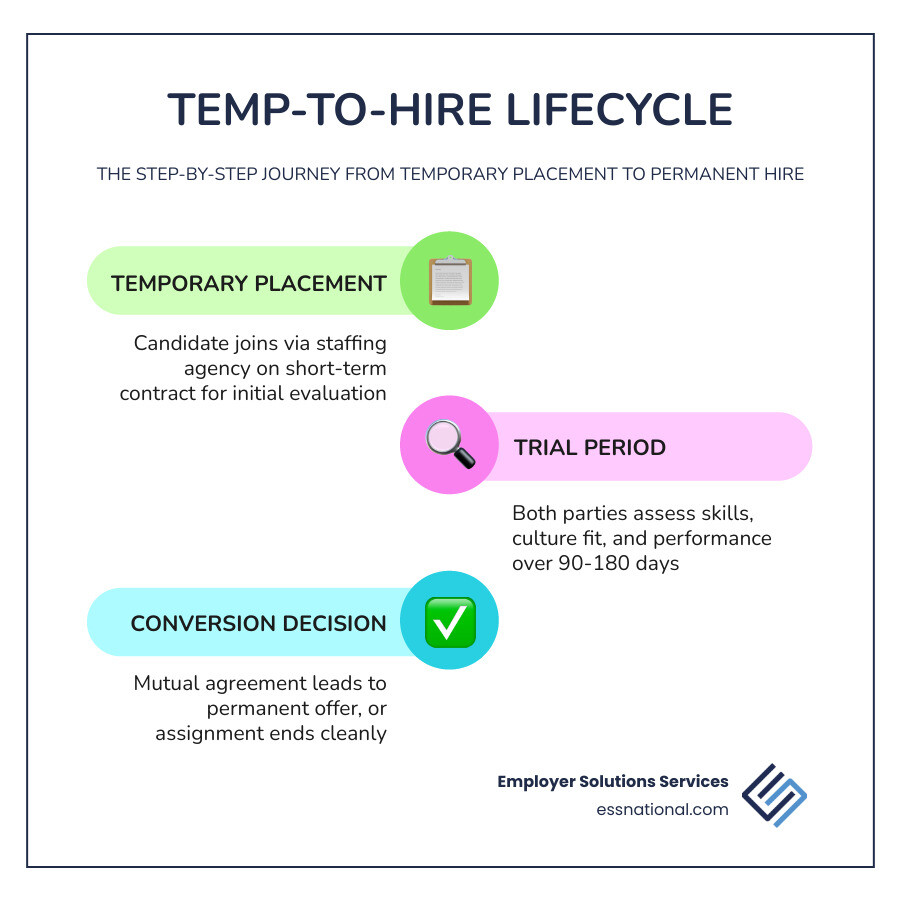
- Start temporary: You (or a candidate) joins the company through a staffing agency on a short-term contract
- Work the trial period: Both sides evaluate fit — skills, culture, performance
- Convert to permanent: If it works out, the employer makes a formal offer for full-time employment
- No conversion: If it doesn’t work, the assignment ends without the complexity of a traditional termination
This model sits between pure temporary staffing and direct hiring — giving employers and workers a low-risk way to test the relationship before committing.
For business owners facing tight labor markets and high turnover costs, this arrangement isn’t just convenient — it’s strategic. Staffing agencies like Employer Solutions Services facilitate these placements, handling screening, compliance, and payroll during the temp phase so employers can focus on evaluating talent, not managing paperwork.
In 2026, with workforce shortages still pressing across manufacturing, healthcare, logistics, and office roles, more companies are turning to temp-to-hire as a smarter path to building reliable teams.
This guide covers everything you need to know — from how the process works to how to make it succeed.
The Mechanics of Temp to Hire Positions

At its core, the temp to hire positions model is the professional equivalent of “dating before marriage.” While traditional hiring involves a few interviews and a leap of faith, this model allows for a hands-on evaluation period.
But how does it differ from other staffing models? To understand the mechanics, we have to look at the three main pillars of modern employment:
- Temporary Staffing: These are short-term assignments with a clear end date. They are perfect for seasonal surges or specific projects.
- Permanent (Direct) Hire: The candidate is hired directly by the company from day one. To learn more about this, see What is Direct Hire Staffing and Why it Beats the Rest.
- Temp-to-Hire (Contract-to-Hire): This is the hybrid. The worker is technically an employee of the staffing agency (like us) during the trial phase but performs work for the client company with the shared goal of eventual permanent placement.
Comparing Employment Models
| Feature | Temporary | Permanent (Direct) | Temp-to-Hire |
|---|---|---|---|
| Employer of Record | Staffing Agency | The Company | Staffing Agency (Initially) |
| Commitment Level | Low | High | Medium (Trial Period) |
| Benefit Eligibility | Through Agency | Through Company | Agency (Initially), then Company |
| Trial Period | N/A | Probationary Period | 90 – 180 Days |
This arrangement provides a unique safety net. If a candidate’s skills don’t quite match the resume, or if the company culture isn’t a fit for the worker, the “breakup” is handled through the agency, minimizing legal risks and administrative headaches for the business.
Why Employers and Job Seekers Choose the Trial Period
Why are so many businesses in Florida, Texas, and Pennsylvania moving toward this model in 2026? It’s about reducing the “revolving door” effect. High turnover is expensive—not just in recruitment costs, but in lost productivity and dampened morale. According to the American Staffing Association, staffing firms provide vital flexibility that helps businesses manage these costs effectively. By utilizing temp to hire positions, companies can stop the revolving door with direct placement staffing strategies that prioritize long-term fit.
Benefits for Job Seekers
For the worker, these positions offer a “foot in the door” at top-tier companies that might not be actively posting permanent roles on public boards. It’s an opportunity for:
- Upskilling: Many agencies offer free training (we’ve seen programs with over 3,000 courses) to help associates bridge skill gaps.
- Resume Building: Gaining experience at a reputable firm, even temporarily, adds significant value to a professional profile.
- Culture Check: The worker gets to see if the management style and work-life balance actually meet their needs before signing a long-term contract.
Advantages for Employers
Employers gain a massive advantage by seeing the “real” version of a candidate. Interviews can be coached; a Monday morning at 8:00 AM in a busy warehouse cannot.
- Reduced Hiring Risk: You don’t have to worry about the “bad hire” cost, which can be 1.5x to 2x the employee’s annual salary.
- Budget Flexibility: You can utilize your operating budget for temporary help rather than a fixed salary budget until the hire is “proven.”
- Seamless Onboarding: By the time the worker converts to permanent, they are already trained and integrated into the team.
Popular Industries for Temp to Hire Positions
While this model works across the board, certain sectors have embraced it as the gold standard:
- Manufacturing & Logistics: In hubs like Illinois and Georgia, the need for reliable forklift operators, welders, and CNC machinists is constant. The trial period ensures safety standards and technical proficiency are met.
- Healthcare: Stability is vital in medical settings. Direct placement for healthcare workers is the ultimate stability play, but many nursing and administrative roles start as temp-to-hire to ensure clinical competency.
- Administrative & Office: From accountants to legal assistants, office roles require a specific cultural “click.” Using an agency is often the ultimate guide to hiring via an office job staffing agency for those seeking high-level clerical talent.
Regional Trends and Opportunities
In 2026, we are seeing specific trends across our service areas:
- Florida & Texas: Explosive growth in construction and hospitality has led to a surge in on-demand labor that transitions into permanent site management roles.
- Illinois & Pennsylvania: A resurgence in specialized manufacturing is driving a need for “technical temp-to-hire” where workers are upskilled on-site.
- Georgia & New Jersey: Logistics and supply chain hubs are using this model to manage high-volume staffing needs during peak seasons with an eye toward retaining top performers year-round.
The Step-by-Step Conversion Process
The journey from applicant to permanent employee is a structured process designed to ensure no one gets “lost in the shuffle.” With over 17 million candidates in the national pipeline and 32,000+ associates on assignment each week across the industry, having a clear roadmap is essential.
- Application & Screening: The agency vets the candidate through interviews, skill assessments, and background checks.
- The Placement: The candidate begins work at the client site. They are paid by the agency and are technically agency employees.
- The Performance Phase: This is the heart of the temp to hire positions experience. The employer monitors KPIs (Key Performance Indicators) while the agency provides ongoing support.
- The Evaluation: Around the 60 or 90-day mark, the employer decides whether to convert the worker.
- The Conversion: The worker transitions to the client’s payroll. To make this work, both parties must master the seamless direct hire process to ensure paperwork and benefits transition smoothly.
Compensation and Benefits During the Temp Phase
One common myth is that temp workers don’t get benefits. In reality, reputable agencies provide:
- Competitive Hourly Pay: Often matching what the permanent role would offer.
- Health Coverage & 401(k): Many agencies offer medical, dental, and vision plans, along with retirement contributions (sometimes allowing 401(k) contributions up to 90% of pay).
- Upskilling Opportunities: Access to platforms like Aspire Academy, offering over 3,000 free courses, allows workers to increase their value during the trial period.
Transitioning to Permanent Status
When the “temp” label is dropped, a few things happen. Salary negotiations usually occur—though the hourly rate during the temp phase often sets the floor. Onboarding becomes simpler because the worker already knows where the breakroom is and how to use the software. However, this is also the time to implement Direct Hire Cherry Hill strategies for long-term success, focusing on long-term career mapping and integration into the company’s full benefit suite.
How to Succeed in Temp to Hire Positions
Success in a temp-to-hire role isn’t just about showing up; it’s about proving you are indispensable. In states like Pennsylvania, where the labor market is highly competitive, standing out is key.
- Reliability is King: In the temporary world, attendance is the first thing managers track. Being five minutes early is being on time.
- Take Initiative: Don’t wait to be told what to do. If you finish your task in the warehouse or at the desk, ask for the next one.
- Network Internally: Treat every coworker like a future teammate. Build relationships across departments.
Performance Evaluation and Feedback Loops
Regular check-ins are vital. In Nevada and Illinois, many of our clients use digital tracking to monitor output. Workers should proactively ask for feedback: “How am I doing against my KPIs?” or “What skills should I focus on to become a permanent member of the team?” This shows the manager you are thinking about the future, not just the next Friday paycheck.
Navigating the Conversion Interview
Sometimes, a formal interview is required before the final conversion. This is your chance to present your “value proposition.” Don’t just talk about what you can do—talk about what you have done during your trial period.
- Prep: Review your accomplishments from the last 90 days.
- Goals: Express your desire for long-term growth within the company.
- New Jersey Insights: In the NJ market, employers value “problem solvers.” Highlight a specific time you resolved a conflict or improved a process during your temp phase.
Navigating Risks and Legal Compliance
While temp to hire positions are generally win-win, there are compliance “must-haves” to protect both the business and the worker.
- E-Verify & W-2 Status: All reputable agencies ensure workers are E-Verified and classified as W-2 employees. This reduces the risk of misclassification audits.
- Labor Laws: Compliance with state-specific laws in places like Massachusetts or Nevada regarding overtime, rest breaks, and sick leave is handled by the staffing agency during the temp phase. For more information on federal workplace standards, businesses can consult the U.S. Department of Labor.
- Job Security: The primary risk for the worker is that a conversion isn’t guaranteed. However, the agency acts as a safety net—if one assignment doesn’t convert, they often have five more ready to go.
Compliance Checklist for Employers
- Clear Contracts: Define the length of the temp period.
- Benefit Parity: Ensure the transition to company benefits is clearly documented.
- Safety Training: Temporary workers must receive the same safety briefings as permanent staff.
- Performance Documentation: Keep clear records to justify the hire (or the decision not to hire).
The Role of Technology and AI in Modern Staffing
Technology has revolutionized how we manage temp to hire positions. In 2026, AI-powered applicant tracking systems (ATS) allow us to “reverse match” resumes to roles with incredible precision.
- Digital Onboarding: Gone are the days of stacks of paper. Digital portals allow for fast signing and verification.
- Data Integrity: With over 54,000 businesses served annually, agencies use data to predict which candidates are most likely to convert based on past performance metrics.
- AI Matching: AI doesn’t just look at keywords; it looks at “soft skill” markers that predict cultural fit, helping to ensure that the 153,000 people connected with work each year are placed in roles where they can actually thrive.
Frequently Asked Questions about Temp to Hire
How long does the temp-to-hire period usually last?
Most assignments last between 90 and 180 days. This gives the employer enough time to see the worker through at least one full business cycle or “peak” period.
Can I negotiate my permanent salary before starting the temp phase?
Yes! In fact, it’s encouraged. Most agencies will discuss the “conversion salary” upfront so there are no surprises when the formal offer letter arrives.
What happens if the company decides not to hire me permanently?
If a conversion doesn’t happen, the assignment simply ends. The beauty of working with an agency like ESS is that we immediately begin looking for your next placement. You don’t have to start your job search from scratch; you already have a recruiter who knows your strengths.
Conclusion
The workforce of 2026 demands flexibility and precision. Temp to hire positions provide exactly that—a bridge between talent and opportunity that minimizes risk while maximizing potential.
At Employer Solutions Services (ESS), we bring 30+ years of experience to the table. We’ve connected 153,000 people with work, helping over 54,000 businesses find the perfect fit through customized staffing and payroll solutions. Whether you are a business owner in Florida looking to scale or a job seeker in Texas looking for your next career move, we are ready to hire and ready to help.
Explore our comprehensive staffing and payroll services today and discover why the trial period is the smartest move you can make for your professional future.