The Hiring Challenge Most Businesses Don’t Know How to Solve
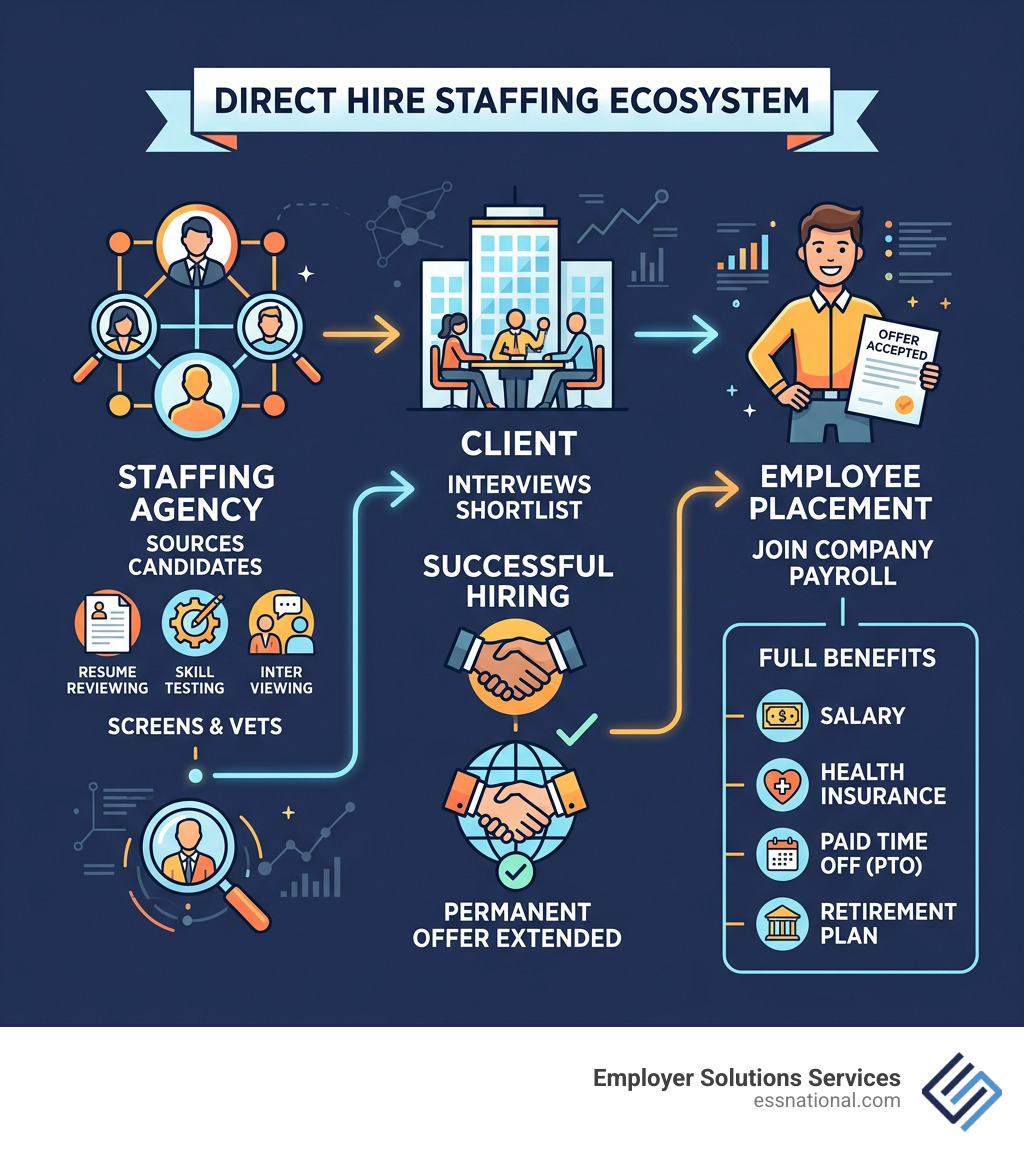
What is direct hire staffing? It is a recruitment model where a staffing agency finds and places candidates directly onto your payroll as permanent, full-time employees — from day one.
Here’s a quick breakdown:
- Who hires them: Your company (not the agency)
- Employment type: Permanent, full-time
- Benefits: Full package — salary, health insurance, PTO, retirement
- When it starts: The employee joins your payroll immediately upon hire
- Who handles recruitment: A staffing agency sources, screens, and presents top candidates
Finding the right person for a critical role is one of the hardest things a growing business does. Post a job, get flooded with unqualified applicants, interview for weeks, make an offer — and still end up with the wrong hire.
That cycle is expensive. A bad hire can cost up to 30% of that employee’s annual salary, and that’s before you factor in lost productivity and the cost of starting over.
Direct hire staffing exists to break that cycle.
Instead of sifting through hundreds of resumes yourself, a staffing agency does the heavy lifting — sourcing, screening, and delivering a shortlist of qualified, vetted candidates ready for a permanent role at your company. According to industry data, 80% of employers say staffing agencies lower the risk of a bad hire, and agencies can reduce time-to-hire by more than 70%.
For mid-sized businesses already stretched thin on HR resources, that’s a significant advantage.
What Is Direct Hire Staffing?
At its core, direct hire staffing—also frequently referred to as direct placement—is a strategic partnership between a business and a staffing firm. In this model, we act as your external talent acquisition arm. We handle the heavy lifting of finding the perfect candidate, but once the “I do’s” are exchanged and the offer letter is signed, that individual becomes your legal employee.
Unlike temporary staffing, where the worker remains on the agency’s books, a direct hire candidate goes straight onto your company’s payroll. This means they are eligible for your internal full-time benefits, from health insurance to 401(k) matching, right from their first day in the office.
To get a better handle on the industry jargon often used during this process, you can explore this Staffing Industry Analysts Glossary. Understanding these terms helps bridge the gap between human resources and executive leadership when discussing long-term staffing needs.
Defining the Direct Hire Staffing Model
The direct hire model is built for longevity. When we talk about what is direct hire staffing, we are talking about permanent roles that require immediate integration into your company culture. This isn’t a “trial run” or a stop-gap measure for a busy season; it is a commitment to organizational fit.
Because the employee knows they are being hired for a long-term career path rather than a temporary assignment, there is an immediate sense of loyalty and career stability. This model is particularly effective for roles that are critical to your daily operations—positions where you need someone to “own” the desk and grow with the company over several years.
How Direct Hire Staffing Differ from Recruiting
You might wonder, “Isn’t this just traditional recruiting?” While they share a common goal, direct hire staffing through an agency offers several layers of expertise that standard internal recruiting often lacks.
First, there is the matter of passive candidate access. Most internal HR departments post a job and wait for applicants. However, research shows that 70% of the global workforce is made up of passive candidates—people who aren’t actively looking for a job but would move for the right opportunity. Our team at ESS spends every day building talent pipelines and networking within specific industries in states like Florida, Texas, and New Jersey to find these “hidden” gems.
Furthermore, we provide extensive employer branding support. We don’t just “sell” a job; we tell your company’s story to high-level talent who might otherwise ignore a standard job board posting. You can learn more about how we tailor these approaches in Our Services section.
Direct Hire vs. Temporary and Contract Staffing
Understanding the differences between staffing models is crucial for budget planning and risk management. Each serves a specific purpose, but they operate very differently regarding payroll and benefits.
| Feature | Direct Hire | Temporary Staffing | Temp-to-Hire |
|---|---|---|---|
| Payroll Provider | The Employer | The Staffing Agency | Agency (Initially) |
| Duration | Permanent / Long-term | Short-term / Project-based | Trial period to Permanent |
| Benefit Eligibility | Immediate (Employer) | Agency-provided | Agency, then Employer |
| Hiring Fee | One-time percentage | Hourly markup | Conversion fee |
According to American Staffing Association Statistics, direct hire recruiting firms across the country log more than 16 million successful hires each year. This volume proves that while temporary staffing is excellent for flexibility, direct hire is the gold standard for workforce stability.
Why Choose Direct Hire Staffing Over Traditional Recruiting?
Traditional internal recruiting can be a massive administrative burden. Between drafting job descriptions, managing an Applicant Tracking System (ATS), and scheduling dozens of initial phone screens, your HR team can easily lose 40 hours a week on a single vacancy.
By choosing direct hire staffing, you offload the “top of the funnel” work. We specialize in executive search and specialized roles that require a high degree of vetting. This allows your internal team to focus on high-level strategy and employee engagement rather than sifting through 500 resumes for a single accounting manager role. To see how our 30+ years of experience can streamline this for you, check out our About Us page.
The Step-by-Step Direct Hire Process
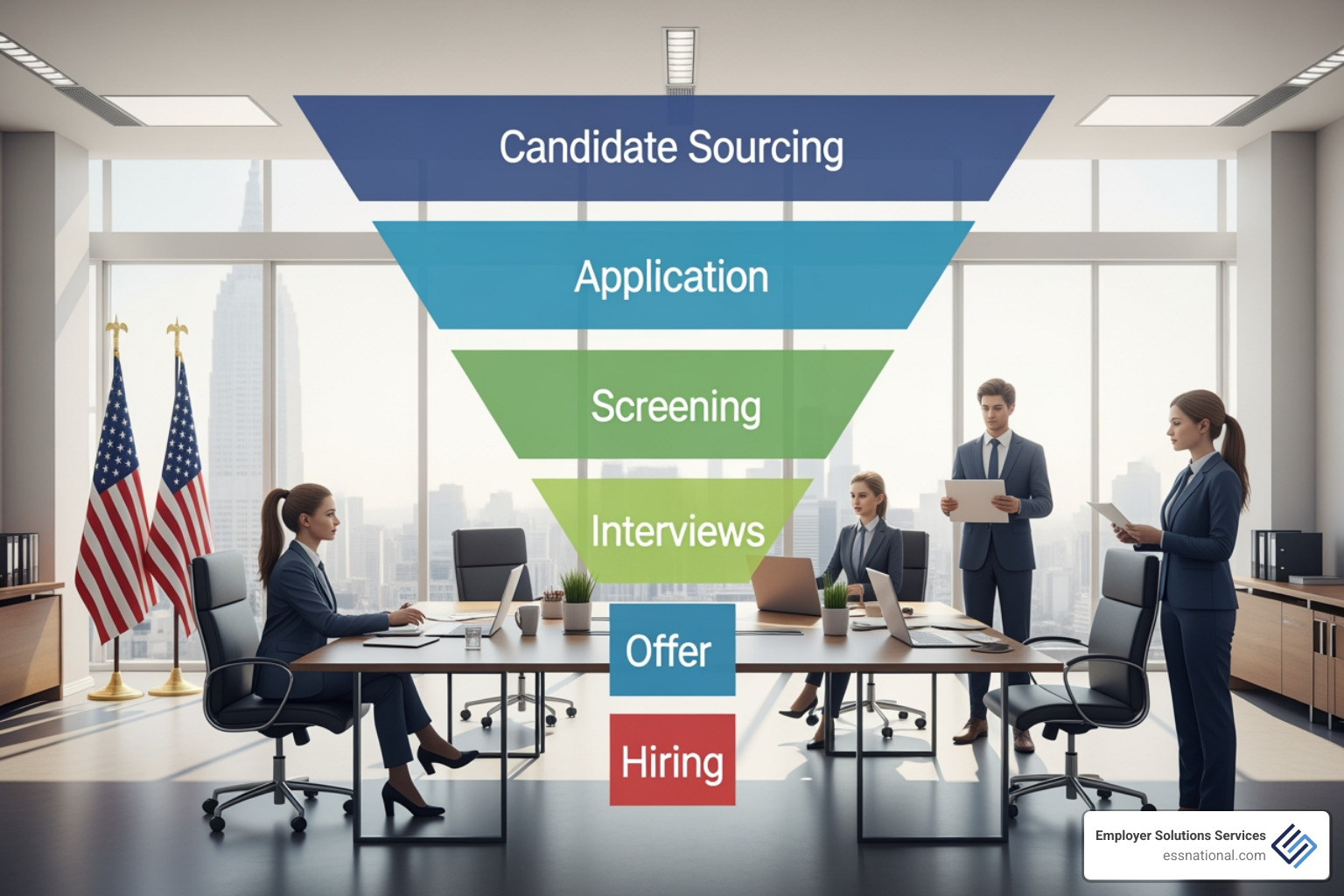
How exactly does a candidate go from a “passive lead” to a “permanent employee”? The process is meticulous and designed to filter out anyone who isn’t a 100% match for your needs.
- Needs Assessment: We start by sitting down with your team to understand the role’s technical requirements and, more importantly, the “soft skills” required to thrive in your office culture.
- Candidate Sourcing: We tap into our proprietary databases, LinkedIn networks, and industry-specific circles to find candidates who fit the profile.
- Multi-level Screening: We don’t just look at resumes. We conduct initial interviews to verify experience and interest levels.
- Skills Evaluation & Personality Testing: Depending on the role, we may utilize specialized testing to ensure the candidate can actually perform the tasks required and that their personality aligns with your existing team.
- Background Checks: We handle the nitty-gritty, including reference checks, criminal history, and employment verification.
- Offer Negotiation: We act as a bridge between you and the candidate, helping to navigate salary expectations and benefit packages to ensure a “yes” on both sides.
- Onboarding: Once the offer is signed, we help facilitate the transition so the employee is ready to hit the ground running on day one.
Key Benefits of Direct Placement for Employers and Seekers
The benefits of direct hire staffing extend to both sides of the hiring equation. For employers, the most immediate “win” is the quality of talent. Statistics show that 72% of companies report higher quality candidates when using a staffing agency compared to internal efforts.
For job seekers, direct hire roles offer the security they crave. They aren’t looking for a “gig”; they are looking for a home. This leads to higher retention rates—when an employee feels invested in from the start, they are much less likely to jump ship for a minor pay increase elsewhere.
- 70% Faster Hiring: Agencies like ESS can cut the time-to-hire significantly by having a pre-vetted pool of talent ready to go.
- Reduced Bad-Hire Risk: With professional vetting, the chances of a candidate failing in the first 90 days drop dramatically.
- Professional Development: Direct hire roles often come with clear paths for advancement, which is a major selling point for top-tier talent.
If you are struggling to find the right people to help your business scale, you can view our current openings or request talent on our Ready to Hire page.
Frequently Asked Questions About Direct Hiring
How do direct hire fees and payment structures work?
Most direct hire agreements operate on a contingent fee basis. This means you don’t pay a dime until the candidate actually starts working. The fee is typically a one-time payment calculated as a percentage of the employee’s first-year annual salary.
In some cases, for high-level executive searches, a retained search model is used. This involves an upfront fee to secure the recruiter’s dedicated time for a highly specialized or confidential search. Both models are designed to be risk-free sourcing—if we don’t find you the right person, you aren’t out of pocket for the recruiting costs.
What industries and roles are best suited for direct hire?
While direct hire can work for almost any role, it is particularly effective in high-skill sectors where talent is scarce. We see a high volume of direct hire success in:
- STEM & IT: Software developers, engineers, and data analysts.
- Healthcare: Specialized nurses, administrators, and lab technicians.
- Manufacturing & Aerospace: Plant managers, quality control experts, and specialized technicians.
- Executive Leadership: CEOs, CFOs, and Department Heads.
What guarantees are involved in direct hire staffing?
One of the biggest fears in hiring is that a new employee will quit after three weeks. To mitigate this, most reputable agencies offer a replacement period or a 90-day guarantee. If the candidate leaves or is terminated for performance issues within that window, the agency will find a replacement at no additional cost. This significantly reduces the financial risk of turnover.
Conclusion
When you look at the current landscape—with over 11 million open roles in the U.S.—it is clear that finding talent is no longer a part-time job. It requires a dedicated, professional approach to ensure your company isn’t just filling seats, but building a legacy.
At Employer Solutions Services, we bring over 30 years of experience to the table. We don’t just send you resumes; we send you the future leaders of your company. From our locations in Florida and Texas to Pennsylvania and Massachusetts, we provide customized HR programs and deeply screened talent to ensure your workforce is stable, productive, and ready for long-term growth.
Ready to stop the endless cycle of “post and pray” hiring? Contact Us today and let’s find the permanent talent your business deserves.