
What Is a Payroll Administrator Salary in 2026?
Payroll administrator salary figures vary widely depending on where you work, how much experience you have, and what skills you bring to the table. Here’s a quick snapshot of where things stand in 2026:
| Role | Average Annual Salary | Notes |
|---|---|---|
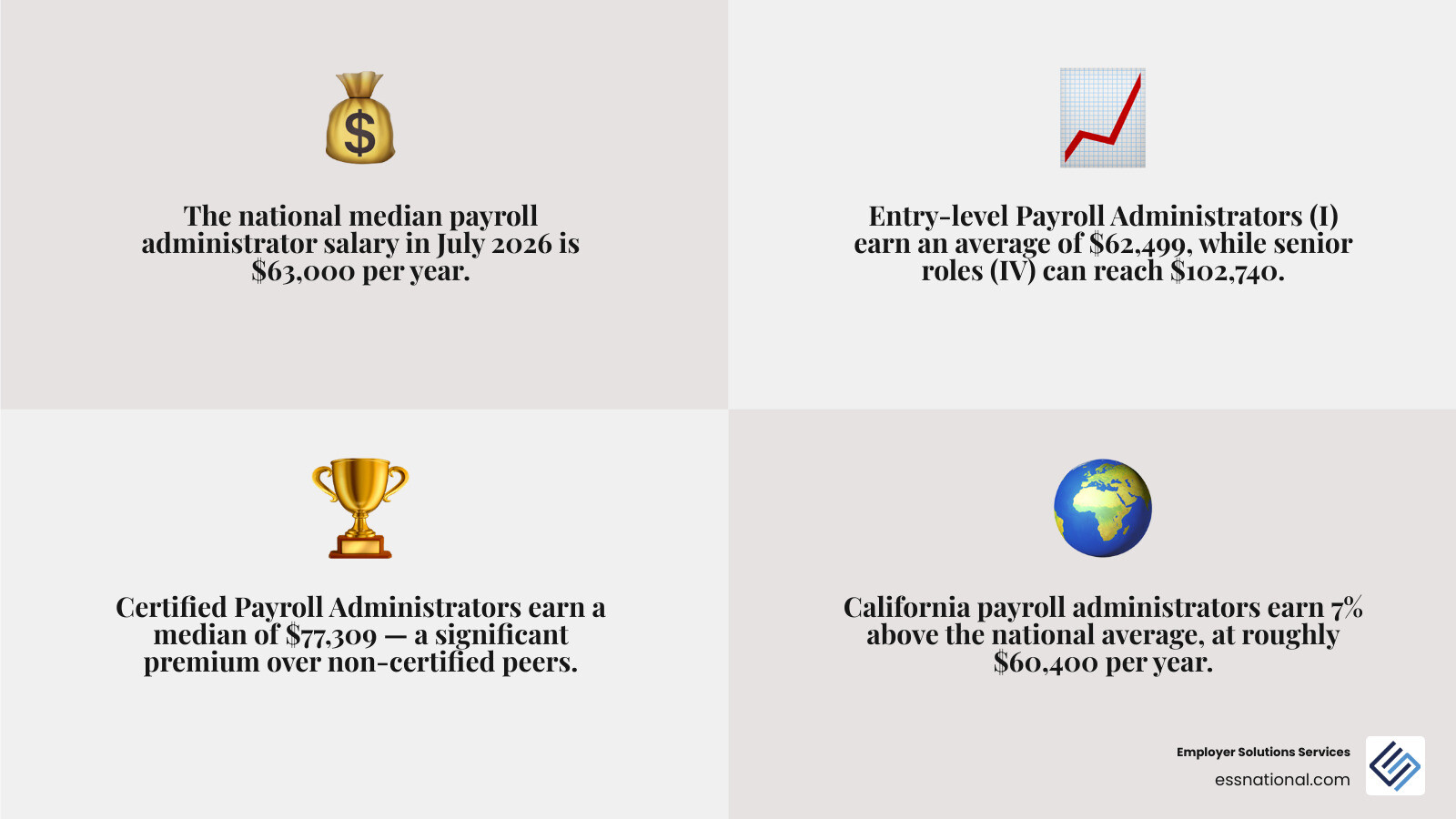
| Payroll Administrator I (entry-level) | $62,499 | 0-2 years experience |
| Payroll Administrator (national median) | ~$63,000 | All experience levels |
| Payroll Administrator IV (senior) | $102,740 | 7+ years experience |
| Certified Payroll Administrator | $77,309 | With professional certification |
| HR/Payroll Administrator | $75,811 | Dual-function role |
| Accounts Payable & Payroll Administrator | $74,523 | Dual-function role |
| California average (hourly) | $29.06/hr (~$60,400/yr) | 7% above national average |
Whether you’re a business owner trying to budget for a new hire or a professional benchmarking your own pay, these numbers give you a solid starting point.
The range is broader than most people expect. Entry-level administrators can start around $50,000, while top earners with certifications and the right software skills can clear $100,000. Location, industry, and credentials all play a major role.
In the sections below, we break down exactly what drives these differences — so you can make smarter decisions, whether you’re hiring or negotiating.
National and Regional Benchmarks: The Average Payroll Administrator Salary
When we look at the national landscape in July 2026, the median total pay for a payroll administrator in the United States sits at $63,000 per year. However, looking at a single national average doesn’t tell the whole story. The typical salary range spans from $51,000 at the 25th percentile to $78,000 at the 75th percentile, with additional compensation like bonuses and profit-sharing frequently adding between $6,000 and $11,000 annually.
To truly understand what dictates a payroll administrator salary, we have to look closely at geographic regions and local costs of living. For instance, if you are managing operations in New Jersey, you will find that local regulations and a higher cost of living drive compensation upward. Knowing how to navigate these regional payroll landscapes is crucial, which is why resources like our guide on How to Master New Jersey Payroll Without Losing Your Mind are so valuable for employers trying to remain compliant while offering competitive wages.
According to market data, the average base salary for a Payroll & Benefits Administrator Salary in 2026 | PayScale is $66,150 per year, but this can climb significantly when factoring in regional adjustments. Let’s look at how specific states stack up:
- Massachusetts: Average of $81,104 for dual accounts payable/payroll roles, and up to $84,135 for certified professionals.
- New Jersey: A strong average of $80,776 for combined roles and $83,795 for certified specialists.
- Pennsylvania: A surprising leader in some databases, with an average salary of $84,938 per year ($40.84 per hour) for dedicated payroll administrators.
- Illinois: Highly competitive at $75,961 for dual roles and $78,801 for certified administrators.
- Nevada: A steady average of $73,756 for combined administration duties.
- Texas: Offering a balanced $72,690 to $75,407 depending on specific certifications.
- Georgia: Averaging $71,878 for multi-functional payroll staff.
- Florida: Averaging $70,514 for blended administrative positions, scaling up to $73,149 for certified specialists.
For comparison, looking at the West Coast, the Payroll And Benefits Administrator Salary in California (July 01, 2026) | Salary.com averages $81,285 per year, showing how high-cost-of-living regions consistently command premium rates.
California vs. The National Average
The average hourly rate for a payroll administrator in California is $29.06, which sits roughly 7% above the national average. While California represents a high benchmark, our East Coast and Southern partners face similar upward pressures.
In high-density markets like New Jersey, businesses must offer premium rates and comprehensive benefits packages to attract experienced talent. This is why many local enterprises leverage specialized New Jersey Payroll Services for Every Small Business to manage these rising overhead costs while ensuring absolute compliance with complex state-specific labor laws.
Highest-Paying Cities for Payroll Administrators in California
Within California, metropolitan areas showcase dramatic salary variances:
- San Jose: Leads the pack with an average salary of $97,509 for certified professionals and $78,830 for entry-level roles.
- San Francisco: Commands an impressive $39.60 per hour, with certified administrators averaging $96,442.
- Irvine: Offers a competitive hourly average of $33.96.
- Los Angeles: Features a strong base average of $31.01 per hour.

These metro-specific numbers highlight a clear trend: cities with a high concentration of technology, biotechnology, and corporate headquarters pay significantly higher wages to offset the local cost of living.
Career Progression and Role Variations
A career in payroll administration is far from static. As professionals gain experience and take on more complex compliance and reporting duties, their earning potential increases significantly.
Below is a detailed breakdown of how different payroll-focused roles compare across experience levels and specialization areas:
| Job Title | Experience Level | Key Responsibilities | Average National Salary |
|---|---|---|---|
| Junior Payroll Administrator | 0–1 Year | Basic data entry, timecard verification, administrative support | $39,386 |
| Payroll Administrator I | 0–2 Years | Regular payroll processing, system reconciliation, basic tax filings | $62,499 |
| Payroll Administrator II | 2–4 Years | Complex payroll runs, multi-state compliance, query resolution | $73,154 |
| Payroll Administrator III | 4–7 Years | System audits, vendor management, payroll accounting integration | $84,636 |
| Payroll Administrator IV | 7+ Years | Departmental leadership, software migrations, strategic planning | $102,740 |
| Lead Payroll Administrator | 8+ Years | Team supervision, enterprise-wide compliance, executive reporting | $103,416 |
To visualize how these roles evolve over time, consider the following progression path:
How Experience Levels Impact Your Payroll Administrator Salary
Moving from a Payroll Administrator I to a Payroll Administrator II yields an average pay jump of roughly 17%, taking the average salary from $62,499 to $73,154. This jump reflects the transition from supervised processing to independent management of complex payroll runs.
By the time an administrator reaches Level IV (typically requiring 7 or more years of experience and deep system knowledge), they cross the six-figure mark, averaging $102,740. According to historical data from the Payroll Administrator Salary (March 2026) | IIMC, payroll wages have risen steadily by about 29% over the last decade, proving that payroll remains an indispensable, recession-proof business function.
Comparing Related Roles: HR, Accounts Payable, and Benefits
Many businesses — especially small to mid-sized firms — do not hire a standalone payroll processor. Instead, they combine payroll with other back-office functions.
- HR/Payroll Administrator: Averaging $75,811 per year, this dual-function role manages onboarding, benefits enrollment, and payroll runs. To learn more about this role’s compensation details, see the HR/Payroll Administrator Salary, Hourly Rate (June 01, 2026) in the United States | Salary.com.
- Accounts Payable and Payroll Administrator: Averaging $74,523 per year, this role bridges the gap between finance and HR, managing vendor invoices alongside employee compensation. For a detailed breakdown of this position, refer to the Accounts Payable And Payroll Administrator Salary, Hourly Rate (June 01, 2026) in the United States | Salary.com.
Combining these roles requires a unique mix of quantitative accounting skills and high-level communication. When companies scale and transition to direct hiring models, managing these blended roles can become overwhelming. Understanding How to Handle Payroll Processing for Direct Hires Like a Pro is essential for keeping these multi-talented team members focused and productive.
Key Drivers of Payroll Compensation
What makes one payroll administrator earn $55,000 while another in the same city makes $95,000? Outside of geographic location, the primary drivers of compensation are industry sector, employer type, software expertise, and professional credentials.

When we look at industry sectors, Telecommunications leads the private sector with a median total pay of $66,821, followed closely by Healthcare at $65,176. However, some of the absolute highest-paying employers are actually in the public sector. Municipal governments, school districts, and transit authorities consistently pay top-tier salaries to manage complex union contracts, civil service pay scales, and pension systems.
For example, public sector and municipal employers in California, such as the City and County of San Francisco ($139,113/yr) and the City of Santa Monica ($130,332/yr), pay massive premiums compared to standard corporate averages.
Boosting Your Earnings: Skills That Increase a Payroll Administrator Salary
If you are an administrator looking to maximize your market value, focusing on specialized software skills is your fastest path to a higher salary:
- ADP Workforce Now: Mastering this platform can increase a Payroll Administrator I’s salary by up to 17%.
- HRIS Systems: Proficiency in enterprise HRIS platforms can yield up to an 8% salary premium.
- Verbal Communication & Analytical Skills: High-level communication and data analysis skills add an average 7% bump.
- Workday & PeopleSoft: These ERP systems command a 4% to 5% premium due to their complexity in enterprise settings.
Staying ahead of the technology curve is vital. Knowing how to leverage The Best Small Business Online Payroll Tools of 2026 can make an administrator significantly more efficient, allowing them to manage larger workforces and negotiate higher compensation.
The Value of Professional Certifications
Obtaining professional credentials is one of the most reliable ways to boost your payroll administrator salary. The industry gold standard is the Certified Payroll Professional (CPP) designation, alongside the Fundamental Payroll Certification (FPC).
According to the Certified Payroll Administrator Salary, Hourly Rate (June 01, 2026) in the United States | Salary.com, certified payroll administrators earn an average of $77,309 per year ($37 per hour), with top earners in the 90th percentile taking home up to $88,140. Certification proves to employers that you understand complex federal tax codes, state reciprocity rules, and labor compliance standards, making you an immediate asset to any team.
Frequently Asked Questions about Payroll Salaries
What is the average starting salary for an entry-level Payroll Administrator?
An entry-level Payroll Administrator I (typically requiring 0 to 2 years of experience and an associate degree or equivalent) earns an average of $62,499 per year nationally. The typical starting range is between $56,268 and $67,331.
Which industries pay the highest salaries for payroll professionals?
The highest-paying sectors include:
- Public Sector & Municipalities: Managing complex civil service payrolls and pensions.
- Telecommunications: Averaging a median of $66,821.
- Healthcare & Biotechnology: Averaging $65,176, with specialized biotech firms paying significant premiums for compliance experts.
How does outsourcing affect the demand for in-house payroll administrators?
Many small to mid-sized businesses are shifting away from dedicated in-house payroll administrators. Instead, they are choosing to outsource these functions to professional staffing and back-office agencies.
This shift allows businesses to avoid the rising overhead of in-house salaries while gaining access to seasoned compliance experts. If you are weighing these options for your own business, reading The Definitive Guide to Comparing Payroll Outsourcing Options can help you determine the most cost-effective path forward.
Conclusion
Navigating payroll administrator salary trends in 2026 requires balancing regional cost-of-living adjustments, software expertise, and certification premiums. For employers, maintaining a competitive, compliant in-house payroll department is becoming increasingly expensive and complex.
At Employer Solutions Services, we bring over 30 years of experience to the table. We provide customized staffing programs and comprehensive back-office administration, including expert payroll services, across our target locations in Florida, Georgia, Illinois, Massachusetts, Nevada, New Jersey, Pennsylvania, and Texas.
Whether you need to hire screened and trained payroll talent or want to offload your back-office administration entirely so you can focus on growing your business, we are here to help. Explore our customized payroll and staffing solutions today on our Employer Solutions Services page, and let us take the drama out of your business operations.