
Why Contract and Temporary Employment Is More Complex Than You Think
Contract and temporary employment covers a wide range of flexible work arrangements — and mixing them up can cost your business significantly in back taxes, fines, and legal headaches.
Here’s the core difference at a glance:
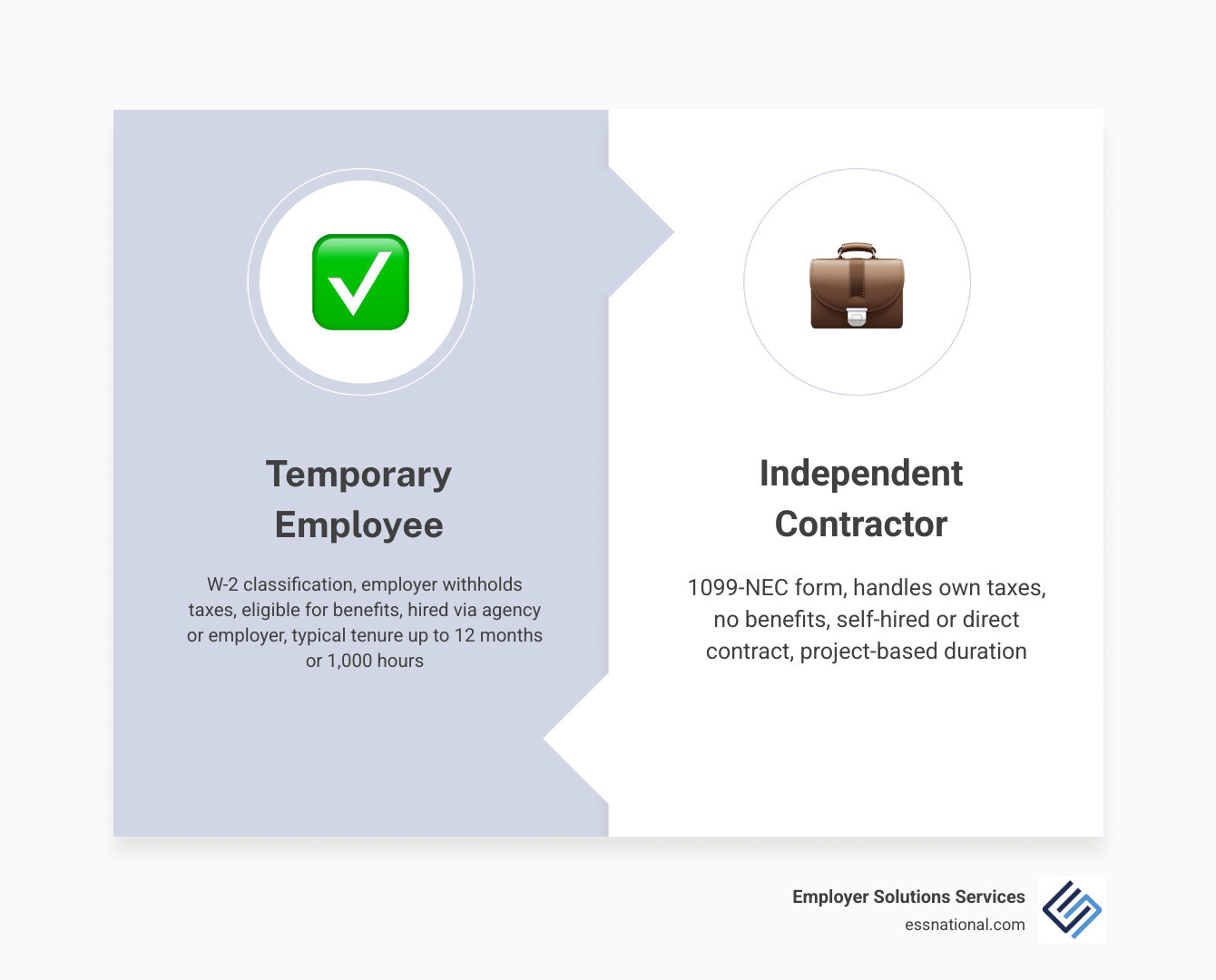
| Temporary Employee | Independent Contractor | |
|---|---|---|
| Tax form | W-2 | 1099-NEC |
| Who controls the work? | Employer | Worker |
| Who pays payroll taxes? | Employer withholds | Worker handles own |
| Benefits eligible? | Sometimes | No |
| Typical duration | Up to 12 months / 1,000 hours | Project-based |
| Hired through | Employer or staffing agency | Self or direct contract |
One in eight companies rely on temporary help, according to the Associated Press — and that number has been climbing steadily. Yet many businesses still blur the line between a temp and a contractor, which can trigger IRS audits, Department of Labor wage claims, and state-level penalties.
This guide cuts through the confusion. Whether you’re dealing with seasonal spikes, covering a leave of absence, or bringing in a specialist for a one-off project, understanding which type of flexible worker you actually need — and how to hire them correctly — is essential.
Easy contract and temporary employment glossary:
Defining the Landscape of Contract and Temporary Employment
To navigate this landscape successfully, we must start with the basics. As we look at the modern workforce in July 2026, flexible staffing is no longer a last-resort backup plan. It is a core business strategy. Understanding why temporary staffing across industries is the new normal helps explain why so many companies are shifting away from rigid, permanent-only hiring models.
When we talk about flexible staffing, we are generally looking at two distinct pathways: bringing on a temporary W-2 employee or partnering with a 1099 independent contractor. The path you choose changes your tax obligations, your legal liability, and how much control you have over the worker’s day-to-day routine.
What is a Temporary Employee?
A temporary employee is a W-2 worker hired for a limited time. They are on your payroll (or a staffing agency’s payroll), meaning you withhold FICA, FUTA, and state unemployment taxes. They receive hourly wages and work under your direct supervision, following your schedule and using your company’s tools.
Historically, temporary roles were reserved for basic administrative support or manual labor. But looking back at three decades of temping: a guide to industry longevity, we can see how the industry has evolved. Today, temporary employees fill highly skilled roles in healthcare, IT, education, and professional services.
Under the Employee Retirement Income Security Act (ERISA), temporary employees may become eligible for your company’s retirement plans if they work at least 1,000 hours per year. Generally, we design temporary assignments to last under 1,000 hours or one year to keep them clearly distinguished from permanent roles.
What is an Independent Contractor?
An independent contractor (often called a freelancer or a 1099 contractor) is not your employee. They operate as an independent business entity. When you hire an independent contractor, you file a Form 1099-NEC at the end of the year if you pay them $600 or more.
The IRS evaluates three common-law categories to determine if a worker is truly independent:
- Behavioral Control: Does your business control how the worker does their job? If you dictate their daily hours, provide step-by-step instructions, and closely supervise their tasks, they are likely an employee.
- Financial Control: How is the worker paid? Do they have unreimbursed business expenses? Have they invested in their own tools and software? Independent contractors typically realize a profit or loss and market their services to other clients.
- Relationship Type: Do you provide benefits like paid time off or insurance? Is the work a core, ongoing aspect of your business?
Independent contractors are perfect for specialized, non-core tasks—like hiring an outside firm to rebuild your website or bringing in a specialist to handle a complex corporate audit.
Legal Frameworks and Global Compliance Standards
Managing a flexible workforce requires strict adherence to labor laws. While domestic regulations govern our daily operations in states like Florida, Georgia, Illinois, Massachusetts, Nevada, New Jersey, Pennsylvania, and Texas, looking at global standards helps us understand where employment law is heading.
The concept of “co-employment”—where both a staffing agency and a client company share legal responsibility for a worker—is a major compliance focus. If a worker is injured on-site or files a discrimination claim, both entities can be held liable.
International Protections for Contract and Temporary Employment
In the global labor market, temporary and contract workers often receive extensive structural protections. For example, the European Union’s Directive 2008/104/EC on temporary agency work establishes the principle of “equal treatment.” This means temporary agency workers must receive the same basic working and employment conditions (such as pay, working hours, and rest periods) as if they had been recruited directly by the user company to occupy the same job.
Furthermore, international legal precedents, such as the Daimler Mercedes-Benz Werk Berlin ruling, underscore the strict boundaries of what constitutes “temporary” work. Under highly regulated frameworks like the German Act on Temporary Agency Work (AÜG), a temporary assignment is capped at 18 consecutive months. If an agency operates without a proper permit, or if an assignment exceeds these limits, a permanent employment relationship is legally deemed to materialize directly between the hiring client and the worker.
While US states do not have an 18-month statutory cap quite like Germany’s AÜG, these global frameworks show how seriously courts take the protection of temporary labor. In the US, joint-employment doctrines under the Fair Labor Standards Act (FLSA) mirror these concerns, holding client businesses accountable for wage and hour violations alongside their staffing partners.
The Wage Gap and Labor Market Dualism
Academic research highlights a phenomenon known as “labor market dualism,” which divides the workforce into “insiders” (highly protected permanent employees) and “outsiders” (temporary and contract workers). According to a comprehensive multilevel study, Labour Market Dualism and the Heterogeneous Wage Gap for Temporary Employment, partial deregulation—where permanent workers retain strong job protections while temporary contracts are deregulated—frequently widens the wage gap between temporary and permanent staff.
The study reveals that the temporary wage gap is often wider for prime-age workers (ages 36 to 55) than for younger workers (ages 25 to 35). For younger workers, temporary roles often act as “screening devices” or stepping stones to permanent roles, keeping the wage-to-productivity gap smaller. For prime-age workers, however, temporary roles are sometimes used as a “buffer stock” to protect permanent staff from economic fluctuations.
To maintain high productivity and a healthy workplace culture, we recommend using temporary staffing strategically. Rather than using temporary contracts to permanently lower labor costs, use them as structured screening tools with clear pathways to permanent roles.
The Risks and Penalties of Worker Misclassification
Misclassifying an employee as an independent contractor is one of the most expensive mistakes an employer can make. The IRS, the Department of Labor (DOL), and state agencies in Florida, Georgia, Illinois, Massachusetts, Nevada, New Jersey, Pennsylvania, and Texas regularly audit businesses to ensure workers are classified correctly.
Financial and Legal Consequences of Misclassification
If the IRS determines you misclassified a worker, the financial penalties can accumulate rapidly. Under IRS Tax Code Section 3509, standard misclassification penalties include:
- 1.5% of the worker’s wages for failing to withhold federal income taxes.
- 20% of the employee’s FICA contribution that should have been withheld.
- 100% of the employer’s matching FICA and FUTA taxes.
If you failed to file required Form 1099-NEC information returns for the worker, those penalties double to 3% of wages and 40% of FICA.
Beyond federal tax penalties, the DOL can demand back pay for unpaid overtime and minimum wage violations. State-level agencies can also levy heavy fines for unpaid workers’ compensation premiums and unemployment insurance.
Additionally, under ERISA rules, if a court reclassifies a group of 1099 contractors as W-2 employees, those workers may retroactively become eligible for your company’s retirement and health benefits, creating massive liability.
How to Determine Proper Classification
When in doubt, we recommend utilizing a systematic evaluation process. If you are unsure how to classify a worker, you can file IRS Form SS-8 to request an official determination from the government. However, because this process can take several months, you should apply the “economic reality test” internally.
Ask yourself these four questions:
- Is the work core to your business? If you run a software development company and hire a developer to write code, that worker is performing a core business task and should almost always be a W-2 employee. If you hire an electrician to fix your office wiring, that is a non-core task.
- Who controls the schedule and methods? If you set their hours, require them to attend internal team meetings, and manage their daily workflow, they are an employee.
- Who provides the equipment? If you supply the computer, software licenses, and office space, they are likely an employee. Contractors generally provide their own tools.
- How long is the relationship? Is it a continuous, open-ended engagement, or is it tied to the completion of a specific, defined project?
Strategic Hiring: When to Choose Temps vs. Contractors
Knowing when to hire a temporary employee versus an independent contractor is key to optimizing your budget and protecting your business. Let’s break down the ideal scenarios for each:
Hire a Temporary W-2 Employee When:
- You need to cover seasonal spikes in demand (e.g., retail holidays, manufacturing peaks, or summer tourism).
- A permanent employee is out on parental leave, medical leave, or a sabbatical.
- The role involves core daily operations that require your direct supervision and training.
- You want to evaluate a worker’s skills on the job before committing to a permanent hire. Learning how to master temporary employment staffing for your business will help you seamlessly integrate these workers into your teams.
Hire an Independent Contractor When:
- You need highly specialized expertise for a short-term, non-core project (e.g., a graphic designer for a rebrand, or a specialized consultant to upgrade your database).
- The worker operates as an independent business, works off-site, sets their own hours, and uses their own tools.
- You do not have the internal capacity or desire to manage, train, or supervise the worker’s day-to-day activities.
Best Practices for Drafting a Temporary Employment Contract
When hiring temporary staff directly, drafting a comprehensive, legally binding agreement protects both parties. A strong temporary employment contract should include:
- Clear Term of Employment: Specify a clear start and end date, or outline a maximum duration (typically under one year) to keep the role legally distinct.
- Detailed Job Description: Define explicit, measurable outcomes rather than vague, open-ended duties.
- Confidentiality and Non-Solicitation Clauses: Protect your proprietary data, customer lists, and intellectual property.
- Work for Hire Clause: Ensure that any intellectual property, software code, or creative work produced by the temporary worker belongs entirely to your company.
- Agency Provision: Explicitly state that the temporary worker cannot sign agreements or bind your organization to external contracts without written consent.
- Notice Period and Termination Clauses: Outline how either party can end the agreement early.
Managing and Onboarding Flexible Talent
Onboarding temporary and contract workers effectively requires a balanced approach. While you want them to become productive quickly, you must manage them according to their legal classification.
For temporary W-2 employees, focus heavily on safety training, clear operational guidelines, and cultural integration. Under OSHA regulations, temporary workers have the exact same rights to a safe, hazard-free workplace as your permanent staff.
For independent contractors, focus on project deliverables rather than daily processes. Avoid onboarding them through your standard employee channels. Instead, integrate your applicant tracking system (ATS) with your accounts payable software to manage their invoices as business expenses rather than payroll entries. Implementing 5 smart strategies for temporary staffing services can help you keep these workflows clean, efficient, and legally compliant.
Navigating Staffing Agencies and Temp-to-Hire Models
Managing the administrative burden of W-2 payroll, tax withholding, workers’ compensation, and background checks for temporary staff can overwhelm your HR department. This is why many businesses partner with professional staffing agencies.
Using a staffing agency significantly reduces your co-employment and misclassification risks because the agency acts as the primary Employer of Record (EOR). The agency handles:
- Recruiting, screening, and background checks.
- Onboarding and safety training.
- Payroll processing, tax withholdings, and year-end tax reporting.
- Unemployment insurance claims and workers’ compensation coverage.
This model is especially valuable when exploring “temp-to-hire” positions. If you are curious about how this works, we break down the operational realities in the truth about temp-to-hire positions.
Maximizing Value in Contract and Temporary Employment Partnerships
To get the most out of a staffing partnership, work with an agency that provides pre-screened, trained talent tailored to your specific industry.
By navigating the world of professional temp-to-hire specialists, you can find partners who take the time to understand your company’s unique culture and performance standards. This ensures that the temporary workers placed in your facility are ready to contribute from day one.
If you are looking to scale your workforce quickly without taking on permanent overhead, understanding why your business needs temp-to-hire staffing services now can give you a major competitive advantage.
Transitioning from Temporary to Permanent Roles
The temp-to-hire model acts as an extended working audition. It allows you to evaluate a candidate’s work ethic, technical skills, and cultural fit in real-time before making a long-term financial commitment.
When you are ready to transition a temporary worker to a permanent role, partnering with temp-to-perm employment agencies makes the process seamless. They will handle the contractual transitions and payroll adjustments.
If you are new to this strategy, reading a beginners guide to temp-to-hire jobs will help you structure your trial periods effectively, ensuring high retention rates and smoother transitions.
Frequently Asked Questions about Flexible Staffing
How long can a temporary assignment last before it is no longer considered temporary?
While there is no strict federal statutory limit, standard business and legal practice in the United States dictates that a temporary assignment should last under 12 months or 1,000 hours. If a worker’s assignment exceeds one year without a clear, objective project-based justification, regulatory bodies may view the relationship as permanent, exposing your business to co-employment liabilities and benefit claims.
What are the main benefits and drawbacks of using temporary staffing agencies?
Benefits:
- Administrative Relief: The agency handles recruitment, payroll, taxes, and workers’ comp.
- Flexibility: You can scale your workforce up or down rapidly to meet changing market demands.
- Risk Mitigation: The agency absorbs primary employer liabilities, reducing your misclassification risks.
- Using local temporary services provides access to a pre-screened, local talent pool that can be deployed quickly.
Drawbacks:
- Markup Fees: Agencies charge a percentage markup on top of the worker’s hourly wage to cover administrative costs and insurance.
- Co-Employment Risks: If you do not manage the relationship carefully (e.g., if you directly discipline or terminate an agency worker without involving the agency), you can still face joint-employer liability.
What steps should employers take to ensure compliance with tax and employment laws?
To protect your business, we recommend taking these three proactive steps:
- Conduct Regular Audits: Review your list of 1099 contractors annually. If any contractor has worked for you continuously for over a year, performs core business tasks, or works under your direct schedule, consult with legal counsel about transitioning them to W-2 status.
- Partner with a Licensed Staffing Provider: Ensure your staffing partner is fully licensed, holds robust workers’ compensation and liability insurance, and has a proven compliance record in your operating states.
- Establish Clear Contracts: Never rely on verbal agreements. Ensure every flexible worker—whether hired directly or through an agency—is backed by a signed, legally reviewed agreement that clearly outlines their classification and scope of work.
Conclusion
Navigating the complexities of contract and temporary employment doesn’t have to be overwhelming. By understanding the legal boundaries of W-2 temporary employees and 1099 independent contractors, you can build a highly agile, compliant, and productive workforce.
At Employer Solutions Services (ESS), we bring over 30 years of industry experience to your business. We design customized staffing and back-office administration programs—including temporary, temp-to-hire, direct-hire, and payroll services—specifically tailored to your needs. Our deeply screened, trained talent pools are ready to support your business across our key locations in Florida, Georgia, Illinois, Massachusetts, Nevada, New Jersey, Pennsylvania, and Texas.
Ready to scale your business safely and efficiently? Read The Definitive Guide to Temp-to-Hire Staffing Agencies or contact us today to build your custom workforce solution.