
How 30 Years of Temping Experience Shapes Better Workforce Solutions
30 years of temp staffing experience is not just a milestone — it is a signal that an agency has survived recessions, technology shifts, and labor market upheavals that forced less-prepared firms to close or consolidate.
What does 30 years of temp staffing experience mean for your business?
- Deeper talent pools — decades of candidate relationships built across industries and skill levels
- Proven screening methods — refined over thousands of placements, not just a few hundred
- Compliance expertise — hard-won knowledge of evolving labor laws, payroll rules, and worker classification standards
- Economic cycle resilience — experience managing workforce needs through multiple recessions and recovery periods
- Stronger employer partnerships — long-term clients trust agencies that have consistently delivered results over decades, not just quarters
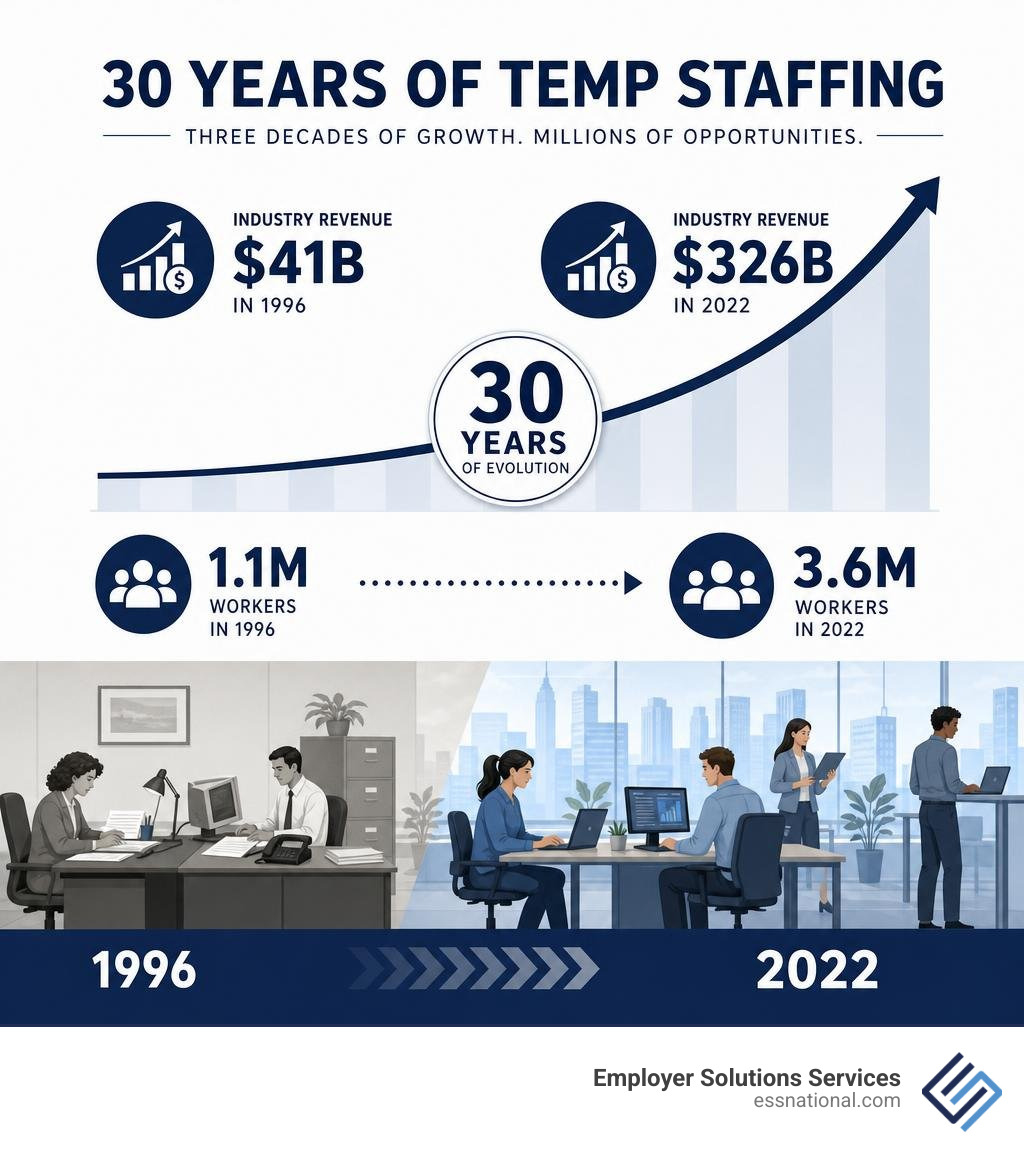
The U.S. temporary staffing industry has grown dramatically since its early days. By 1996, more than 90 percent of U.S. businesses used temporary help in some capacity, generating $41 billion in annual industry revenue. Fast forward to 2022, and verified federal data places temporary help services revenue at $326 billion, with more than 3.6 million workers moving through the sector at any given time.
That growth did not happen by accident. It happened because businesses discovered that temp staffing solves real, recurring problems — workforce flexibility, hiring risk, administrative burden, and cost control.
But not every agency that was around 30 years ago is still here today. Some of the biggest names of the 1990s collapsed under fraud scandals, failed acquisitions, or an inability to adapt. The agencies that survived did so by building genuine expertise, not just scale.
This guide explains what three decades in the staffing industry actually means in practice — and why it matters when you are choosing a workforce partner for your business today.
Know your 30 years temp staffing terms:
Why 30 Years of Temp Staffing Experience Matters in Today’s Market

In a mature market, experience is the ultimate differentiator. When you evaluate experienced staffing providers, you are not just looking for an agency that can post a job ad. You are looking for a partner with deep-rooted systems, a refined matching process, and the ability to offer personalized, consultative service.
Over the past three decades, the staffing landscape has split. On one side, we see massive, private-equity-backed national firms that rely on rigid, automated systems. On the other side, we have digital-only gig platforms that reduce human labor to a transaction. A boutique staffing firm with a 30-year legacy bridges this gap. We combine high-tech efficiency with a highly personalized, “white-glove” approach.
An agency that has stood the test of time understands that a successful placement requires more than checking boxes on a resume. It requires a deep understanding of your company culture, operating realities, and local market dynamics. This level of insight only comes from decades of local partnerships and continuous refinement. To understand how these long-term principles guide the future of work, explore What 30 Years in Human Resources Can Teach You About the Future.
From Stopgaps to Strategic Partners: How Temping Has Changed
Historically, temporary staffing was treated as an emergency stopgap. If a receptionist went on vacation or an administrative assistant called in sick, businesses hired a “temp” for a few days.
Today, contingent labor is used as a strategic workforce tool. Modern executives use temporary staffing to convert fixed labor costs into variable expenses, allowing them to scale operations up or down in response to real-time demand. This shift has turned temporary staffing into a vital driver of business flexibility across all major sectors. For a deeper look at this transformation, see Why Temporary Staffing Across Industries is the New Normal.
Historical Shifts: Comparing the 1990s to the 2020s
To truly appreciate how far the industry has come, we must look at the structural differences between the staffing market of the 1990s and today.
In the 1990s, the market was dominated by generalist commercial staffing firms. The focus was heavily on clerical, administrative, and basic light industrial roles. The rise of the “permanent temp” economy during this era was often criticized by labor advocates as a way for corporations to avoid paying benefits, as discussed in The Rise of the Permanent Temp Economy – The New York Times.
Today, the market is highly segmented, professionalized, and integrated. Modern temp agencies provide comprehensive benefits packages, including healthcare and retirement plans, to attract and retain top-tier talent.
| Feature | 1990s Staffing | 2026 Staffing |
|---|---|---|
| Primary Focus | Reactive, short-term vacancy coverage | Proactive, strategic workforce planning |
| Dominant Sectors | Clerical, administrative, basic manual labor | Highly specialized (IT, Healthcare, Advanced Logistics) |
| Technology | Paper timesheets, fax machines, local databases | AI-driven matching, automated timekeeping, VMS/MSP |
| Talent Pool | Walk-in applicants, local newspaper classifieds | Multi-channel digital sourcing, passive candidate networks |
| Worker Benefits | Rarely offered; transient workforce focus | Portable benefits, 401(k) plans, continuous training |
The Role of Specialized Agencies in Modern Staffing
The generalist model of the past has largely given way to vertical specialization. Today’s businesses require specialized temporary professionals who can step into complex environments with minimal onboarding.
According to Staffing Industry Trends 2026: Data & Outlook | VantaInsights, the fastest-growing segments of the staffing industry are specialized niches, including:
- Healthcare: Credentialed nurses, allied health professionals, and medical administrative staff.
- IT and Technical: Systems administrators, software developers, and technical writers.
- Advanced Light Industrial: Certified machine operators, quality assurance inspectors, and logistics coordinators who understand complex OSHA safety protocols.
By focusing on these specialized talent pools, modern agencies ensure that businesses receive candidates who possess both the technical proficiency and the cultural adaptability required for immediate productivity.
Navigating Economic Cycles and Managing Business Risk
Temporary staffing has long been recognized as a leading economic indicator. Because contingent workers are the first to be hired during an economic expansion and the first to be released during a downturn, tracking temporary employment trends helps economists forecast broader labor market shifts.
For businesses, this cyclical nature makes temp staffing an invaluable buffer. During times of economic volatility, companies often face “uncertainty paralysis.” They want to capitalize on new opportunities but fear the long-term commitment of fixed payroll costs. Utilizing temporary staffing allows businesses to scale up safely without the risk of future layoffs. To learn how to implement these methods effectively, read 5 Smart Strategies for Temporary Staffing Services.
Mitigating Hiring Risks with 30 Years of Temp Staffing Expertise
Every new hire represents a financial and administrative risk. If a permanent employee does not work out, the business must absorb the costs of recruitment, onboarding, termination, and potential unemployment claims.
An experienced staffing agency mitigates these risks by acting as the Employer of Record (EOR). We handle the entire administrative burden, including:
- Recruiting, screening, and background checks
- Payroll processing and tax withholding
- Workers’ compensation insurance and claims management
- ACA compliance and benefits administration
By transferring these responsibilities to an experienced partner, you can focus on core operations while we handle the back-office complexity. For a step-by-step guide on mastering this approach, see How to Master Temporary Employment Staffing for Your Business.
The Rise of Temp-to-Hire and Contract-to-Perm Models
One of the most significant trends in modern workforce planning is the growth of temp-to-hire placements. According to industry data, temp-to-hire placements have outpaced traditional direct-hire placements as businesses seek to “try before they buy.”
Hiring is a high-stakes decision. Research shows that a bad hire can cost a business anywhere from 30% to 50% of the employee’s annual salary—and up to five times that amount when accounting for lost productivity, disrupted team dynamics, and recruitment costs. A temp-to-hire arrangement allows both the employer and the worker to evaluate the fit during a 90-day to six-month trial period before making a permanent commitment.
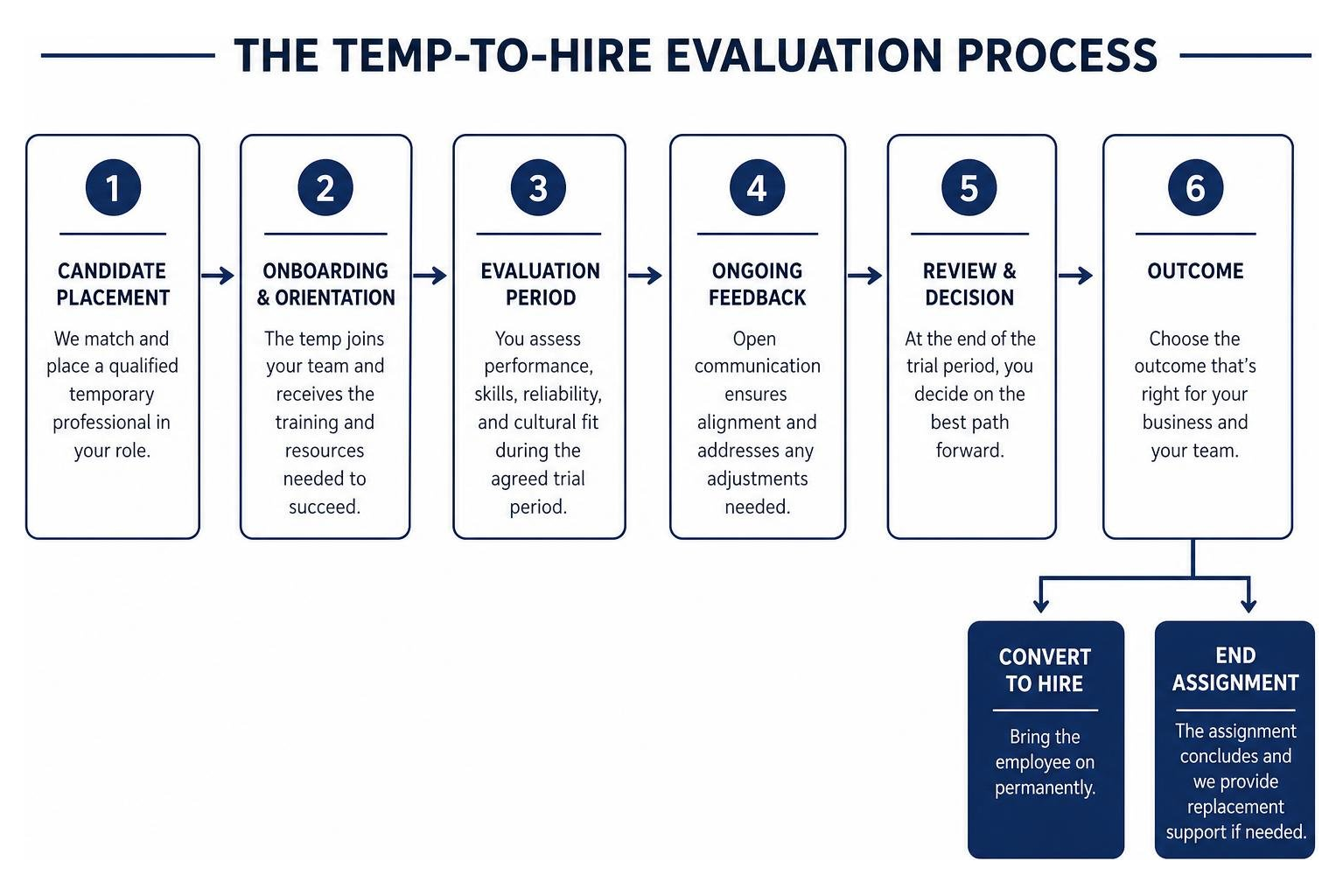
This model eliminates the guesswork of traditional interviewing. Employers can observe the candidate’s actual job performance, reliability, and cultural fit in real-time, while workers can ensure the role aligns with their career goals. To explore how to navigate these placements, consult The Definitive Guide to Temp-to-Hire Staffing Agencies.
Technology and Talent: The Modern Staffing Playbook

The integration of advanced technology has completely transformed how staffing agencies source, screen, and place talent. Over the last 30 years, we have graduated from physical filing cabinets and local spreadsheets to cloud-based Applicant Tracking Systems (ATS), AI-driven candidate matching, and automated skills testing. To see how these tools can streamline your hiring, check out Local Temporary Services and Why They Are Your Secret Hiring Weapon.
Balancing AI-Driven Matching with Human Connection
While AI and automated sourcing tools are incredibly efficient at filtering high volumes of resumes, they cannot replace the human element of recruiting. A purely algorithmic approach often misses the nuance of cultural fit, soft skills, and candidate motivation.
Experienced agencies use technology to handle the repetitive, administrative tasks—such as initial resume parsing, automated scheduling, and basic skills testing—so our recruiters can spend more time building relationships with candidates. This balance ensures a higher-quality match and a better overall experience for the worker. For an honest look at how this balance impacts your career or hiring strategy, see The Truth About Temp-to-Hire Positions.
Recruiting and Retaining Quality Talent in Competitive Hubs
In competitive, low-unemployment markets across our footprint—including metro areas like Dallas, Houston, Atlanta, Chicago, Boston, Newark, Las Vegas, and Philadelphia—finding and retaining quality talent is a constant challenge.
To secure top-tier workers, we employ localized recruitment strategies tailored to the unique economic drivers of each region:
- Texas (Dallas, Houston): Aligning light industrial and administrative staffing with the state’s booming corporate relocation and logistics sectors.
- Illinois (Greater Chicago): Supporting the region’s massive manufacturing and distribution corridors through hands-on, safety-first recruiting.
- Pennsylvania (Philadelphia): Sourcing skilled talent for competitive healthcare, logistics, and professional services sectors.
- Florida (South Florida, Orlando): Navigating seasonal tourism cycles, professional services, and high-tech corridors with flexible staffing models.
- Georgia (Atlanta): Meeting the demands of a major logistics, entertainment, and corporate hub through diverse, rapid-response staffing solutions.
- Massachusetts: Connecting highly skilled technical, administrative, and light industrial talent with the Commonwealth’s innovation-driven economy.
- New Jersey: Staffing the state’s dense pharmaceutical, logistics, and manufacturing sectors using deep regional talent pools.
Compliance, Regulation, and Administrative Complexity
The regulatory landscape surrounding employment has grown increasingly complex over the past 30 years. Today, businesses must navigate a maze of state and federal regulations, including joint-employer liability standards, worker classification rules, the Affordable Care Act (ACA), and complex local wage and hour laws.
Partnering with an agency that possesses decades of compliance expertise is the easiest way to shield your business from costly legal and financial penalties. To learn how we protect our clients, read The Veterans Guide to Staffing Solutions with 30 Years of Expertise.
Overcoming Legal and Payroll Hurdles with 30 Years of Temp Staffing Insights
An experienced staffing agency understands the nuances of co-employment risk and worker classification. By maintaining clear boundaries as the primary employer, managing all workers’ compensation insurance, and handling complex back-office payroll administration, we protect our clients from regulatory scrutiny.
This compliance infrastructure is especially critical for public sector contracts and highly regulated industries. For example, state agency contracts, such as those governed by Temporary Employment Services , require strict adherence to pre-negotiated terms, rigorous background checks, and flawless payroll reporting. Our 30+ years of experience ensures we meet these demanding standards without exception.
Frequently Asked Questions about Temporary Staffing
How does temporary staffing help businesses manage economic uncertainty?
Temporary staffing converts labor from a fixed overhead cost into a variable expense. During periods of economic volatility, businesses can scale their contingent workforce up to meet sudden surges in demand or scale down when production slows, all without the administrative friction, severance costs, or morale damage associated with permanent layoffs. To understand how to leverage these strategies, explore Navigating the World of Professional Temp-to-Hire Specialists.
What is the difference between temporary and temp-to-hire staffing?
Standard temporary staffing is designed to fill short-term business needs, such as seasonal surges, special projects, or medical leave coverage, with no expectation of permanent employment. Temp-to-hire staffing, however, places a candidate in a temporary role with the explicit intention of evaluating their performance, skills, and cultural fit for a permanent position after a trial period. For candidate insights on navigating these opportunities, see The Ultimate Guide to Landing Part-Time Jobs Through Temp Agencies.
Why should a business partner with an agency that has decades of experience?
An agency with decades of experience brings deep local talent pools, refined candidate screening methodologies, and comprehensive compliance expertise to the table. We have weathered multiple economic cycles, meaning we can provide strategic workforce consultation that goes far beyond simply filling open orders.
Conclusion
The staffing industry has evolved dramatically over the past three decades, transitioning from a simple transactional service into a sophisticated, strategic business partnership.
At Employer Solutions Services (ESS), we leverage our 30+ years of industry experience to deliver customized, flexible staffing and back-office administrative solutions across Florida, Georgia, Illinois, Massachusetts, Nevada, New Jersey, Pennsylvania, and Texas. Whether you need temporary support, a seamless temp-to-hire program, direct-hire placements, or expert payroll and back-office administration, we have the infrastructure and the expertise to support your goals.
Ready to optimize your workforce strategy with a trusted partner?
Discover how our customized programs can help your business grow by visiting our services page: Employer Solutions Services.