
Why Getting Payroll Right for Direct Hires Can Make or Break Your Business
Payroll processing for direct hires is one of the most critical — and most underestimated — back-office functions a business manages. When a new permanent employee joins your team, the clock starts immediately. They expect to be paid accurately and on time, every time.
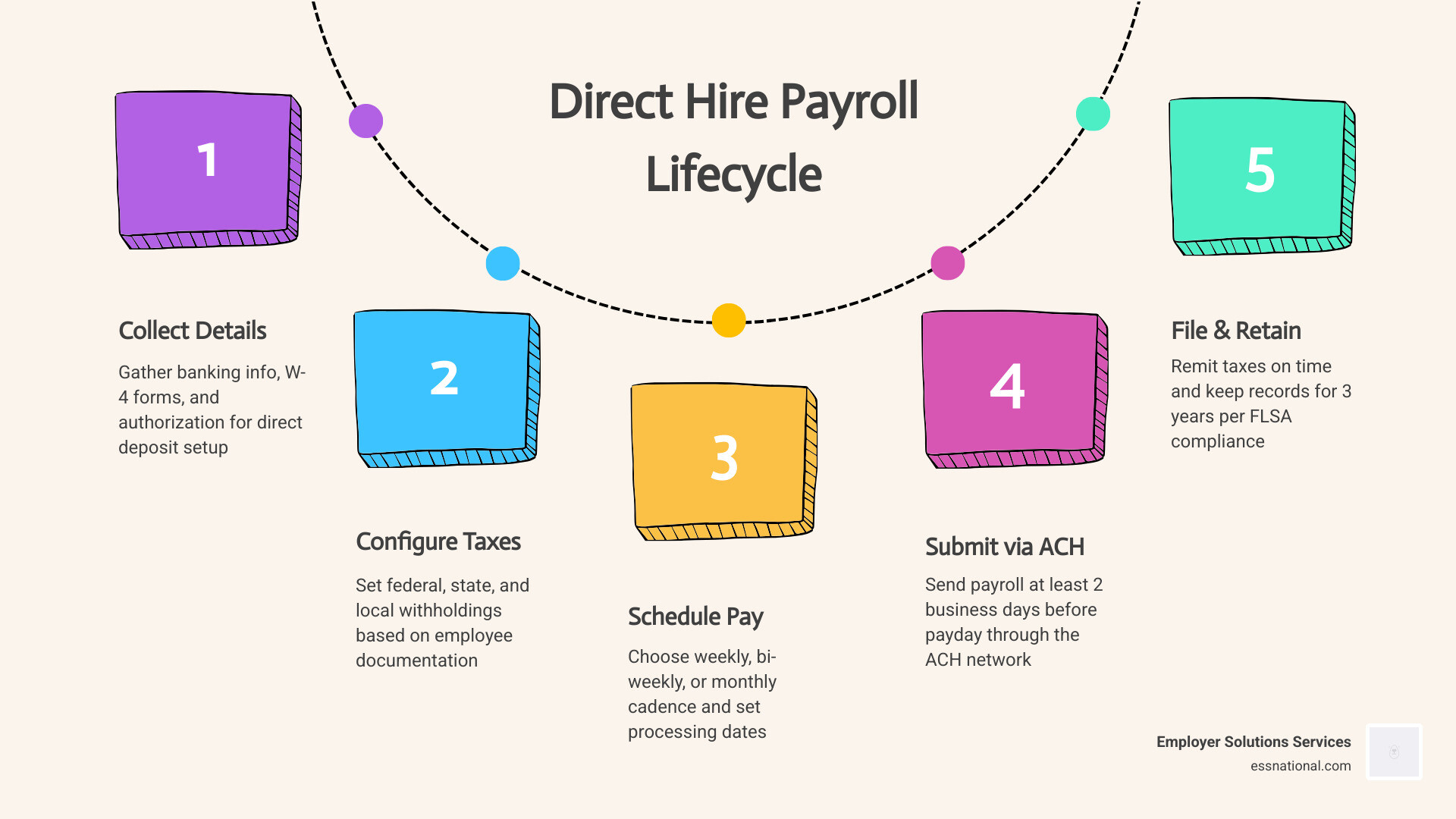
Here’s a quick overview of what’s involved:
- Set up direct deposit – Collect employee banking details and authorization forms
- Configure tax withholdings – Federal, state, and local, based on the employee’s W-4
- Choose a pay schedule – Weekly, bi-weekly, semi-monthly, or monthly
- Process payroll – Submit at least 2 business days before payday via the ACH network
- File payroll taxes – Withhold and remit on time to avoid IRS penalties
- Retain records – Keep payroll records for at least 3 years under FLSA rules
Getting any of these steps wrong has real consequences. A single missed tax deposit on a $40,000 payroll run can trigger a penalty of $6,000 or more. And nearly half of employees start looking for a new job after just two payroll mistakes.
The good news? With the right system — whether in-house software or an outsourced provider — payroll for direct hires can run smoothly and cost-effectively. This guide walks you through everything you need to know.
Payroll processing direct hires vocab to learn:
- direct placement healthcare workers
- direct placement staffing services
- payroll for temporary employees
Understanding the Basics of Payroll Processing for Direct Hires
When we talk about payroll processing direct hires, we are referring to the end-to-end management of compensation for employees who are placed directly onto your company’s books. Unlike temporary staff, these individuals are your legal responsibility from day one.

The backbone of modern payroll is the Automated Clearing House (ACH) network. This is the electronic system used to move money from your business bank account to your employee’s personal account. It’s fast, secure, and—as we’ll see later—significantly cheaper than printing paper checks.
To understand what is direct hire staffing and why it beats the rest, you have to look at the long-term commitment. Because these employees are permanent, your payroll system needs to be robust enough to handle their long-term benefits, tax escalations, and potential multi-state compliance if you operate in places like New Jersey, Texas, or Illinois.
Managing cash flow is another vital piece of the puzzle. Direct deposit allows you to control the exact timing of when funds leave your account. Instead of wondering when an employee will finally cash a paper check, you know exactly when the debit will occur, usually by 9:00 a.m. on payday. This predictability is a lifesaver for small to mid-sized businesses trying to balance the books each month.
A Step-by-Step Guide to Setting Up Direct Deposit
Setting up direct deposit is the “gold standard” for paying direct hires. It’s what 93% of organizations now prefer because it reduces errors and keeps the team happy. But you can’t just flip a switch; there is a process to follow.
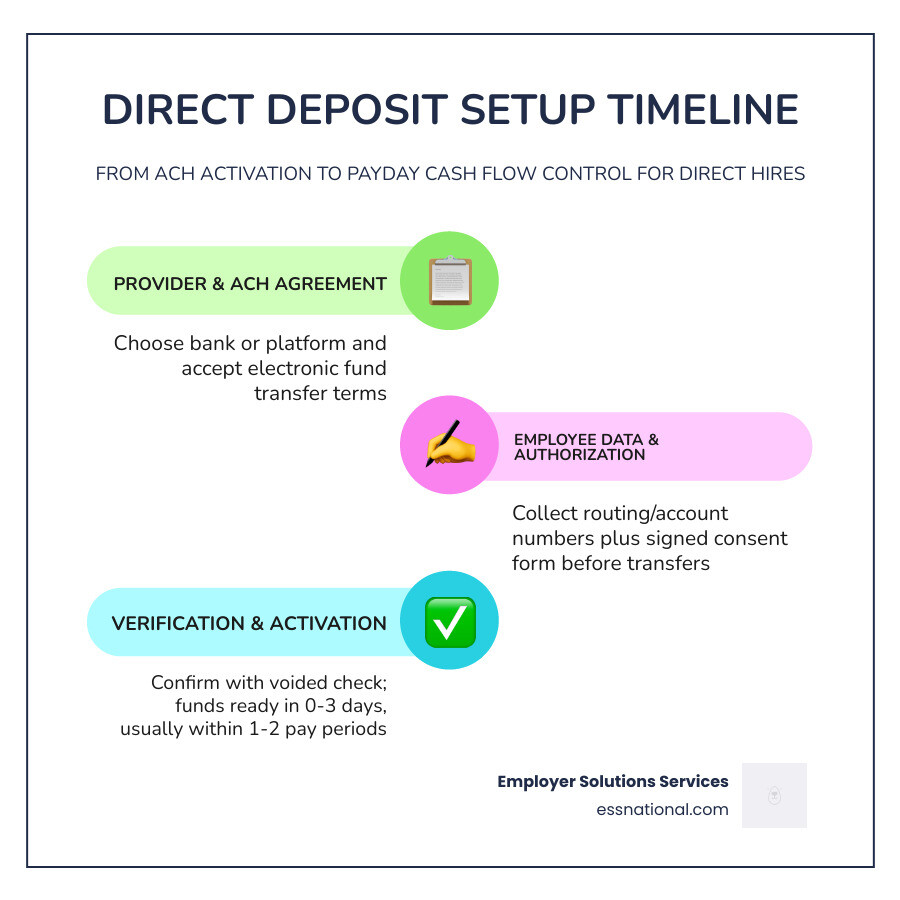
- Select Your Provider: You can use a bank, a software platform, or a full-service provider like us at ESS.
- Accept ACH Terms: You’ll need to sign an agreement with your financial institution to allow electronic fund transfers.
- Gather Employee Data: This is where accuracy is everything. You need the employee’s bank name, account number, and routing number.
- Get Authorization: Never skip this. You must have a signed consent form from the employee before you start electronic transfers. According to the Form Of Payment FAQ – Illinois Department of Labor, state laws often dictate how and when you can mandate certain payment methods, so check your local rules in states like MA or NV.
- Verify with a Voided Check: While deposit slips are okay, a voided check is the most reliable way to verify account and routing numbers to prevent fraud.
Learning how to master the seamless direct hire process involves making these steps part of your standard onboarding checklist. When a new hire signs their offer letter, the direct deposit form should be the very next document they see.
Timeline and Costs for Payroll Processing Direct Hires
Let’s talk numbers, because the savings with direct deposit are massive.
- ACH Transaction Fees: The median cost for initiating an ACH payment is just $0.26.
- Paper Check Costs: Between the check stock, ink, envelopes, and postage, a single paper check costs between $1.01 and $2.30.
- Setup Duration: It typically takes one to two pay periods to fully activate a new direct deposit account.
- Processing Window: Once the system is live, payments usually take 0 to 3 business days to hit the employee’s account. Most businesses aim for a 2-day lead time to ensure funds are available by Friday morning.
Required Information for Employee Enrollment
To keep your payroll processing direct hires secure and compliant, you must collect and store a specific set of data. This isn’t just for the bank; it’s for the IRS and state tax agencies in places like Pennsylvania and Florida.
- Full Legal Name and Address: Must match their tax filings.
- Social Security Number (SSN): Essential for W-2 reporting.
- Financial Institution Details: Bank name, 9-digit routing number, and account number.
- Account Type: You must specify if it’s a checking or savings account.
- Authorization Form: A signed document (digital or physical) giving you permission to deposit and, in the case of an error, reverse a deposit.
Compliance, Taxes, and Avoiding Common Errors
Compliance is the “scary” part of payroll, but it doesn’t have to be. The most important thing to remember is that the IRS and state departments of labor don’t accept “I didn’t know” as an excuse.

For example, IRS Section 3504 outlines specific requirements for payroll tax processing that managers must follow. Furthermore, the Fair Labor Standards Act (FLSA) requires you to retain payroll records for at least three years. If you are operating in the Keystone State, following the no-drama guide to payroll administration Pennsylvania can help you stay on top of local earned income taxes (EIT) which can be notoriously tricky.
Common errors often stem from “NACHA” files—the standard format used for electronic transactions. If a single digit is off in a routing number, the file will fail. If you do make a mistake, NACHA rules give you a narrow 5-day window to reverse an erroneous deposit. After that, you’re likely stuck trying to manually recover the funds from the employee.
Best Practices for Managing Payroll Processing Direct Hires
To run like a pro, you need to think ahead. Multi-state regulations are the biggest hurdle for growing companies. If you hire a remote worker in New Jersey while your office is in Texas, you suddenly have to deal with NJ’s unique disability and family leave insurance withholdings.
We recommend checking out how to master New Jersey payroll without losing your mind for specific tips on handling the Garden State’s requirements.
Pro-level Best Practices:
- Automate Everything: Use software that automatically calculates and files taxes. 96% of organizations using professional payroll services report better compliance.
- Parallel Runs: When switching systems, run your old and new systems side-by-side for one cycle to ensure the numbers match.
- Verify Accuracy: 93% of organizations find that professional processing reduces errors significantly. Considering that the average payroll error costs $291 to correct, accuracy pays for itself.
In-House vs. Outsourced: Choosing the Right Model
This is the age-old question: Should you do it yourself or hire the experts? The answer usually depends on your “bus factor”—what happens to your business if your one payroll person gets hit by a bus (or just goes on vacation)?
| Feature | In-House Payroll | Outsourced Payroll (ESS) |
|---|---|---|
| Annual Cost (40 Employees) | ~$81,000 (Salary + Software) | ~$10,000 – $18,000 |
| Expertise | Limited to one person’s knowledge | Team of multi-state experts |
| Liability | Employer holds all risk | Provider often shares tax accuracy liability |
| Scalability | Hard to scale quickly | Scales instantly with your growth |
| Time Commitment | 6+ hours per month | Minutes for approval |
A dedicated payroll specialist with five-plus years of experience typically commands a salary between $68,000 and $82,000 depending on the metro area. When you add benefits and taxes, that’s a heavy lift for a small business.
According to research from In-House vs Outsourced Payroll: How to Decide – KORE1, many companies choose to outsource because it allows their HR team to focus on strategy rather than data entry. If you’re a local business owner, understanding why payroll outsourcing NJ is a smart move for small biz can help you see the value in reclaiming your time.
Frequently Asked Questions about Direct Hire Payroll
How long does it take to set up direct deposit for a new hire?
While the paperwork takes minutes, the banking system usually needs 7 to 14 days to “pre-note” or verify the account. Most employers find that a new hire receives their first check as a paper check, with direct deposit kicking in by the second pay cycle.
What are the most common errors in direct deposit setup?
The most frequent blunders are transposed digits in account numbers and confusing “routing numbers” with “wire transfer numbers.” Always use a voided check to verify these details. Another common error is failing to update the system when an employee changes banks, leading to “returned” wages that can take days to recover.
Is it cheaper to use direct deposit than paper checks?
Absolutely. When you factor in the time spent printing, signing, and distributing checks—plus the cost of the materials—direct deposit is roughly 80% cheaper than paper checks. Plus, you save on the “hidden” cost of employees leaving work to visit the bank during business hours.
Conclusion
Managing payroll processing direct hires doesn’t have to be a source of stress. By setting up a clear direct deposit workflow, staying on top of state-specific tax rules in places like GA, MA, and FL, and choosing a scalable model, you can ensure your team stays focused on their work—not their paychecks.
At Employer Solutions Services (ESS), we’ve spent over 30 years perfecting the art of back-office administration. We provide customized staffing and payroll programs that take the burden off your shoulders, using screened and trained talent to keep your business moving forward across the country.
Ready to simplify your life? More info about our services is just a click away. Let us handle the compliance and the spreadsheets while you handle the growth.