
What Are Direct Hire Recruiting Services (and Why They Matter)?
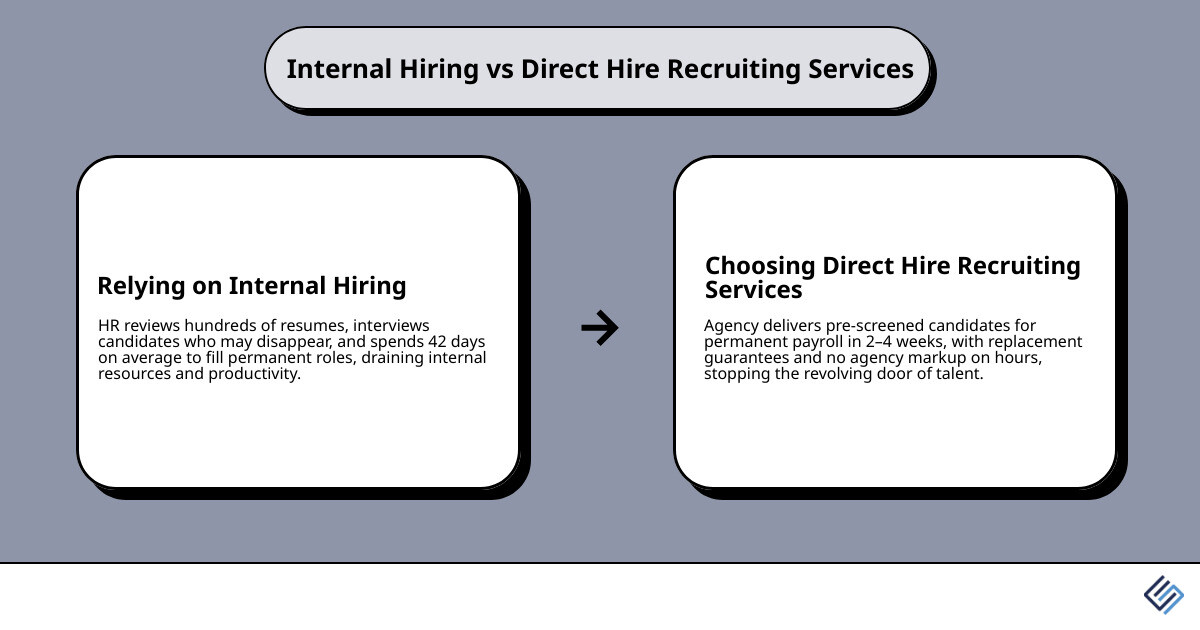
Direct hire recruiting services connect employers with pre-screened candidates who join your payroll immediately as permanent, full-time employees — no trial period, no temp conversion, no agency markup on hours worked.
Quick answer for employers:
- What it is: A staffing agency finds, screens, and places a candidate directly onto your payroll as a permanent hire from day one
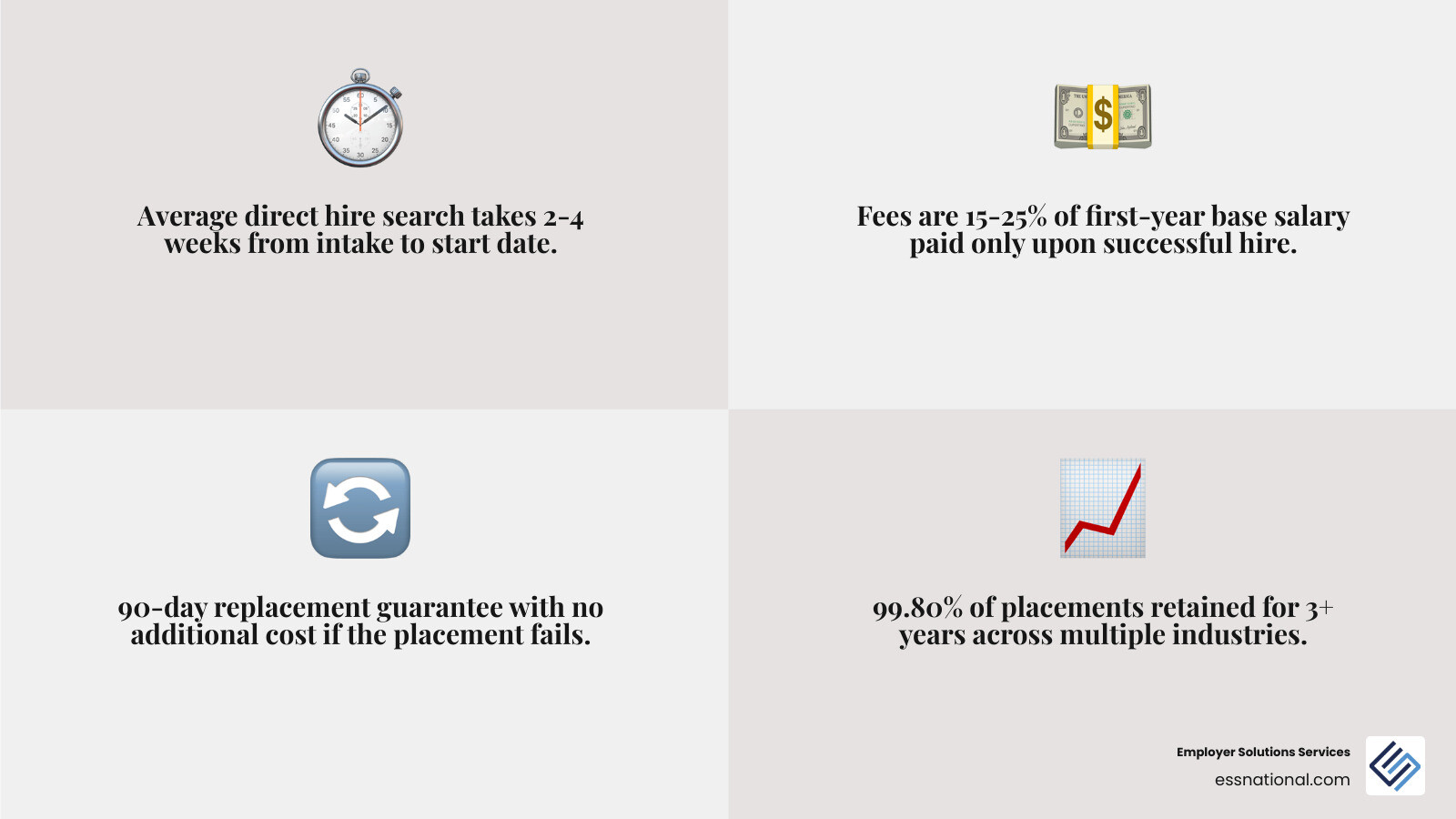
- Who pays: The employer pays a one-time fee (typically 15–25% of first-year salary) only after a successful placement
- How fast: Most placements take 2–4 weeks, compared to a 42-day average when hiring on your own
- What if it fails: Most agencies offer a replacement guarantee — usually 90 days — at no extra cost
- Who it’s for: Employers filling permanent, specialized, or hard-to-fill roles where long-term fit matters
Think of it this way. Temporary staffing is like dating — flexible, low commitment, easy to walk away from. Direct hire is the marriage. You’re choosing someone for the long haul, and you want to get it right the first time.
For mid-sized businesses already stretched thin, running a full internal search for a permanent role is expensive, slow, and distracting. Your HR team reviews hundreds of resumes. You interview candidates who look great on paper but disappear after two months. The role sits open. Productivity drops. The cycle repeats.
That revolving door is exactly what direct hire recruiting is designed to stop.
Terms related to direct hire recruiting services:
- direct staffing agency
- how much do staffing agencies charge for direct hire
- what is direct hire staffing
Understanding Direct Hire vs. Temporary and Contract Staffing

When you enter external recruitment, the terminology can feel like alphabet soup. To find the right talent for your specific needs, it’s vital to understand the difference between the various “relationship statuses” available in the staffing world.
Direct Hire: The Permanent Commitment
In a direct hire arrangement, the candidate becomes your employee from day one. They are on your permanent payroll, receive your company benefits, and are treated as a long-term member of your culture. There is no middleman managing their hours or paycheck after the initial placement. This is the gold standard for stopping the revolving door with direct placement staffing because it signals to the candidate that you are invested in their future.
Temp-to-Hire: The “Trial Run”
Temp-to-hire (or contract-to-hire) is the “extended dating” phase. The candidate works for you but remains on the staffing agency’s payroll for a set period—usually 3 to 6 months. After that period, you have the option to “convert” them to a permanent employee. While this reduces risk, it can sometimes deter the highest-tier passive talent who are already employed and won’t leave a secure job for a “maybe.” You can learn more about the truth about temp to hire positions to see if this model fits your current risk tolerance.
Temporary and Contract Staffing: The Short-Term Fix
Temporary staffing is for project-based work, seasonal peaks, or covering leaves of absence. These workers are employees of the agency, and you pay a markup on their hourly rate. It’s highly flexible but rarely results in the long-term institutional knowledge that a permanent hire brings.
| Feature | Direct Hire | Temp-to-Hire | Contract/Temporary |
|---|---|---|---|
| Payroll | Employer’s Payroll | Agency’s Payroll (initially) | Agency’s Payroll |
| Benefits | Employer-provided | Agency-provided (initially) | Agency-provided |
| Commitment | Permanent/Long-term | Trial period (3-6 months) | Short-term/Project-based |
| Fee Structure | One-time percentage fee | Hourly markup + conversion | Hourly markup |
| Best For | Key roles & growth | Testing “fit” | Seasonal/Gap filling |
Why Employers Choose Direct Hire Recruiting Services Over Internal Hiring
You might be thinking, “We have an HR department; why can’t we just do this ourselves?” While internal teams are great for managing culture and employee relations, they often lack the “scout” mentality required for high-stakes permanent hiring. Here is what is direct hire staffing and why it beats the rest when compared to the DIY approach.
1. Access to Passive Talent
The best candidates for your open role are likely not looking at job boards. They are currently employed, successful, and “passive.” These individuals won’t apply to a public listing because they don’t want to risk their current position. However, they will take a call from a trusted recruiter they’ve known for years. We act as talent scouts, maintaining a “hidden” talent pool that internal HR teams simply can’t access through LinkedIn or Indeed alone.
2. Eliminating the Resource Drain
The average internal hire takes 42 days (and often much longer for specialized roles). During that time, your hiring manager is sifting through hundreds of unqualified resumes, conducting “first-look” interviews that lead nowhere, and losing focus on their actual job. By using direct hire recruiting services, you outsource the “grunt work.” You only see the top 3–5 candidates who are already vetted, interested, and qualified.
3. Specialized Industry Expertise
Recruiting for a Staff Accountant in New Jersey requires a different network than hiring a Warehouse Manager in Texas. At Employer Solutions Services, our 30+ years of experience allows us to understand the nuances of local markets and specific industry requirements. We know the “market price” for talent in your area, ensuring you don’t lose a great candidate because of an uncompetitive offer.
The Step-by-Step Process and Timelines for Permanent Placement

A common misconception is that using an agency takes longer. In reality, the process is built for speed and precision. While industry averages for internal hiring hover around 45 days, our direct hire searches often result in a placement within 21 to 28 days.
Here is how we move from “Help Wanted” to “Welcome Aboard”:
- Intake & Strategy: We don’t just read your job description; we learn your culture. We define a “Candidate Success Profile” that goes beyond technical skills to include personality and long-term goals.
- Market Mapping & Sourcing: We tap into our proprietary database of over 1.2 million candidates and reach out to passive talent.
- Vetting & Analysis: We perform the heavy lifting—screening, interviewing, and verifying.
- Presentation: You receive a “shortlist” of candidates who meet or exceed all requirements.
- Interviews & Closing: We coordinate the interviews, gather feedback, and—most importantly—help negotiate the offer to ensure a “Yes.”
If you are looking for a more flexible start, you might consider navigating the world of professional temp to hire specialists to bridge the gap while we search for your permanent unicorn.
Screening and Vetting in Direct Hire Recruiting Services
The secret sauce of a 90%+ retention rate lies in the vetting. We don’t just check if a candidate can do the job; we check if they should do the job at your company.
- Technical Screening: Does the candidate actually possess the certifications and skills they claim?
- Behavioral Interviews: We use structured interview techniques to see how they’ve handled past challenges.
- Cultural Fit: Will they thrive in your specific office environment?
- Reference & Background Verification: We do the boring but essential work of verifying employment history and performing background checks.
Statistics show that 98.70% of candidates placed in permanent roles by specialized recruiters meet or exceed all job requirements. That level of accuracy is hard to replicate with a standard HR screening process.
Common Roles and Industries for Professional Placement
Direct hire recruiting services are most effective for roles that require a specific “pedigree” or specialized skillset. While we can help across the board, we see the highest success in these verticals:
- Accounting and Finance: From Accounts Payable clerks to Controllers and CFOs.
- Information Technology (IT): Cybersecurity architects, DevOps engineers, and full-stack developers.
- Executive Search: C-suite leaders who will shape the future of your organization.
- Administrative & Professional: Office managers, HR directors, and marketing specialists.
- Specialized Technical: Engineering and skilled trades in manufacturing hubs.
For companies in specific regions, such as those looking for direct hire Cherry Hill strategies for long-term success, local market knowledge is the difference between a hire that lasts three months and one that lasts three years.
Typical Costs and Fee Structures for Direct Hire Recruiting Services
“How much is this going to cost me?” is the first question every business owner asks. It’s a fair one.
Most direct hire recruiting services operate on a contingency basis. This means you don’t pay a dime unless we find you a candidate that you actually hire.
- The Fee: Typically, the fee is a one-time payment calculated as a percentage (usually 15% to 25%) of the candidate’s first-year base salary.
- The Value: While it sounds like a significant upfront cost, compare it to the “cost of a bad hire.” The U.S. Department of Labor estimates that a bad hire can cost a company 30% of that employee’s first-year earnings in lost productivity, training costs, and re-recruiting expenses.
- The Guarantee: To protect your investment, we offer a replacement guarantee. If the employee leaves or is terminated for performance reasons within a set period (usually 90 days), we will find a replacement at no additional cost to you.
For a deeper dive into the math, check out our guide on direct hire costs: what you’ll actually pay for top talent
Frequently Asked Questions about Direct Hire Recruiting
How long does a typical direct hire search take?
In May 2026, the market remains competitive. However, because we maintain an active pipeline, most of our direct hire placements take 2 to 4 weeks from the initial intake call to the start date. This is significantly faster than the 42-day industry average for DIY hiring. Factors that influence this timeline include the scarcity of the skillset and how quickly your internal team can schedule final interviews.
Who pays the fees for direct hire services?
The employer pays the fee. There is never a cost to the job seeker for being placed. This ensures we are attracting the best possible talent who are looking for career advancement, not just a job. The fee is a one-time investment in your company’s human capital.
What happens if a direct hire placement doesn’t work out?
We stand by our work. Most direct hire agreements include a replacement guarantee (often 90 days). If the placement doesn’t stick due to performance issues or the candidate leaving, we jump back into the search to find a replacement at no extra charge. Our 99.80% retention rate for 3+ years means we rarely have to use this, but it’s there for your peace of mind.
Conclusion
Hiring shouldn’t feel like a gamble. When you move away from the “dating” mindset of temporary staffing and commit to the “marriage” of direct hire, you build a foundation for long-term growth.
At Employer Solutions Services, we bring over 30 years of experience to the table, serving businesses across Florida, Georgia, Illinois, Massachusetts, Nevada, New Jersey, Pennsylvania, and Texas. We don’t just send you resumes; we send you your next key team member. Whether you are looking for the best direct hire staffing agency near me and beyond or you’re ready to start building your permanent team today, we have the customized HR programs and screened talent you need to succeed.
Ready to stop dating and start marrying your top talent? Let’s get to work.