Why Manufacturing Recruitment Agencies Are Worth Getting Right
Manufacturing recruitment agencies exist for one reason: to get the right person on the plant floor before a vacancy becomes a crisis.
If you’re a mid-sized manufacturer dealing with open roles right now, here’s a quick breakdown of what these agencies do and who they’re best for:
| Agency Type | Best For | Typical Placement Speed |
|---|---|---|
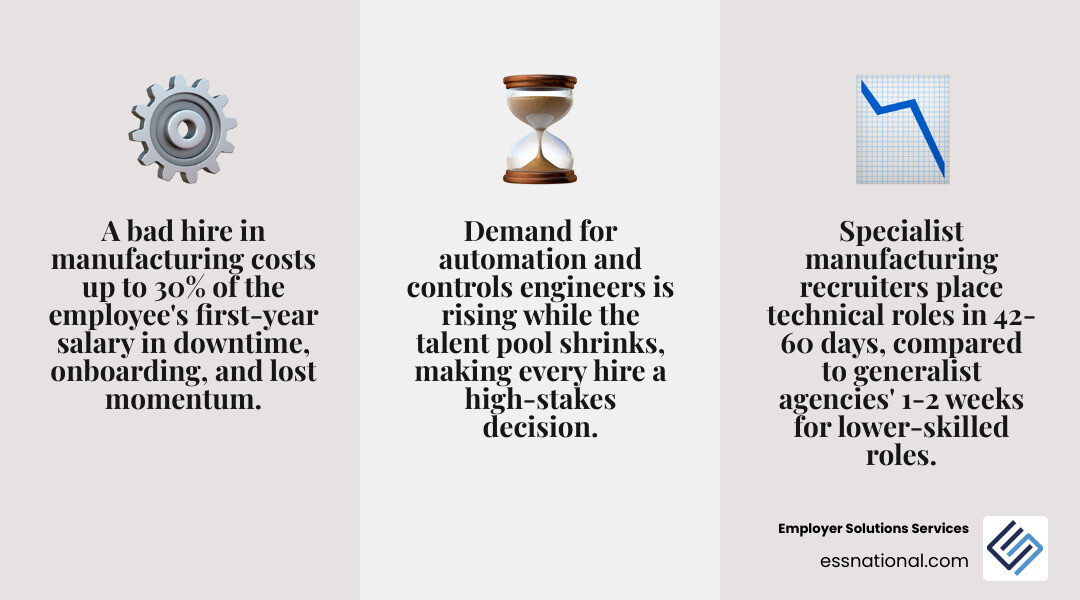
| Specialist manufacturing recruiter | Technical, regulated, or senior roles | 42-60 days average |
| Generalist staffing agency | High-volume, lower-skilled positions | 1-2 weeks |
| Executive search firm | Plant leadership and director-level roles | 60-90+ days |
Industrial hiring has never been harder. The talent pool for automation, controls engineering, and advanced manufacturing is shrinking while demand keeps climbing. At the same time, a wrong hire in a production environment doesn’t just cost money in onboarding and severance — it costs momentum. A delayed line restart or a stalled digital transformation program can ripple through an entire quarter’s output.
That’s the pressure most hiring managers are sitting with right now.
This guide compares the top approaches to manufacturing recruitment so you can move fast and get it right.
Simple manufacturing recruitment agencies word guide:
What Distinguishes Specialist Manufacturing Recruitment Agencies from Generalists?
When you begin your search for a recruitment partner, it is easy to assume that any agency with a database can fill your open roles. However, there is a vast, high-stakes gulf between a generalist agency and a specialist manufacturing recruiter.
A generalist agency typically focuses on high-volume, cross-industry placements. They are built for speed in lower-skilled or administrative roles. While they have their place, they often struggle when faced with the highly technical, safety-critical demands of a modern production facility. They might understand what a “mechanic” is, but they likely do not know the difference between a mechanical assembler and a precision CNC programmer.
Specialist manufacturing recruitment agencies, on the other hand, live and breathe plant-floor operations. They understand the nuances of manufacturing environments, from the flow of a Tier 1 automotive supplier to the sterile requirements of a pharmaceutical cleanroom. They speak the language of Lean Manufacturing, Six Sigma, and Overall Equipment Effectiveness (OEE).
To help you make the right choice, we have put together a guide on How To Pick The Best Light Industrial Temp Agencies For Your Warehouse to dive deeper into selecting the right agency tier.
For highly technical and engineering roles, partnering with a specialized recruitment partner ensures that your candidates are evaluated on actual plant-floor capability, local professional credentials (like PE licensure in the US), and specific automated environments rather than just superficial resume keywords.
| Evaluation Metric | Specialist Manufacturing Agencies | Generalist Staffing Agencies |
|---|---|---|
| Technical Screening | Conducted by recruiters who understand PLCs, SCADA, and MES architectures. | Based on basic keyword matching on resumes. |
| Talent Pool Depth | Access to passive engineering and technical operational talent. | Primarily active job seekers on public job boards. |
| Regulatory Knowledge | Deep understanding of OSHA, FDA, and industry-specific compliance. | Limited to standard state and federal employment laws. |
| Sourcing Strategy | Forensic sourcing, mapping, and deep industry networking. | Job postings, quick-apply platforms, and local databases. |
| Onboarding Support | Custom safety training and site-specific operational orientations. | Standard administrative onboarding and basic safety handouts. |
Mitigating Risk in High-Stakes Plant-Floor and Automation Staffing
As we navigate through 2026, the push toward Industry 4.0 and smart manufacturing has reached a fever pitch. But here is the catch: executing an automation upgrade or a Manufacturing Execution System (MES) implementation is incredibly risky.
If you hire the wrong systems integrator or a sub-par lead engineer, you do not just lose their salary. You risk taking a critical production line down, delaying product launches, and blowing past your project budget. The wrong hire in an MES program doesn’t just cost money; it completely stalls your operational momentum.
To protect your business from these high-stakes setbacks, you need a recruitment strategy that prioritizes deep vetting and workforce flexibility. Partnering with specialists who understand these exact pain points is key. Working with dedicated search specialists helps identify the rare talent capable of steering complex digital transformations, ensuring your smart factory initiatives remain on track and on budget.
When you are scaling up your operational teams, utilizing a structured approach to candidate screening is your first line of defense. We recommend reviewing our resources on Finding The Best Screened Staffing Solutions For Your Business to understand how rigorous background checks, skills testing, and behavioral assessments can protect your facility floor.
Sourcing Passive Candidates via Specialized Manufacturing Recruitment Agencies
The most qualified technical specialists—the ones who can walk into your plant, program a complex PLC, and optimize your MES platform—are rarely browsing job boards on a Monday morning. They are already employed, well-compensated, and focused on their current projects.
Specialist agencies find these passive candidates through forensic sourcing techniques. Instead of waiting for applications to roll in, they map out local and national talent pools. They utilize deep industry networks, attend technical forums, and conduct direct, highly targeted outreach. By building long-term relationships with passive candidates, these agencies can present opportunities to top-tier talent who wouldn’t otherwise know your company is hiring.
Aligning Talent with Production and Operational Demands
Manufacturing demands are rarely static. A sudden surge in consumer demand, a new contract win, or seasonal fluctuations can force you to scale your workforce rapidly. Conversely, a supply chain bottleneck might require you to lean down temporary staff to protect your margins.
This is where workforce flexibility becomes your greatest asset. By leveraging a mix of direct-hire, contract, and temp-to-hire staffing models, you can align your labor costs directly with your production schedules.
- Direct-Hire is ideal for securing permanent leaders, such as Plant Managers and Controls Engineers, who will drive long-term strategy.
- Temp-to-Hire allows you to evaluate a candidate’s technical skills, reliability, and cultural fit on the production floor before making a permanent commitment.
- Contract/Temporary Staffing provides the rapid scaling needed to meet tight production deadlines without increasing your permanent overhead.
Navigating Regulated Sectors and Domestic Talent Markets

Hiring for highly regulated manufacturing sectors—such as aerospace and defense, pharmaceuticals, biotechnology, and food & beverage—presents a unique set of challenges. In these environments, compliance is not optional. A single operational mistake can lead to failed audits, massive regulatory fines, or product recalls that damage your brand permanently.
For instance, in pharmaceutical manufacturing, candidates must have hands-on experience with FDA regulations, Current Good Manufacturing Practices (cGMP), and validated MES platforms. In the aerospace sector, understanding AS9100 standards and strict quality control processes is mandatory.
To help manufacturers navigate these demanding operational landscapes, we focus heavily on compliance-first hiring. You can read more about our tailored approach in our guide on Pa Industrial Staffing Putting The Muscle In Your Manufacturing.
Compliance and Credentials in Manufacturing Recruitment
A reputable manufacturing recruitment agency does not just match resumes; they act as a compliance shield. This involves verifying local professional credentials, checking certifications, and ensuring that all candidates are up to date on safety standards.
Key compliance steps we manage include:
- OSHA Compliance: Ensuring candidates have completed necessary safety training (such as OSHA 10 or OSHA 30) before stepping onto your plant floor.
- Credentials Verification: Confirming professional licenses, engineering degrees, and technical certifications.
- Rigorous Screening: Conducting comprehensive background checks, reference checks, and drug screenings tailored to safety-sensitive positions.
- Local Labor Law Alignment: Ensuring all temporary and contract staffing arrangements adhere strictly to state and federal employment regulations in your specific market.
Managing Urgent Multi-Location Projects
If you operate multiple facilities across states like Texas, Florida, Pennsylvania, or Massachusetts, coordinating your recruitment efforts can quickly become an administrative nightmare. Each region has its own local talent dynamics, wage expectations, and labor availability.
When you need to launch a new production line across multiple sites simultaneously, or need urgent, short-term support, a unified recruitment partner is essential. You can learn how to manage these rapid scaling challenges effectively by reading our guide on How To Scale Your Workforce Using A Prn Staffing Company.
Methodologies and Guarantees That Ensure Quality and Speed
In the manufacturing world, time is money—but a rushed hire is a liability. To balance speed and quality, top-tier manufacturing recruitment agencies rely on structured, data-driven methodologies rather than gut feeling.
Rather than simply matching job titles, modern recruitment processes utilize detailed candidate scorecards. These scorecards evaluate candidates across specific technical competencies, cognitive abilities, and behavioral traits. This structured approach ensures that every candidate presented to you has been thoroughly vetted against the exact requirements of your role.
To understand how these quick, high-quality hiring models work in practice, explore our Ultimate Guide To Essential Staffing Solutions For Quick Hiring.
Furthermore, leading agencies back their work with robust placement guarantees. While standard agencies might offer a basic 30-day replacement window, specialized partners often provide extended guarantees. For example, top-tier partners utilize advanced sourcing frameworks to deliver high right-hire, first-time rates, often backed by extended 12-to-18-month placement guarantees for critical leadership and niche technical roles.
Assessing Technical and Cultural Fit for Plant-Floor Roles
While technical skill is non-negotiable, cultural fit is what drives long-term retention. A candidate might be an exceptional CNC machinist, but if they cannot collaborate effectively with your shift supervisors or do not take your safety protocols seriously, they will not last.
Evaluating cultural fit on the plant floor involves assessing:
- Attitude Toward Safety: Does the candidate view safety protocols as a necessary priority or an annoying hurdle?
- Adaptability: How does the candidate handle sudden schedule changes, equipment downtime, or shifting production priorities?
- Team Dynamics: Will they thrive in your specific plant culture, whether it is a highly structured corporate environment or a tight-knit, family-owned facility?
For a deeper dive into optimizing your retention rates through smart hiring, check out our insights on Warehouse Staffing Strategies That Actually Deliver The Goods.
Frequently Asked Questions About Manufacturing Recruitment
What is the real cost of a bad hire in manufacturing?
The cost of a bad hire in manufacturing is far higher than in most other industries. Beyond the direct costs of recruitment, onboarding, and severance, a poor hire can cause:
- Production Downtime: If a machine operator or maintenance technician makes a critical error, it can take down an entire line, costing thousands of dollars per hour.
- Loss of Momentum: In advanced manufacturing and automation projects, a bad hire can delay software go-lives, push back product launches, and stall digital transformation initiatives.
- Safety Risks: An untrained or careless hire increases the risk of workplace accidents, leading to potential OSHA violations and increased workers’ compensation claims.
How do agencies find passive candidates for niche manufacturing roles?
Specialized agencies do not rely on standard job boards. Instead, they use a combination of:
- Forensic Sourcing: Mapping out competitors and tracking down professionals who have successfully delivered similar projects.
- Deep Networking: Maintaining active relationships within niche professional associations, engineering societies, and trade groups.
- Targeted Outreach: Approaching passive talent with highly tailored, confidential opportunities that align with their long-term career goals.
Which states in the US have the strongest manufacturing talent networks?
While manufacturing is growing nationwide, certain states stand out due to their robust industrial bases and specialized talent pools. For example, Texas has a massively diverse manufacturing network spanning aerospace, electronics, and petrochemicals.
If you are hiring in the Lone Star State, working with an agency that understands the local landscape is critical. You can learn more about navigating this market in our guide to The Best Staffing Agencies In Texas.
Additionally, states like Florida, Pennsylvania, New Jersey, Massachusetts, Illinois, Georgia, and Nevada boast highly active industrial corridors, each requiring a localized approach to recruitment and wage benchmarking.
Conclusion
Partnering with manufacturing recruitment agencies does not have to be a stressful exercise in trial and error. By choosing a partner that understands the technical realities of your plant floor, respects the high stakes of regulatory compliance, and uses data-driven methodologies to vet candidates, you can build a resilient, high-performing workforce.
At Employer Solutions Services (ESS), we bring over 30 years of expertise to the table. We design customized staffing and HR solutions—covering temporary, temp-to-hire, and direct-hire needs—specifically tailored to the unique demands of light industrial and advanced manufacturing businesses.
Our deep talent networks span across our key operating states, including:
- Florida (FL)
- Georgia (GA)
- Illinois (IL)
- Massachusetts (MA)
- Nevada (NV)
- New Jersey (NJ)
- Pennsylvania (PA)
- Texas (TX)
Whether you need to scale up your plant floor rapidly, secure a specialized automation engineer, or offload the administrative burden of payroll and back-office HR, we are here to help. To learn more about our 30-year legacy of helping businesses succeed, read The Veterans Guide To Staffing Solutions With 30 Years Of Expertise.
Ready to build a stronger, more reliable workforce without the hiring headache? Explore Our Services and let’s discuss how we can support your production goals today.