
What Is Temporary Employment Staffing (And Why It Matters in 2026)
Temporary employment staffing is one of the most powerful tools a growing business can use to stay flexible, control costs, and fill workforce gaps fast — without the long-term commitment of a permanent hire.
Here’s a quick answer if that’s what you need:
What is temporary employment staffing?
| Question | Quick Answer |
|---|---|
| What is it? | Hiring workers through a staffing agency for a set period or project |
| Who manages payroll? | The staffing agency acts as employer of record |
| How long do assignments last? | Days, weeks, months — or until a project ends |
| Can temp workers go permanent? | Yes — nearly 40% transition to permanent roles within one year |
| Who uses it? | Over 90% of U.S. companies use temporary staffing to fill short-term roles |
The U.S. temporary staffing industry generates over $150 billion in annual revenue and supports more than 15 million workers every year. That’s not a niche solution — it’s a core part of how modern businesses operate.
For mid-sized business owners, the appeal is straightforward. You need workers now. You don’t have time to run a full hiring cycle. And you can’t afford to get it wrong.
Temporary staffing solves all three problems at once.
Whether you’re managing a seasonal surge, covering an unexpected absence, or testing a candidate before making a permanent offer, a reliable staffing partner can have screened, ready-to-work talent at your door — fast.
In this guide, we’ll walk you through everything you need to know: how temporary staffing works, which industries rely on it most, what to look for in an agency, and how to use it as a strategic tool for long-term workforce success.
Explore more about temporary employment staffing:
Understanding Temporary Employment Staffing and Its Evolution
To truly master temporary employment staffing, we must first understand what it is, how it differs from traditional employment structures, and how it has evolved into the sophisticated industry we see in 2026.
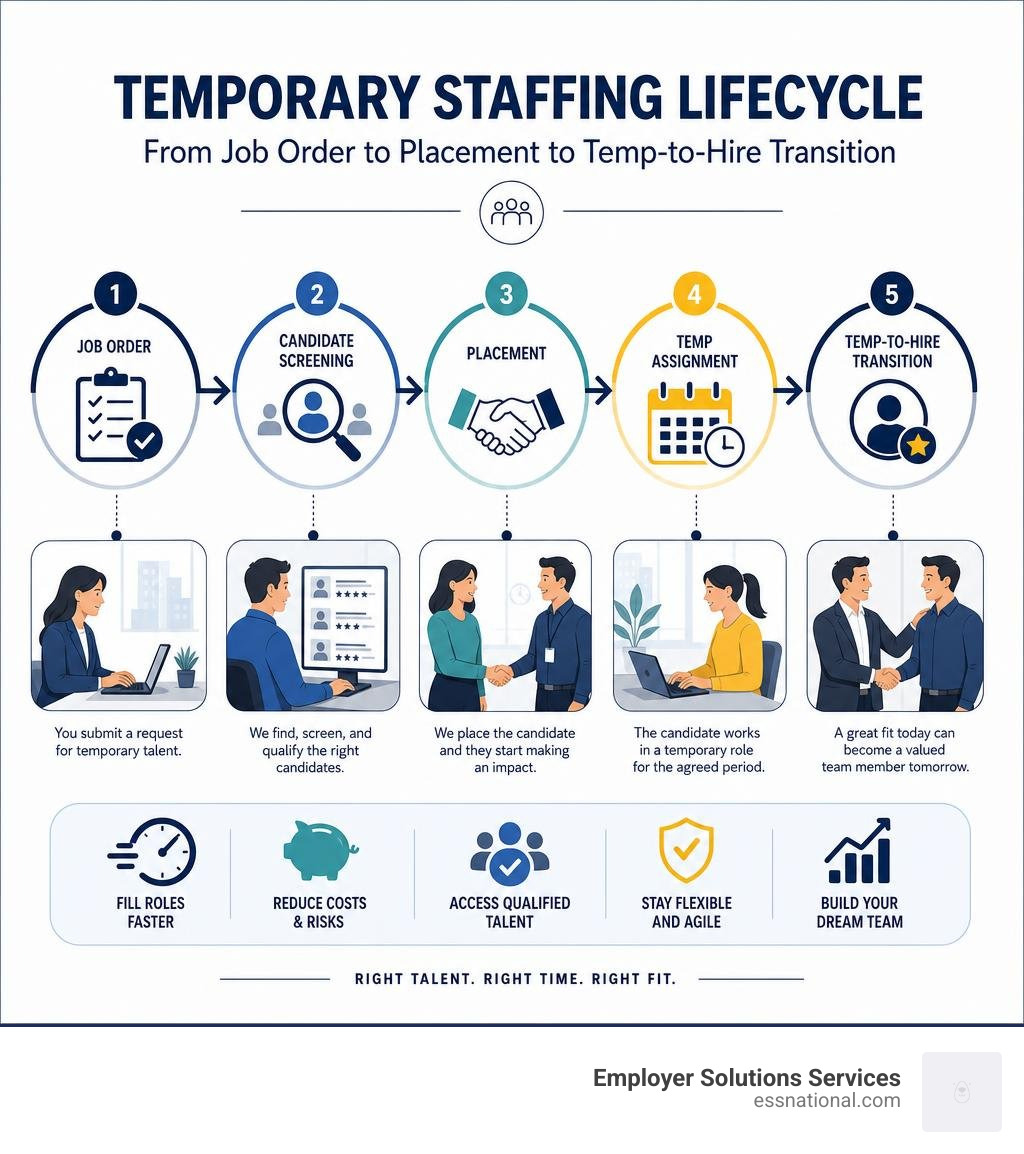
At its core, temporary staffing involves a tri-party relationship between the client company (your business), the staffing agency, and the temporary worker. The staffing agency recruits, screens, hires, and pays the employee, while you manage their day-to-day work on-site.
This contract staffing model allows companies to quickly adjust their labor capacity to align with real-time demand. Unlike permanent hiring, where bringing on an employee involves significant upfront costs, extensive onboarding, and long-term financial commitments, temporary staffing offers an elegant, low-risk alternative.
| Feature | Temporary Staffing | Permanent Hiring |
|---|---|---|
| Commitment Level | Short-term or project-based; flexible end dates | Long-term; expectation of ongoing employment |
| Primary Employer | Staffing agency (Employer of Record) | Your business |
| Hiring Speed | Fast (often 24 to 48 hours) | Slow (typically weeks or months) |
| Upfront Costs | Minimal recruiting expenses | High advertising, screening, and onboarding costs |
| Trial Periods | Built-in; easy to evaluate “on-the-job” | Limited to formal probationary periods |
| HR & Payroll Burden | Managed entirely by the staffing agency | Handled internally by your HR department |
The History and Evolution of Temporary Employment Staffing
The concept of temporary staffing isn’t new, but its complexity certainly is. The modern staffing industry began taking shape in the mid-20th century, but it truly found its footing during the 1970s. Initially, agencies focused almost exclusively on providing clerical support—think “temp pool” typists and receptionists.
Over the decades, the industry underwent a massive transformation. As corporate structures evolved and global supply chains grew more volatile, businesses realized that maintaining a 100% permanent workforce was both risky and expensive.
By the time the modern gig economy emerged in the 2010s, the perception of temporary work had shifted completely. No longer just a fallback plan for administrative gaps, contingent labor became a deliberate career choice for many skilled professionals. Today in 2026, the temporary staffing market is projected to grow at a compound annual growth rate (CAGR) of 6% through 2028, reflecting how deeply integrated flexible labor has become in our economic fabric.
Temporary vs. Permanent Hiring: Key Differences
The most critical distinction between temporary and permanent hiring lies in the allocation of risk and administrative responsibility.
When you hire a permanent employee, you commit to salary, benefit structures, payroll taxes, unemployment insurance, and the risk of a bad hire. If a permanent hire doesn’t work out, parting ways can be legally complicated and financially draining.
With temporary staffing, the financial risk is minimized. The agency takes on the burden of workers’ compensation, benefits administration, and tax withholding. Furthermore, if a temporary worker’s performance isn’t up to par, you can contact the agency to request a replacement without navigating the standard HR hurdles of termination.
This dynamic is especially valuable when utilizing “temp-to-hire” strategies. This approach acts as an extended, real-world trial period where you can observe a worker’s skills, punctuality, and cultural fit before extending a full-time offer. To learn more about how this model protects your bottom line, check out our deep dive into The Truth About Temp to Hire Positions.
Key Benefits of Temporary Staffing for Employers

Why do over 90% of companies utilize temporary staffing services? It isn’t just about finding warm bodies to fill seats; it is a strategic business decision that yields massive operational advantages.
By partnering with a staffing provider, businesses can hand over the tedious, time-consuming administrative tasks associated with recruiting and employment. This allows internal teams to focus on core operations, business development, and strategic growth.
Streamlining Payroll and HR Compliance
Managing payroll, tax filings, and employment compliance is incredibly complex, particularly if you operate in multiple states. Each state has its own unique labor laws, reporting guidelines, and tax structures.
For instance, if your business operates in Massachusetts, you must navigate specific rules governing temporary agencies, such as those monitored by the Employment, Placement, and Staffing Agencies Program – Mass.gov. Similarly, states like New Jersey, Pennsylvania, Texas, Florida, Illinois, Nevada, and Georgia all have distinct legal frameworks regarding workers’ compensation, overtime, and workplace safety.
When you use a temporary staffing agency, the agency acts as the Employer of Record (EOR). This means they are legally responsible for:
- Calculating and withholding federal, state, and local taxes
- Managing and funding workers’ compensation insurance
- Administering Affordable Care Act (ACA) compliant health benefits
- Handling unemployment claims and disputes
This administrative relief translates to direct cost savings. Your internal HR and accounting teams spend fewer hours processing paperwork, tracking hours, and managing compliance audits.
Scaling Your Workforce with Agility
Business demands are rarely static. A manufacturer in Pennsylvania might experience a massive spike in orders ahead of the holidays, while a logistics facility in Texas might face unpredictable supply chain fluctuations.
Using temporary employment staffing allows you to scale up your workforce rapidly during peak seasons and scale back down when demand normalizes—without laying off permanent staff. This protects your core team from burnout during busy periods and shields your business from high unemployment tax rates when things slow down. To understand why companies across the board are adopting this agile approach, read our analysis on Why Temporary Staffing Across Industries Is the New Normal.
Industries and Roles That Rely on Temporary Staffing

Temporary staffing is no longer confined to a single sector. Today, it spans across nearly every industry, from blue-collar warehousing to highly specialized technical roles.
Administrative and Office Support Roles
Keeping an office running smoothly requires reliable support staff. Whether you need data entry clerks to assist with a massive database migration, receptionists to cover medical leave, or executive assistants to manage a transitional period, temporary staffing provides rapid solutions.
Administrative staffing helps businesses maintain daily continuity without delaying critical projects. To find out how to secure top-tier administrative talent, explore our guide on The Best Staffing Agency for Office Work and Administrative Assistants.
Specialized Sectors: Healthcare and Light Industrial
Two of the largest consumers of temporary staffing are healthcare and light industrial/logistics.
- Light Industrial & Logistics: Warehouses, distribution centers, and manufacturing plants rely heavily on temporary labor to manage seasonal shifts. Common roles include forklift operators, assembly line workers, packers, and shipping clerks.
- Healthcare: Medical facilities must maintain strict nurse-to-patient ratios to ensure safety and compliance. Healthcare staffing agencies place registered nurses (RNs), certified nursing assistants (CNAs), and medical administrative staff on short-term or per-diem assignments. To learn more about the unique regulatory and credentialing requirements of this sector, read Everything You Need to Know About Medical Staffing Agencies.
Selecting and Partnering with a Staffing Agency
Choosing the right temporary staffing partner is critical. The agency you select becomes an extension of your brand; their ability to find, screen, and retain reliable talent directly impacts your operational success.
Screening and Matching in Temporary Employment Staffing
A top-tier staffing agency does far more than forward resumes. They employ rigorous, multi-step screening processes to ensure every candidate sent to your facility is qualified, safe, and ready to work. This process typically includes:
- In-depth Interviews: Assessing work history, soft skills, and reliability.
- Skills Testing: Verifying technical proficiency, whether it’s software usage for office roles or safety protocols for industrial work.
- Background Checks & Drug Screening: Tailored to meet your specific industry standards and regulatory compliance requirements.
- Onboarding & Safety Training: Ensuring workers understand general workplace safety before their first day on the job.
Working with an agency that takes these steps seriously prevents the dreaded “ghosting” phenomenon, where workers fail to show up for their shifts. For tips on avoiding unreliable agencies, see our resource on Local Temp Job Agencies That Won’t Ghost You.
Leveraging National Alliances and Regional Networks
If your business has a footprint across multiple states, you need a staffing partner with both local depth and national reach. Local agencies often participate in national staffing alliances, allowing them to coordinate large-scale hiring programs across different states while maintaining localized expertise.
For example, a business operating across our core states can leverage regional resources to understand local labor pools and state-specific regulations:
- In the Southeast, employers utilize regional networks to tap into localized talent pools in Florida and Georgia, while staying aligned with Georgia employment regulations.
- Up in the Northeast, companies navigate distinct industrial corridors using regional resources in New Jersey and Pennsylvania to find qualified workers.
- Out West and in the Southwest, businesses leverage local networks alongside official Texas workforce resources to scale their operations rapidly in Nevada and Texas.
By utilizing a provider connected to a broader network, your business can achieve consistent service standards whether you are hiring in Chicago, Houston, or Miami.
Frequently Asked Questions about Temporary Staffing
What are the pros and cons of temporary work for job seekers?
For job seekers, temporary work offers incredible flexibility, a chance to build diverse skills, and a foot in the door at top companies. Nearly 40% of temporary workers transition to permanent roles within a year, making it a highly effective job search strategy.
On the downside, temporary assignments lack long-term job security and may not always offer the same level of benefits as permanent roles. However, for those looking to pivot careers or find steady work quickly, partnering with the right agency can be life-changing. Learn more about making this transition in Making the Leap With Temp to Perm Employment Agencies.
What are the current trends and challenges in 2026?
In 2026, the temporary staffing industry is heavily shaped by technology and labor market shifts:
- AI-Powered Matching: Advanced algorithms help agencies screen resumes and match candidate skills to job descriptions faster than ever.
- Persistent Talent Shortages: Despite technological advances, finding skilled trade and technical talent remains a challenge, prompting many companies to shift toward direct hire for highly specialized positions. To compare these strategies, read What Is Direct Hire Staffing and Why It Beats the Rest.
- Flexible & Remote Work: Administrative and professional temp roles increasingly demand hybrid or remote setups, requiring agencies to adapt their screening and onboarding processes.
How do agencies handle worker compliance and payroll?
As the Employer of Record, the staffing agency manages all back-office administrative tasks. They track hours, process weekly payroll (often via direct deposit), withhold taxes, issue W-2s, and manage any unemployment or workers’ compensation claims. This completely insulates the client company from the administrative burden of employment.
Conclusion
Mastering temporary employment staffing is all about choosing a partner who understands your business, your industry, and your local market.
At Employer Solutions Services (ESS), we bring over 30 years of experience to the table. We don’t believe in one-size-fits-all staffing. Instead, we design customized programs tailored to your unique operational goals, providing thoroughly screened, trained, and reliable talent across our key locations in Florida, Georgia, Illinois, Massachusetts, Nevada, New Jersey, Pennsylvania, and Texas.
Whether you need flexible temporary staff, a temp-to-hire trial program, direct-hire recruiting, or comprehensive back-office payroll administration, we are here to support your growth.
Ready to optimize your workforce? Partner with ESS for Your Staffing Needs today and let us handle the hard work of hiring.