
Why Temporary Staffing Services Give Your Business a Competitive Edge
Temporary staffing services connect businesses with pre-screened workers on a flexible, short-term basis — without the cost and commitment of permanent hiring.
Quick answer: What are temporary staffing services?
| Question | Answer |
|---|---|
| What are they? | Short-term or contract workers placed by a staffing agency |
| Who manages payroll? | The staffing agency handles payroll, taxes, and compliance |
| How long do assignments last? | Days, weeks, or months — based on your needs |
| Can temps become permanent? | Yes, through temp-to-hire arrangements |
| Who benefits? | Businesses needing flexibility; job seekers wanting varied experience |
If you run a mid-sized business, you’ve likely felt the pressure of sudden workforce gaps, seasonal spikes, or the risk of a bad permanent hire. These problems are expensive. A wrong full-time hire can cost up to twice that employee’s annual salary when you factor in recruiting, onboarding, and lost productivity.
That’s exactly where a smart temporary staffing strategy pays off.
Top staffing agencies collectively serve tens of thousands of businesses each year — and there’s a reason demand keeps growing. As of May 2026, workforce agility isn’t a nice-to-have. It’s a core business strategy.
This article breaks down 5 practical strategies to get the most out of temporary staffing — from defining your hiring goals to streamlining payroll and compliance.
Simple guide to temporary staffing services terms:
- direct placement healthcare workers
- direct placement staffing services
- payroll for temporary employees
Understanding the Power of Temporary Staffing Services
To truly appreciate the value of temporary staffing services, it helps to look at how they stack up against traditional direct-hire methods. Many businesses treat staffing as a last-second rescue mission when someone calls out sick. While it is great for emergencies, a proactive temporary staffing strategy is a powerful tool for everyday growth.
Here is a quick look at how temporary staffing compares to traditional permanent hiring across key operational metrics:
| Operational Metric | Temporary Staffing | Permanent Hiring |
|---|---|---|
| Time-to-Hire | Extremely fast (often within 24 to 48 hours) | Slow (typically 30 to 45+ days) |
| Upfront Cost | Low; agency handles sourcing, screening, and onboarding | High; advertising, HR hours, and background checks |
| Administrative Burden | Minimal; agency manages payroll, taxes, and benefits | High; managed entirely by your internal HR team |
| Flexibility | High; scale up or down based on current demand | Low; long-term commitment regardless of market shifts |
| Hiring Risk | Low; easily replace workers or use a trial period | High; termination costs, severance, and potential legal risks |
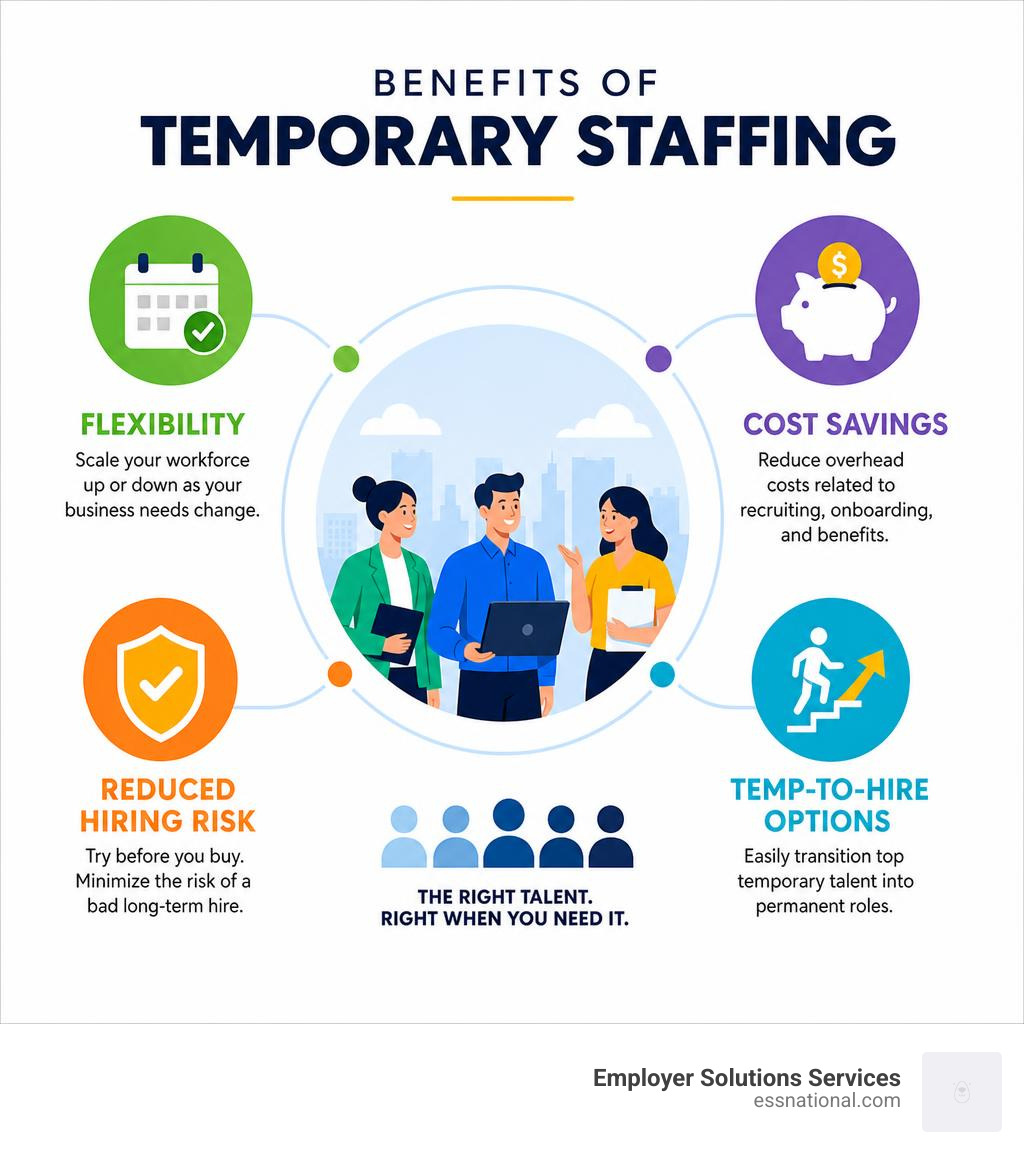
When you partner with a professional staffing firm, you are not just buying labor; you are purchasing operational flexibility. By utilizing temporary staff, you can scale your production lines during seasonal peaks without worrying about lay-offs when things quiet down. This model offers incredible cost savings because you only pay for productive hours worked, completely avoiding the overhead of recruiting, onboarding, and full-time benefit packages for short-term projects.
Furthermore, using temporary talent is one of the most effective ways to lower your hiring risk. Instead of committing to a long-term salary based on a couple of interviews, you get to evaluate a worker’s real-world skills, work ethic, and attitude in your actual work environment. It is no wonder that Why Temporary Staffing Across Industries Is the New Normal has become a central theme for forward-thinking business leaders.
At Employer Solutions Services, we help businesses navigate these choices by designing custom staffing structures that align with their distinct operational rhythms.
5 Smart Strategies to Maximize Contingent Workforce Success
Managing a flexible workforce requires a different playbook than managing permanent employees. If you simply bring in temporary workers without a plan, you might experience inconsistent productivity, high turnover, or cultural friction.

To build a highly productive, seamless contingent talent pipeline, we recommend focusing on five core strategies. These strategies ensure you optimize your workforce, protect your bottom line, and maintain peak productivity.
1. Define Clear Goals for Temporary Staffing Services
Before you pick up the phone to request workers, you must know exactly what you want those workers to accomplish. A vague request like “we need some help in the warehouse” often leads to mismatched talent and frustration on both sides.
- Role Definition: Write down the exact tasks the temporary employee will perform. Are they packing boxes, operating heavy machinery, managing customer calls, or handling data entry?
- Project Scope & Timeline: Determine how long you will need the support. Is this a three-day project to clear a backlog, a three-month assignment to cover parental leave, or an open-ended engagement to handle a seasonal surge?
- Skill Requirements: Be honest about the level of experience required. If you need someone who can hit the ground running with zero training, specify those exact certifications or system proficiencies. If the role is entry-level and you are willing to train, let your agency partner know so they can find enthusiastic candidates eager to learn.
When you clarify these expectations upfront, you lay the groundwork for a highly successful partnership. It also helps you decide if a role should eventually transition into a permanent position. For a deeper dive into this planning phase, read about Why Your Business Needs Temp to Hire Staffing Services Now.
2. Partner with Agencies that Offer Screened and Trained Talent
Not all staffing agencies are created equal. Some simply pull warm bodies from a digital database and send them to your job site, hoping for the best. To protect your business and maintain high standards, you should partner with an agency that takes candidate screening and training seriously.
A reliable staffing partner should perform:
- Thorough Sourcing & Skills Assessments: Verifying that candidates actually possess the skills listed on their resumes.
- Comprehensive Background Checks: Ensuring safety and security on your work floor.
- Targeted Training Programs: Pre-orienting workers so they arrive with a basic understanding of industry safety and workplace expectations.
At Employer Solutions Services, we bring over 30 years of experience to the table, delivering customized programs with highly screened and trained talent. We understand the unique economic climates of the states we serve.
Whether you need local talent in Florida, on-demand industrial support in Georgia, or specialized manufacturing teams in Illinois, having a partner with localized expertise makes all the difference.
If you are operating in the Northeast, we provide comprehensive staffing solutions across Massachusetts, New Jersey, and Pennsylvania. Out West, we support businesses in Nevada, including the Las Vegas market.
Meanwhile, East Coast operations benefit from our deep regional presence in Pennsylvania, and Southern enterprises count on our expertise in Texas. Working with a partner who understands these localized markets ensures you always get the right fit.
3. Leverage Temp-to-Hire Models for Cultural Fit
One of the greatest benefits of modern temporary staffing services is the ability to “try before you buy.” This is known as the temp-to-hire (or temp-to-perm) model.
[ Temporary Assignment ] --> [ Performance & Cultural Evaluation ] --> [ Permanent Offer ]
During the initial trial period, the worker remains an employee of the staffing agency. You pay an hourly rate for the hours they work, while we handle their payroll, taxes, and insurance. This trial period gives you a front-row seat to evaluate:
- Cultural Alignment: Do they get along with your existing team? Do they respect your company values?
- Punctuality and Reliability: Do they show up on time, ready to work, every single day?
- Performance: Can they handle the actual workload and maintain your quality standards?
If the worker is a perfect match, you can seamlessly transition them to your permanent payroll once the contract terms are met. If they aren’t the right fit, you can simply end the assignment and ask the agency for a replacement—without the awkwardness, documentation, and potential unemployment claims associated with firing a permanent staff member. To understand how to utilize this strategy effectively, read The Truth About Temp to Hire Positions.
4. Streamline Onboarding and Integration
Just because an employee is temporary doesn’t mean their onboarding should be ignored. A poor onboarding experience is the number-one reason temporary workers walk off the job in their first week. If they feel lost, ignored, or unsafe, they will simply look for another assignment.
To ensure high retention and rapid productivity, implement these onboarding best practices:
- Prepare Your Team: Let your permanent staff know that temporary workers are arriving. Explain their roles so your full-time team views them as helpful support rather than a threat to their own jobs.
- Assign a Buddy: Pair each temporary worker with an experienced team member who can answer quick questions, show them where the breakroom is, and make them feel welcome.
- Prioritize Safety Training: Never skip safety orientations. Ensure temporary workers receive the exact same safety briefings and personal protective equipment (PPE) as your permanent staff.
- Establish Clear Communication: Give them clear instructions on who to report to and what to do if they encounter an issue.
By treating temporary staff with respect and integrating them smoothly, you build a reputation as an employer of choice. This makes it much easier to secure top-tier talent from Local Temp Job Agencies That Won’t Ghost You.
5. Optimize Back-Office Administration and Payroll
The administrative work behind managing a workforce can quickly overwhelm your internal HR department. When you hire temporary staff, you aren’t just managing their daily work; you are also responsible for tracking hours, calculating overtime, processing payroll, withholding taxes, managing workers’ compensation, and keeping up with changing labor laws.
A major advantage of partnering with a comprehensive staffing agency is that they take over this entire administrative burden.
Staffing Agency Handles:
- Payroll Processing
- Tax Withholding & Filing
- Workers' Compensation Insurance
- ACA Compliance & Benefits

(Saves hours of internal HR work)

Your Business Focuses On:
- Daily Operations
- Core Business Growth
- On-Site Productivity
By outsourcing these complex back-office tasks, your internal team can stop drowning in paperwork and focus on core business growth. To learn how to master this administrative balance, check out our guide on Back Office Bliss: Mastering Temp Payroll and Admin.
Key Legal and Compliance Considerations in Staffing
While temporary staffing services offer incredible flexibility, they also come with legal responsibilities. You cannot simply treat temporary workers as “independent contractors” or assume you have zero legal obligations toward them.

First, make sure your staffing partner classifies their workers as W-2 employees rather than 1099 independent contractors. Agencies that use the W-2 model (like we do at ESS) handle all payroll taxes, unemployment insurance, and workers’ compensation. This drastically reduces your risk of facing misclassification audits from the IRS or state labor departments.
Additionally, you must ensure that your workplace complies with all local, state, and federal labor laws, including proper safety standards overseen by OSHA. If an accident occurs on your job site, both you and the staffing agency could be held responsible. Partnering with a compliant agency like Employer Solutions Services keeps your business safe, insured, and fully compliant with all employment regulations.
Navigating Co-Employment in Temporary Staffing Services
Co-employment is a legal concept where both the staffing agency and the client employer share employer responsibilities.
Under a standard co-employment relationship:
- The Staffing Agency is the primary employer. We handle payroll, taxes, benefits, workers’ comp, and the legal right to hire or fire.
- The Client (You) acts as the secondary employer. You supervise their daily work, control the job site environment, and direct their daily tasks.
To minimize co-employment risks, you must maintain a clear division of duties. For example, your managers should never directly handle a temporary worker’s pay raises, disciplinary actions, or benefit discussions. Instead, any performance issues or compensation changes must be routed directly through your staffing agency representative.
Understanding these boundaries is crucial for a smooth operation. You can learn more about managing these professional lines by reading about Navigating the World of Professional Temp to Hire Specialists.
Frequently Asked Questions
What industries use temporary staffing the most?
While almost any business can benefit from flexible labor, temporary staffing services are most heavily utilized in , demand-driven sectors. These include:
- Manufacturing & Logistics: Handling seasonal production spikes, holiday shipping rushes, and warehouse operations.
- Administrative & Office Support: Filling in for parental leave, medical leave, or managing high-volume data entry projects.
- Healthcare: Providing support staff and administrative professionals to keep medical offices running smoothly.
- Retail & Hospitality: Scaling up teams for peak shopping seasons, large events, or convention rushes.
How do staffing agencies screen candidates?
A professional staffing agency uses a multi-layered screening process to ensure you get reliable, capable workers. At ESS, our process includes:
- Skills Assessments: Testing technical skills, software proficiency, or manual dexterity.
- In-Depth Interviews: Evaluating past work history, reliability, and career goals.
- Background & Reference Checks: Verifying employment history and conducting criminal background checks.
- Drug Screening & Certifications: Ensuring workers meet specific safety requirements for specialized roles.
What is the difference between temp-to-hire and direct-hire?
The main difference is the initial employment relationship and the level of hiring risk:
- Temp-to-Hire: The candidate starts as an employee of the staffing agency. You evaluate them during a trial period, and if they excel, you transition them to your permanent team. This lowers your hiring risk.
- Direct-Hire: The agency acts as a recruiter, sourcing and screening candidates for a permanent position. Once selected, the candidate goes directly onto your company’s payroll from day one. This is ideal for highly specialized, long-term professional roles.
To decide which path is right for your current needs, explore our guide on Making the Leap with Temp to Perm Employment Agencies.
Conclusion
In today’s fast-moving business climate, maintaining a rigid, permanent-only workforce can hold your company back. Embracing temporary staffing services gives you the agility to scale production, manage seasonal demands, and test out new talent with minimal financial risk.
By defining clear goals, partnering with a high-quality agency, leveraging temp-to-hire models, streamlining your onboarding, and outsourcing your back-office administration, you set your business up for long-term, sustainable growth.
At Employer Solutions Services, we draw on more than 30 years of experience to build customized staffing and HR programs tailored to your exact operational needs. From Florida to Texas, and everywhere in between, we connect businesses with the screened, trained, and dependable talent they need to thrive.
Ready to build a more agile, productive, and cost-effective workforce? Discover how we can support your business by exploring Our Services today!