
What You Need to Know About Temp to Hire (Before You Commit)
Temp to hire is a staffing arrangement where a worker joins a company on a temporary basis — with the clear goal of becoming a permanent employee if things go well.
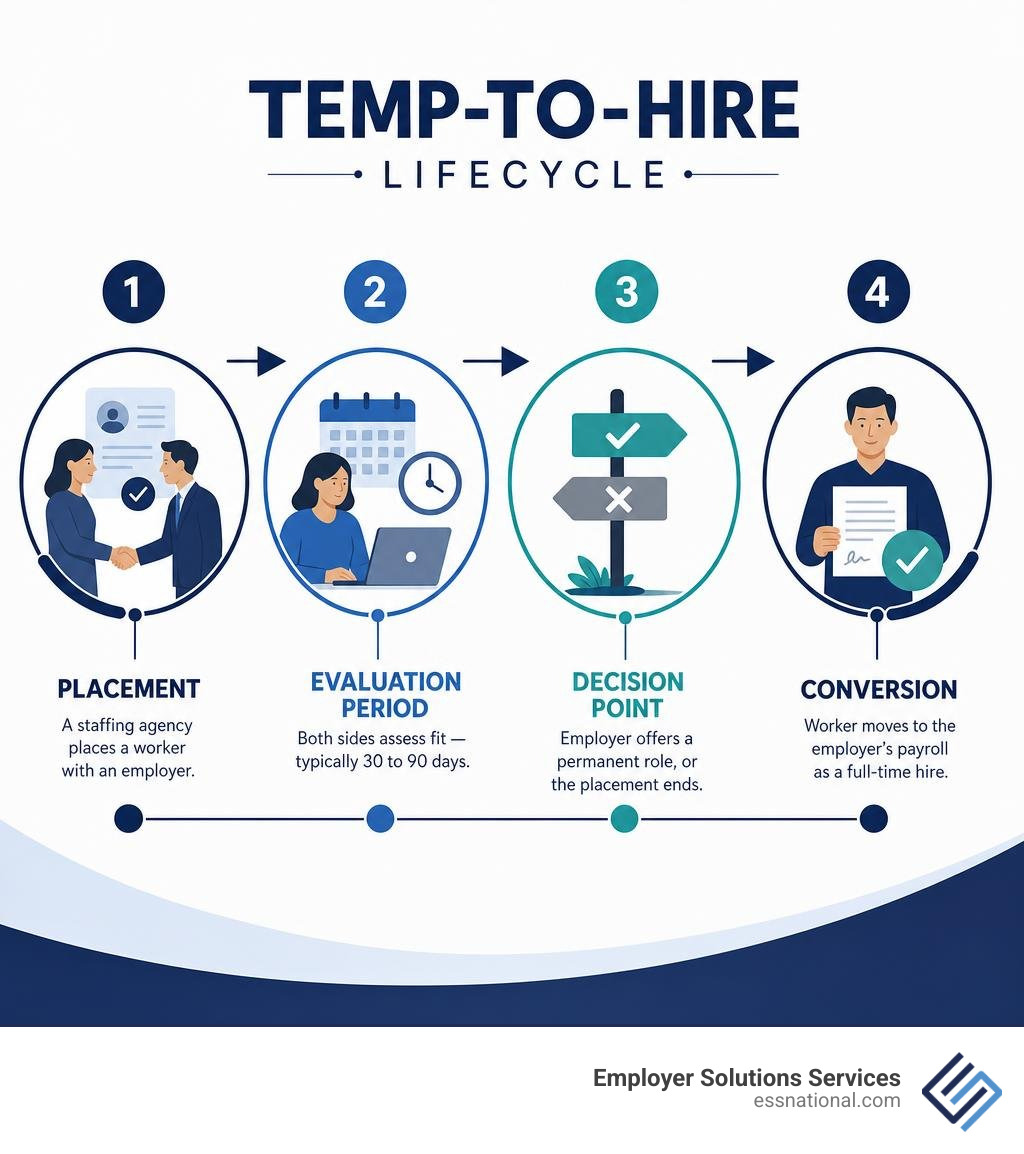
Here’s a quick breakdown of how it works:
| Step | What Happens |
|---|---|
| Placement | A staffing agency places a worker with an employer |
| Evaluation period | Both sides assess fit — typically 30 to 90 days |
| Decision point | Employer offers a permanent role, or the placement ends |
| Conversion | Worker moves to the employer’s payroll as a full-time hire |
It’s different from a standard temp job (no hire intent) and different from direct hire (no trial period). Think of it as a working interview — for both sides.
Finding the right hire is hard. Making the wrong one is expensive — failed permanent hires can cost up to 30% of that employee’s annual salary in turnover expenses alone.
That’s exactly why temp to hire has grown in popularity. As of 2023, 6.9 million Americans — about 4.3% of the entire workforce — held contingent positions, up from just 3.8% in 2017. Businesses are using this model to reduce risk. Workers are using it to test roles before committing.
Whether you’re a business owner trying to fill critical roles without costly mis-hires, or a job seeker weighing your options in a shifting market, understanding how temp to hire actually works can save you time, money, and frustration.
This guide covers everything — the process, the benefits, the misconceptions, and how to get it right.
What is Temp to Hire Staffing?
To truly understand how this model fits into the modern employment landscape of 2026, we have to look at how it compares to other traditional hiring formats. In the staffing world, there are three primary paths: temporary staffing, temp to hire (sometimes called contract-to-hire), and direct hire.
| Feature | Temporary Staffing | Temp to Hire Staffing | Direct Hire |
|---|---|---|---|
| Primary Intent | Short-term help / Project coverage | Long-term permanent employment | Immediate permanent placement |
| Employer of Record | Staffing Agency | Staffing Agency (initially) | Client Company (immediately) |
| Tax Status | W-2 (issued by agency) | W-2 (issued by agency, then company) | W-2 (issued by company) |
| Trial Period | Ongoing / None | Structured (typically 30 to 90 days) | None (standard probationary period) |
| Conversion Option | Rarely / Ad-hoc | Standardized part of the contract | Immediate |
In a temp to hire arrangement, the staffing agency acts as the employer of record during the initial evaluation phase. This means the agency handles the worker’s payroll, tax withholdings, workers’ compensation, and initial onboarding logistics. The candidate is hired as a W-2 employee of the staffing agency, not a 1099 independent contractor. This is a crucial distinction: you still receive standard tax withholding and legal protections as an employee of the agency.
Once the pre-determined trial period is successfully completed, the client company has the option to “convert” the employee. At this point, the worker transitions directly onto the employer’s company payroll, officially ending their employment relationship with the staffing agency. For a deeper look into the realities of this arrangement, read our guide on The Truth About Temp to Hire Positions.
The Benefits of Temp-to-Hire for Employers

Every hiring manager knows the anxiety of reviewing a pile of resumes. On paper, a candidate might look like a superstar. They might even give a flawless, polished performance during a structured interview. But how do they actually handle a high-stress Tuesday afternoon? How do they communicate with teammates when things go off the rails?
Traditional hiring processes rely heavily on speculation. The temp to hire model replaces speculation with real-world observation. By utilizing a trial period, employers can evaluate a worker’s actual attendance, productivity, and interpersonal skills under real job conditions before extending a permanent offer.
Additionally, this model significantly reduces hiring risks. If a direct hire fails, the company is saddled with high turnover costs—which, as noted, can average 30% of that position’s annual salary. With temp to hire, if a placement does not work out, the business can simply end the assignment through the staffing agency without facing the steep administrative and financial burdens of a traditional termination. To learn more about how this strategy can protect your bottom line, explore Why Your Business Needs Temp to Hire Staffing Services Now.
Why Companies Choose the Temp to Hire Model
Businesses don’t just use this model to avoid mistakes; they use it as a proactive strategy to manage growth and uncertainty. In 2026’s rapidly shifting economic landscape, flexibility is everything. Here are the primary reasons companies choose this path:
- Real-World Performance Evaluation: There is no substitute for seeing a professional perform the actual job duties in your unique environment. You can assess their technical skills, speed, accuracy, and reliability firsthand.
- Assessing Cultural Fit: A candidate might have the perfect technical skills, but if their working style clashes with your existing team, productivity will suffer. A trial period lets you see how they mesh with your company culture.
- Budget and Headcount Flexibility: When facing market uncertainty or waiting on final budget approvals, companies can bring in essential help using operational budgets rather than permanent salary allocations.
- Reduced Administrative Burden: The staffing agency handles time-consuming tasks like initial screening, skills testing, drug checks, and background verifications, allowing your internal HR team to focus on core strategic objectives.
The Advantages of Temp-to-Hire for Job Seekers
Many job seekers initially hesitate when they see a position listed as “temp to hire.” They worry it lacks stability or carries a historical stigma. However, modern professionals increasingly view these roles as strategic career moves.
First and foremost, it allows you to “test-drive” the employer. Is the management style supportive? Do they actually live up to the cultural values they bragged about on their website? Is there a clear path for professional growth? Taking a temp to hire role gives you a front-row seat to evaluate the company before you sign a long-term contract.
Second, it unlocks access to the “hidden” job market. Many top-tier companies do not post their premier permanent openings on public job boards. Instead, they partner exclusively with staffing agencies to find trial-period candidates.
According to historical workforce data, 6.9 million Americans (4.3% of the workforce) held contingent positions as of 2023. While nearly 45% of those contingent workers stated they would prefer a permanent job, a significant 41% actually preferred the flexibility and control of their contingent arrangement. This model bridges the gap, offering a clear, structured pathway to permanent stability for those who want it. For step-by-step guidance on leveraging this path, check out our advice on Making the Leap with Temp to Perm Employment Agencies.
How to Succeed in Temp to Hire Roles
If you want to convert your temporary assignment into a permanent dream job, you have to treat the evaluation period like an extended audition. Here is how to stand out:
- Prioritize Reliability: Show up on time every single day. Attendance and punctuality are the absolute foundation of trust.
- Show Your Value Early: Don’t wait to be asked to do things. Look for small ways to make processes smoother, help teammates, or take on extra tasks once you have mastered your core duties.
- Embrace Adaptability: Every company has its own way of doing things. Be open to learning their systems, even if you are used to a different software or workflow.
- Ask for Feedback: Don’t wait until the end of your 90 days to find out how you are doing. Check in with your supervisor and your agency recruiter to ensure you are meeting performance expectations.
- Network Naturally: Treat everyone you meet with respect. Build genuine professional relationships across departments—your peers often have a major say in whether you get hired permanently.
How the Temp-to-Hire Process Works Step-by-Step

Navigating a temp to hire arrangement is straightforward when you understand the milestones. Whether you are an employer or a job seeker, working with a professional agency makes the journey seamless. To find out how specialists guide both sides through this process, check out our article on Navigating the World of Professional Temp to Hire Specialists.
Here is the standard step-by-step process:
- Consultation & Sourcing: The employer outlines the role’s requirements, culture, and conversion expectations. The staffing agency then sources, interviews, and pre-screens qualified candidates.
- The Matching Phase: The agency presents the top candidates to the employer. The employer may conduct a brief interview before approving the placement.
- Onboarding & Day One: The candidate is hired as an employee of the staffing agency. The agency handles compliance, safety briefings, and payroll setup.
- The Evaluation Period: The worker performs the job for a set period (typically 30 to 90 days). The agency conducts regular check-ins with both the worker and the supervisor to monitor performance and resolve any issues.
- The Conversion Decision: As the contract end date approaches, the employer decides whether to transition the worker to their permanent payroll. If yes, a formal job offer is extended, and the transition is completed.
Key Questions to Ask Before Committing
To ensure a successful partnership, both employers and job seekers should ask clarifying questions before signing a contract.
For Employers to Ask the Agency:
- What is the exact length of the evaluation period before conversion can happen without a fee?
- How does your agency handle candidate screening, skills testing, and background checks?
- What happens if a candidate does not meet our performance or attendance standards?
- Are there options to extend the evaluation period if we need more time to make a decision?
For Candidates to Ask the Recruiter:
- What is the realistic timeline for permanent conversion at this company?
- What specific performance metrics or goals will the company use to evaluate my work?
- What benefits (such as health insurance) are available to me through the agency during the temp phase?
- What is the historical conversion rate for this specific client?
Best Industries and Roles for Temp-to-Hire Placements
While the temp to hire model can work across almost any business sector, certain industries rely heavily on it because of seasonal surges, project-based workflows, or high-volume staffing needs. According to the American Staffing Association, staffing companies play a critical role in bridging the gap between temporary assignments and permanent careers.
- Light Industrial and Logistics: Warehouse workers, machine operators, assembly technicians, and logistics coordinators are frequently hired through this model to manage fluctuating supply chain demands.
- Administrative and Office Support: Roles like administrative assistants, customer service representatives, data entry clerks, and office managers are ideal for temp-to-hire because soft skills and cultural fit are so critical to success.
- Accounting and Finance: Bookkeepers, accounts payable/receivable clerks, and payroll specialists are often placed on a trial basis to ensure their technical accuracy and compliance standards align with company goals.
- Technology and IT: Help desk technicians, system administrators, and software testers often utilize contract-to-hire paths to prove their technical capabilities on active projects.
- Healthcare Support: Patient care assistants, medical receptionists, and billing coordinators are highly suited for this model to ensure patient-facing compatibility.
If you are looking to partner with local experts who understand regional talent markets, Employer Solutions Services (ESS) provides comprehensive staffing solutions across our key operational states:
- Florida: Access top-tier talent and customized staffing programs tailored to Florida’s dynamic market.
- Georgia: Connect with regional light industrial and administrative networks to support your business growth.
- Illinois: Benefit from our customized staffing and back-office support programs tailored to the Midwestern market.
- Massachusetts: Explore professional and technical placements designed to meet local industry demands.
- Nevada: Leverage western market opportunities with reliable, pre-screened candidates.
- New Jersey: Build your local dream team with specialized professional networks, and read our localized guide on Temp to Hire Cherry Hill Secrets for Building a Dream Team.
- Pennsylvania: Find trusted local workforce solutions to manage fluctuating business demands.
- Texas: Access deep Southern talent pools to fill critical roles quickly and efficiently.
Common Misconceptions About Temp-to-Hire Jobs
Despite the massive growth of the contingent workforce, a few outdated myths persist about temp-to-hire roles. Let’s set the record straight.
Myth 1: Temp-to-hire jobs offer low pay. Actually, because companies are looking for high-quality talent that they eventually want to keep permanently, temp-to-hire pay rates are highly competitive. In many cases, staffing agencies offer strong hourly rates during the contract period to attract top-tier professionals.
Myth 2: Temp-to-hire employees don’t get benefits. While you may not get the client company’s direct benefits on day one, reputable staffing agencies offer their own health, dental, and vision insurance options to W-2 contract workers. Once you convert to a permanent employee, you transition to the employer’s standard benefits package.
Myth 3: Contract work looks bad on a resume. In 2026, the stigma around contract work is completely gone. Employers actively look for candidates who are adaptable, proactive, and have experience working in diverse environments. A series of successful contract-to-hire placements signals that you are a versatile professional who can deliver results quickly.
To separate more facts from fiction, take a look at our resource on The Best Temp to Hire Employment Agencies Near You.
Frequently Asked Questions About Temp-to-Hire
How long does a temp-to-hire period typically last?
Most standard evaluation periods run between 30 to 90 days. However, the exact timeline depends on the complexity of the role, the industry, and the terms agreed upon between the employer and the staffing agency. In some cases, if both parties need more time to evaluate the fit, the contract can be extended.
Do temp-to-hire employees get benefits?
Yes. While you are working during the trial phase, you are an employee of the staffing agency, and many agencies offer access to essential medical, dental, and vision plans. Once you are converted to a permanent employee, you become eligible for the client company’s standard internal benefits program.
What happens if a temp-to-hire placement doesn’t work out?
If the placement is not a good fit for either the employer or the employee, the assignment can be ended through the staffing agency. For employers, this avoids the cost and legal risk of a direct termination. For candidates, your recruiter will simply begin looking for a new placement that better aligns with your skills and career goals.
Conclusion
The temp to hire model is a powerful, low-risk strategy that helps businesses build stronger teams and helps job seekers find rewarding, long-term careers. By introducing a structured evaluation period, both sides can make informed, confident employment decisions.
At Employer Solutions Services (ESS), we bring over 30 years of industry experience to the table. We design customized staffing programs tailored to your unique business goals, providing thoroughly screened and trained talent across Florida, Georgia, Illinois, Massachusetts, Nevada, New Jersey, Pennsylvania, and Texas. Beyond finding the right people, we also handle back-office administrative burdens, including comprehensive payroll services, workers’ compensation management, and compliance support.
Ready to build your dream team or find your next great career opportunity? Read The Definitive Guide to Temp to Hire Staffing Agencies or contact us today to see how our customized programs can drive your success.