Why Payroll Administration Pennsylvania Is More Complex Than You Think
Payroll administration Pennsylvania is one of the most regulation-dense back-office functions a mid-sized business can face in the Keystone State. Between state income tax withholding, local Earned Income Tax (EIT), the Local Services Tax (LST), wage payment laws, and multi-state compliance at the New Jersey and Delaware borders — the administrative burden adds up fast.
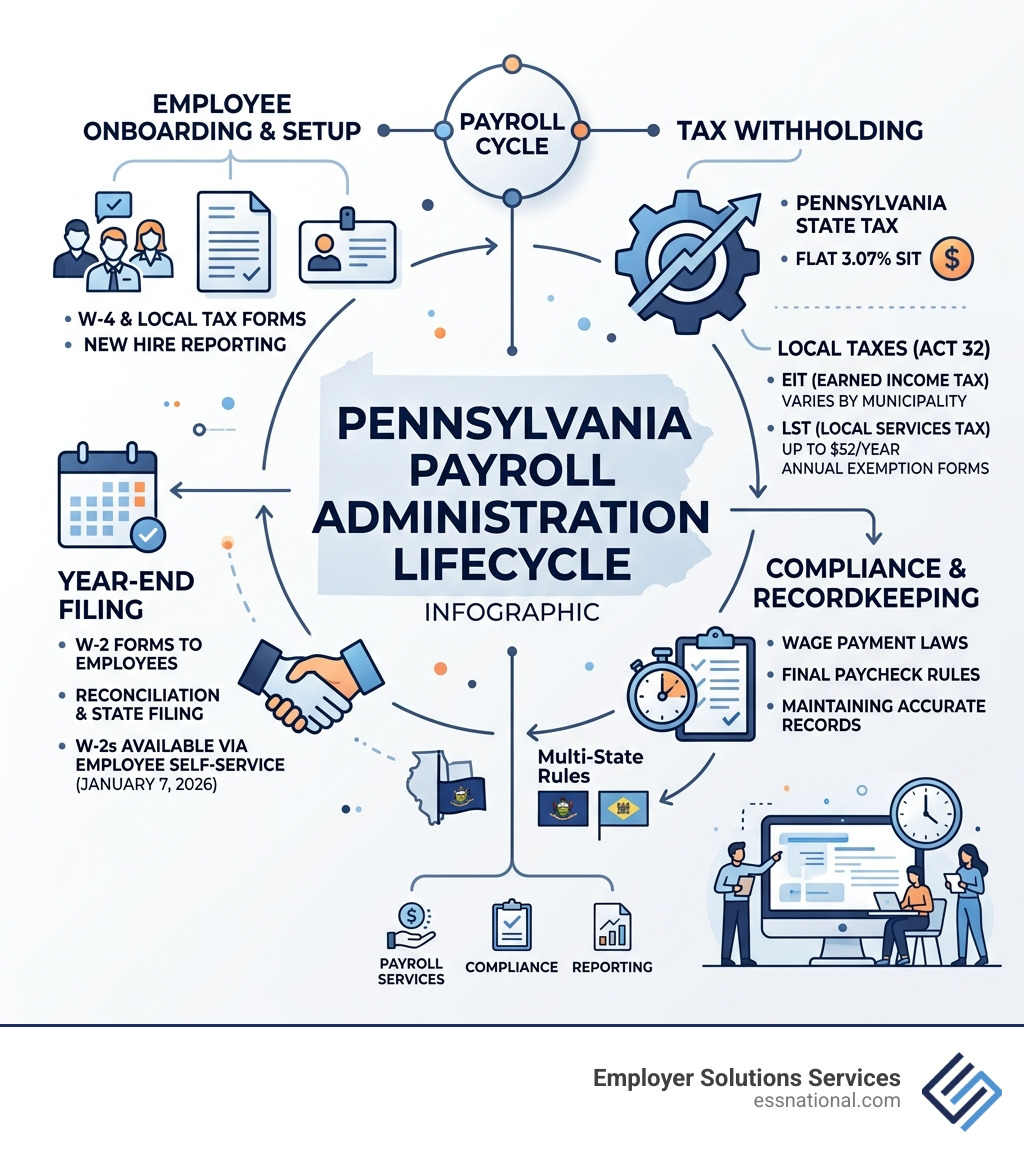
Here’s a quick overview of what Pennsylvania payroll administration involves:
- State income tax withholding at a flat 3.07% rate for all employees
- Local Earned Income Tax (EIT) collected under Act 32, varying by municipality
- Local Services Tax (LST) up to $52 per year, with annual exemption forms required
- Wage Payment and Collection Law compliance, including strict final paycheck rules
- New hire reporting to the Pennsylvania State Directory of New Hires
- Year-end W-2 filing, with 2025 W-2s available to Commonwealth employees via Employee Self-Service starting January 7, 2026
- Multi-state payroll rules for employees working across PA borders
For many business owners, keeping up with all of this while managing daily operations simply isn’t sustainable. That’s where outsourcing payroll administration becomes less of a luxury and more of a practical necessity.
Key Responsibilities and Regulatory Compliance

In payroll administration Pennsylvania, the buck stops with the administrator. It isn’t just about cutting checks; it’s about maintaining a delicate balance between federal mandates and the Commonwealth’s unique quirks. A payroll professional in PA is responsible for the end-to-end lifecycle of an employee’s pay, which includes calculating gross-to-net earnings, managing time and attendance integrations, and ensuring that every penny of incentive pay or shift differential is accounted for.
One of the most critical areas of focus is the Pennsylvania Wage Payment and Collection Law (WPCL). This law dictates how and when employees must be paid. For example, if an employee leaves the company, Pennsylvania has strict final paycheck mandates that require payment by the next scheduled payday. Failing to meet these deadlines can result in liquidated damages, which is a “drama” no business owner wants to deal with.
Furthermore, administrators must handle complex garnishments and child support calculations. These aren’t just simple deductions; they involve specific state thresholds and limitations that must be honored to remain compliant. Understanding Payroll Services and Why You Need Them is the first step in realizing that these technicalities require professional oversight. Even state agencies rely on specialized divisions, such as the Payroll Operations | Office of the Budget, to manage the accounting, processing, and injury payment services for thousands of employees.
Navigating Local Services Tax (LST) and EIT
If Pennsylvania’s state tax is a straight line, its local taxes are a labyrinth. Under Act 32, the collection of the Earned Income Tax (EIT) was consolidated, but it still requires administrators to identify the correct tax collection district for every employee based on where they live and work.
Then there is the Local Services Tax (LST). This is a fee—often $52 per year—levied on individuals who work within a specific municipality. While it seems small, the administration is a headache. Employees who expect to earn less than a certain threshold (often $12,000) can file an LST exemption form. As an administrator, you must collect these forms annually and ensure you don’t withhold the tax from those specific individuals.
| Tax Type | Authority | Rate/Amount | Filing Requirement |
|---|---|---|---|
| State Income Tax | Commonwealth of PA | 3.07% (Flat) | Quarterly/Annual |
| Earned Income Tax (EIT) | Local Municipality | Varies by District | Quarterly via Act 32 |
| Local Services Tax (LST) | Local Municipality | Up to $52/year | Quarterly |
| Unemployment Tax | PA Dept. of Labor | Varies by Experience | Quarterly |
Managing Multi-State Payroll Administration Pennsylvania
Pennsylvania shares borders with six states, and in regions like Philadelphia or the Lehigh Valley, it’s common for employees to live in one state and work in another. This brings us to reciprocity agreements. Pennsylvania has a reciprocal agreement with New Jersey, meaning PA residents working in NJ (and vice versa) only pay income tax to their state of residence.
However, this doesn’t apply to every neighbor. If you have employees commuting from Delaware or New York, the rules change, and you may find yourself dealing with “nexus” issues—the legal term for having a business presence in another state that triggers tax obligations. For businesses near the border, looking into New Jersey Payroll Services for Every Small Business can provide clarity on how to handle these overlapping jurisdictions without doubling your workload.
Preparing for Year-End Payroll Administration Pennsylvania
As we move through April 2026, many administrators are finally catching their breath after the 2025 year-end rush. In Pennsylvania, the preparation for year-end starts long before December. For the 2025 tax year, W-2 forms were made available to Commonwealth employees as early as January 7, 2026, through Employee Self-Service (ESS).
Modern payroll administration Pennsylvania relies heavily on these ESS portals. They allow employees to download their own W-2s and 1095 forms, reducing the number of “Where is my tax form?” emails hitting your inbox. To stay ahead, businesses must ensure their software is updated with the latest 2026 tax tables and that all quarterly filings are reconciled. Using The Best Small Business Online Payroll Tools of 2026 can automate much of this, flagging errors before they become permanent records.
Staying Ahead of Recent Pennsylvania Legislation
The legislative landscape in the Keystone State is constantly shifting. Recent years have seen a massive push toward “wage theft” prevention and stricter overtime rules. Pennsylvania has moved to align more closely with federal standards while maintaining its own stricter interpretations in certain areas, such as pay equity and how final paychecks are handled.
One significant change involves record-keeping. Pennsylvania now requires more granular data regarding hours worked and rates of pay, especially for those in the manufacturing and logistics sectors where shift differentials and bonuses are common. While we focus on PA, it’s worth noting that other states are following suit; for instance, the Certified Transcript of Payroll – Illinois Department of Labor shows how states are becoming more demanding regarding payroll transparency.
Professional Development and Training
Because the laws change so frequently, “setting and forgetting” your payroll process is a recipe for a Department of Labor audit. We highly recommend that anyone handling payroll administration Pennsylvania stays connected with professional organizations.
The Western Pennsylvania Chapter of Payroll Professionals (WPACPP) and the national PayrollOrg are gold mines for information. These organizations offer certifications like the Certified Payroll Professional (CPP), which proves you have the chops to handle complex multi-state operations. With over 100,000 participants in training programs annually, these groups ensure that professionals aren’t just processing checks, but are acting as compliance officers for their companies.
The Strategic Value of Outsourcing Payroll Administration Pennsylvania
Why do so many Pennsylvania businesses choose to outsource? It comes down to risk and time. When you outsource, you aren’t just buying software; you’re buying a shield. A professional provider takes on the responsibility of staying updated on every local ordinance change in all 2,500+ Pennsylvania municipalities.
Outsourcing also offers significant cost efficiency. Instead of hiring a full-time Payroll Manager (who, in Pittsburgh, might command a salary up to $100,000), you can access a team of specialists for a fraction of the cost. This is a strategy used nationwide; for example, many companies look to The Ultimate Guide to Payroll Companies in Florida to see how specialized regional providers can mitigate risk more effectively than a generalist HR person.
Integration with HR and Benefits Systems
The “No-Drama” approach to payroll relies on one thing: integration. When your payroll system talks to your time-tracking software and your benefits portal, errors vanish.
- Time Tracking: No more manual entry of hours. Data flows directly from the punch clock to the paycheck.
- 401(k) Integration: Contributions and employer matches are calculated and transferred automatically.
- Workers’ Compensation: Many PA providers now offer “pay-as-you-go” workers’ comp, which calculates premiums based on actual payroll rather than estimates. This prevents huge end-of-year audit bills.
- Data Accuracy: Government entities, such as those described in Accounting & Payroll – Admin Services – NV.gov, emphasize that integrated accounting and payroll are the backbone of financial transparency.
Frequently Asked Questions about PA Payroll
What are the salary ranges for payroll professionals in PA?
In the current 2026 market, salary ranges in Pennsylvania vary by role and volume. In Pittsburgh, a Payroll Specialist processing payroll for a large workforce (1,700+ employees) can expect to earn between $55,000 and $65,000. Meanwhile, Payroll Managers overseeing multi-state manufacturing operations are seeing offers between $85,000 and $100,000. These roles demand expertise in garnishments, benefit deductions, and complex tax compliance.
How do small businesses handle LST exemptions?
Small businesses must provide employees with the LST Exemption Certificate at the start of each year. If an employee expects to earn less than the local threshold (often $12,000), they submit the form, and the employer stops the $52 (or applicable) deduction. It is the employer’s responsibility to keep these forms on file for tax audits.
What role does Employee Self-Service play in 2026?
Employee Self-Service (ESS) is no longer optional; it’s the standard. In 2026, employees expect mobile access to their pay stubs, the ability to update their W-4 withholding in real-time, and digital access to year-end forms. For the employer, ESS reduces administrative inquiries by up to 40%, as employees can find answers to “How much PTO do I have?” or “Can I get a copy of my last check?” on their own.
Conclusion
At Employer Solutions Services (ESS), we know that payroll administration Pennsylvania is about more than just numbers—it’s about people and peace of mind. With over 30 years of experience, we’ve seen every tax change and legislative shift the Keystone State has thrown at business owners.
Whether you need temporary staffing to cover a seasonal spike or a full-scale back-office administration partner to handle your payroll, taxes, and HR compliance, we provide customized programs tailored to your specific industry. From Philadelphia to Pittsburgh, we help you eliminate the drama of payroll so you can focus on growing your business.
Ready to simplify your operations? More info about our services is just a click away. Let us put our screened, trained talent and decades of expertise to work for you.