
What Every Business Owner Should Know Before Hiring Short-Term Help
A temporary employment contract is a legally binding agreement between an employer and a worker for a defined, short-term period. Before you hire your next seasonal worker, project specialist, or leave-of-absence replacement, here is what you need to know fast:
At a glance — temporary employment contracts:
- What it is: A written agreement covering duties, pay, duration, and termination for short-term work
- How long it lasts: No strict legal maximum in the US, but the US Chamber of Commerce notes most temporary roles run under 1,000 hours or one year
- Who it covers: W-2 employees (not 1099 contractors) working under your direct supervision
- Key clauses needed: Job title, compensation, work schedule, confidentiality, IP rights, and termination terms
- Laws that apply: The Fair Labor Standards Act (FLSA), ACA, EEOC protections, and your state’s labor rules all still apply
Most business owners assume temporary hiring is simpler than permanent hiring. In some ways it is. But a missing clause or a wrong worker classification can turn a short-term staffing fix into a very expensive legal problem.
The IRS alone can hit you with back taxes, penalties, and interest if you misclassify a temporary worker. And that is before state agencies get involved.
The good news? You do not need a law degree to get this right. You just need to understand the basics — and put the right terms in writing.
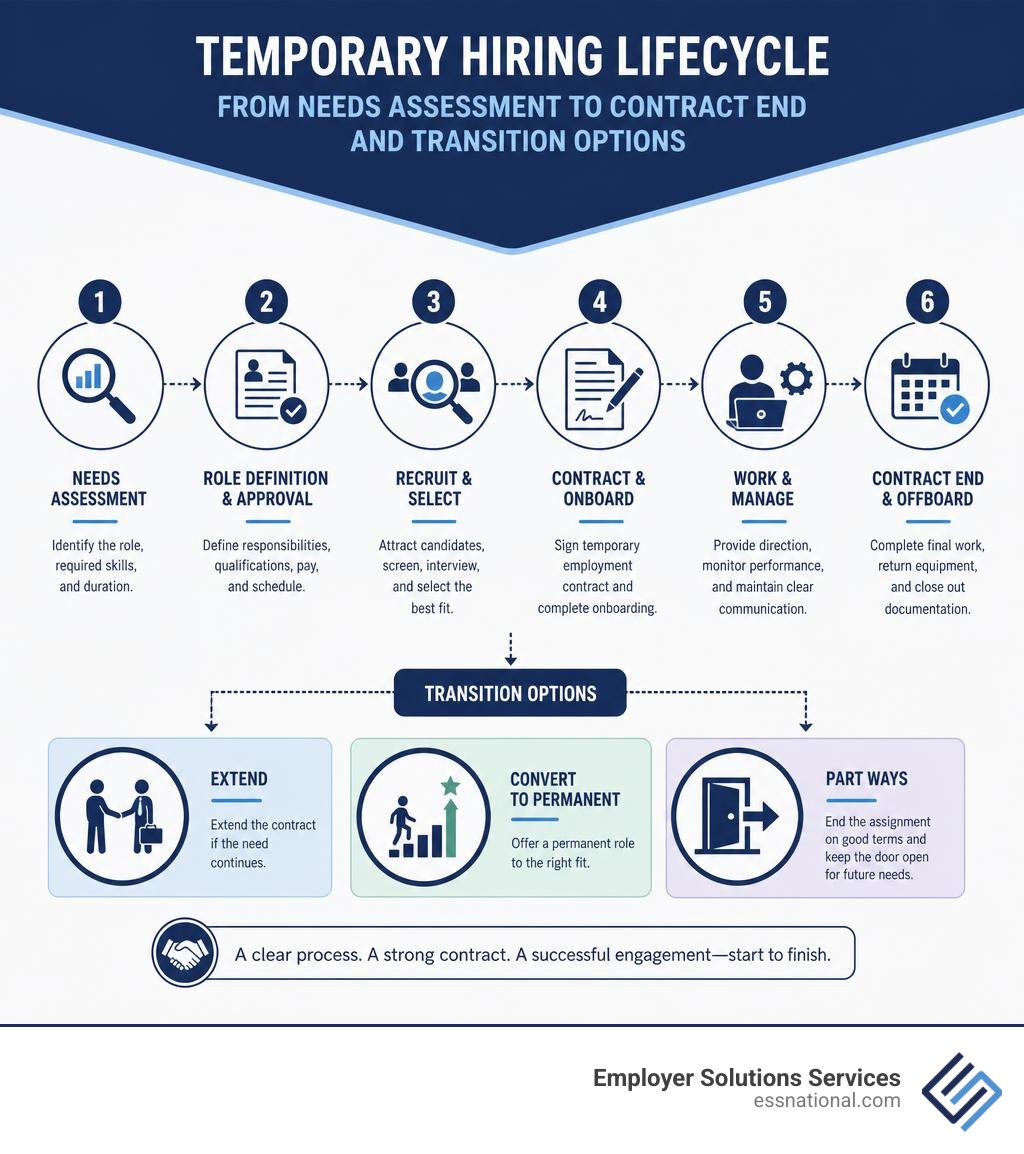
Terms related to temporary employment contract:
Understanding the Basics of Short-Term Agreements
When business demands fluctuate, hiring permanent staff isn’t always the smartest financial move. Whether you are ramping up for the holiday retail rush in Florida, handling peak agricultural seasons in Georgia, or covering for an administrative assistant on medical leave in Texas, short-term agreements keep your business agile.
Relying on handshakes and verbal agreements for short-term help is a recipe for operational chaos. Written agreements define expectations from day one, ensuring both parties are protected.
What is a Temporary Employment Contract?
A temporary employment contract is a formal, written agreement that establishes an employer-employee relationship for a limited duration. Unlike permanent hiring, which assumes an ongoing relationship, a temporary contract is built for casual, seasonal, or project-based work. It outlines the specific scope of work, compensation, hours, and crucially, the understanding that the role has a built-in shelf life.
This document serves as your legal shield. It clarifies that the worker is a W-2 employee, subject to standard payroll tax withholdings and company policies, but explicitly states there is “no expectation of permanent employment.” Learn more about temporary employment to understand how these agreements keep your business running smoothly without long-term overhead.
Temporary vs. Fixed-Term Contracts
While people often use the terms interchangeably, there is a distinct operational difference between a temporary contract and a fixed-term contract:
- Temporary Contracts: These are highly flexible. They are ideal for casual, seasonal, or “as-needed” work where the exact end date might be fluid (e.g., “until the harvest is complete” or “for the duration of the holiday shopping rush”). They can typically be terminated by either party with minimal notice.
- Fixed-Term Contracts: These have a hard, predetermined end date or are tied to a highly specific project milestone (e.g., “ending on December 31, 2026” or “upon the completion of the software migration”). They offer more stability for the worker but bind the employer to a set timeline unless there is “cause” for early termination.
| Feature | Temporary Contract | Fixed-Term Contract | Permanent Contract |
|---|---|---|---|
| Duration | Short-term, fluid end date | Defined period or project milestone | Indefinite |
| End Date | Flexible / Estimated | Predetermined / Fixed | None |
| Best Used For | Seasonal peaks, general coverage | Specialized projects, parental leave | Core business growth |
| Commitment Level | Low | Moderate | High |
Temporary Employee vs. Independent Contractor: Key Legal Distinctions
One of the most common legal traps for businesses is confusing a temporary employee with an independent contractor. Calling a worker a “contractor” and handing them a 1099 form does not make them one in the eyes of the law.
W-2 Employee vs. 1099 Contractor
The IRS and state labor departments look closely at the reality of the working relationship, not just the label on the contract. They evaluate three primary categories of control:
- Behavioral Control: Do you direct how, when, and where the worker does their job? If you set their daily schedule, provide their training, and closely supervise their tasks, they are legally an employee.
- Financial Control: Who provided the laptop, the software licenses, or the safety gear? If you provide the business tools and pay them an hourly wage, they are an employee. Independent contractors typically use their own specialized tools and submit invoices for flat-fee project rates.
- Type of Relationship: Is the work core to your daily business operations? If you run a logistics facility in New Jersey and hire warehouse packers, those workers are performing core business functions under your direct supervision. They are temporary W-2 employees, not independent contractors.
For a detailed breakdown of how government entities evaluate these relationships, you can review the IRS guidelines on worker classification.
The Severe Risks of Worker Misclassification
Misclassifying a temporary employee as an independent contractor to avoid paying payroll taxes or workers’ compensation premiums is a high-risk gamble.

Under IRS Section 3509, if you misclassify an employee, you can be held personally liable for:
- 1.5% of the worker’s wages for federal income tax withholding.
- 20% of the employee’s share of FICA (Social Security and Medicare) taxes.
- 100% of the employer’s matching share of FICA and FUTA (unemployment) taxes.
If you failed to file a Form 1099-NEC for that worker, those penalties double to 3% of wages and 40% of the employee’s FICA share. Additionally, the Department of Labor (DOL) can demand years of back pay for unpaid overtime, and state agencies in places like Illinois or Massachusetts can levy massive civil fines and stop-work orders for failing to carry workers’ compensation coverage.
Essential Clauses to Include in Your Temporary Employment Contract
To protect your business from wage disputes, intellectual property theft, and wrongful termination claims, your temporary employment contract must be structurally sound.
Core Terms: Duration, Duties, and Compensation
Every solid agreement starts with the basics. You must clearly define:
- The Parties: The legal names of your business and the employee.
- Start and End Dates: Clearly state when the work begins and the estimated or fixed date it will end.
- Job Title and Measurable Duties: Do not write a vague description. Clearly outline what the worker is expected to do. This makes performance evaluations straightforward and prevents “scope creep.”
- Work Schedule: Specify the expected hours, shifts, and whether overtime is anticipated.
- Financial Compensation: State the exact hourly wage or salary, how often they will be paid (e.g., weekly or bi-weekly), and how timesheets must be submitted.
To kickstart your drafting process, you can Download a free temporary employment contract template to ensure you have a clean, structured baseline.
Protective Clauses: Confidentiality, IP, and Termination
Short-term workers often get access to sensitive company information, client lists, or proprietary workflows. To safeguard your business assets, include these protective clauses:
- Confidentiality: Prevents the worker from sharing your trade secrets, customer data, or operational strategies during and after their employment.
- Intellectual Property (Work-for-Hire): Explicitly states that any software, designs, copy, or products created by the temporary worker during their hours of employment belong solely to your business.
- At-Will Disclaimer: Clarifies that the employment relationship is “at-will” (applicable in states like Florida, Texas, and Georgia), meaning either party can terminate the agreement at any time, with or without cause or advance notice.
- No Expectation of Permanent Employment: A vital clause that prevents the worker from claiming they were promised a permanent role after their temporary contract expires.
How Employment Laws Apply to Temporary Workers
A common myth is that labor laws only apply to “regular” full-time employees. In reality, temporary workers enjoy almost all of the same federal and state statutory protections as permanent staff.
Federal Regulations: FLSA and ACA Compliance
At the federal level, temporary workers are fully protected under the Fair Labor Standards Act (FLSA). This means you must:
- Pay at least the federal minimum wage (or the state minimum, whichever is higher).
- Pay overtime (1.5 times their regular rate) for any hours worked over 40 in a single workweek.
- Maintain accurate records of all hours worked.
Furthermore, under the Affordable Care Act (ACA), if your business has 50 or more full-time equivalent employees, you may be required to offer health insurance to temporary workers who average 30 or more hours of work per week over a specific measurement period.
Additionally, under the Employee Retirement Income Security Act (ERISA), the “1,000-hour rule” dictates that if a temporary or part-time worker completes 1,000 hours of service within a 12-month period, they may become legally eligible to participate in your company’s retirement plans.
State-Specific Legal Variations
Because we operate across multiple states, it is critical to understand that local compliance rules vary wildly.
Florida
Florida relies heavily on federal standards for wage and hour compliance, and is a strict at-will employment state. However, you must ensure your contracts do not inadvertently create implied long-term contracts. Review the Florida employment contract rules to stay compliant.
Georgia
Like Florida, Georgia is an at-will state with few state-specific restrictions on temporary workers, but contracts must clearly define the scope of work to avoid breach-of-contract disputes. See Georgia employment agreements for details.
Illinois
Illinois has some of the strictest temporary labor laws in the country. The Illinois Day and Temporary Labor Services Act mandates that temporary workers placed through agencies must receive equal pay and equivalent benefits to direct-hire permanent employees after they have worked 90 days in a matching role.
New Jersey
New Jersey’s New Jersey Temporary Workers’ Bill of Rights provides sweeping protections for temporary workers in specific occupational categories (such as manufacturing, logistics, and food preparation). It requires equal pay, equal benefits, detailed written disclosures of work conditions, and strictly regulates how staffing agencies and client businesses handle temporary payroll.
Massachusetts
Massachusetts requires clear, written notices of job details, pay rates, and workers’ compensation coverage before work begins. For guidance on structuring these agreements, consult Employment Agreements.
Weighing the Pros and Cons of Temporary Hiring
Hiring temporary workers is an excellent way to scale your business, but it is not without operational hurdles.
Benefits for Employers
- Operational Flexibility: Scale your workforce up or down based on seasonal demands without the painful process of layoffs.
- Specialized Skills: Bring in experts for short-term projects (like a system migration or a marketing campaign) without paying a permanent executive salary.
- Reduced Overhead: Temporary workers often do not qualify for standard company-sponsored benefits (like paid vacation or health insurance, provided they stay under ACA/ERISA hour thresholds).
- Trial Periods: Use the temporary period as a real-world test drive to see if the worker is a good fit for a permanent role.

To learn more about why companies are shifting to this model, read about Why temporary staffing is the new normal.
Drawbacks and Limitations
- Training Costs: You must spend time and resources training a worker who will eventually leave your organization.
- Cultural Integration: Temporary workers may struggle to bond with your permanent team, potentially impacting morale.
- High Turnover: Because the role is short-term, temporary employees are always looking for their next permanent gig and may leave abruptly if offered a full-time position elsewhere.
How to Draft and Manage Your Agreement
Managing the lifecycle of a temporary employment contract requires diligence to prevent compliance drift.
Step-by-Step Process to Draft a Temporary Employment Contract
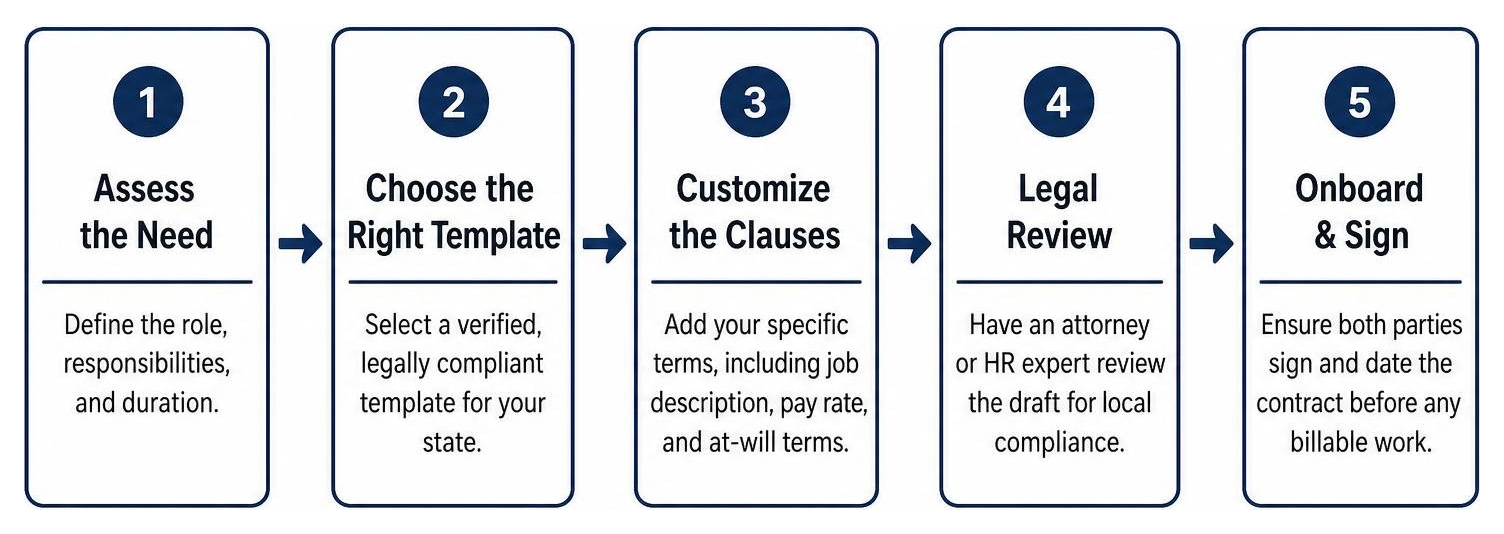
- Assess the Need: Define exactly why you need the worker, what they will do, and how long they will be needed.
- Choose the Right Template: Start with a verified, legally compliant template tailored to your state’s laws.
- Customize the Clauses: Input your specific terms, paying close attention to the job description, hourly wages, and at-will disclaimers.
- Legal Review: Have an experienced employment attorney or HR expert review the draft to ensure local compliance.
- Onboard & Sign: Ensure both parties sign and date the contract before the employee performs any billable work.
Managing Renewals and Transitions
If a temporary project runs over schedule, you might want to extend the contract. However, keeping a worker on a temporary contract indefinitely is a major compliance risk.
As a best practice, if a temporary worker is still with your business after 12 months, you should convert them into a permanent W-2 employee. Keeping them in “temporary limbo” can trigger audits, benefits disputes, and claims of implied permanent employment.
If you are ready to transition a stellar temp worker into a permanent team member, read our guide on Transitioning temp-to-hire workers to handle the process seamlessly.
Frequently Asked Questions about Temporary Contracts
How long can a temporary employment contract last?
There is no strict federal limit on how long a temporary contract can last. However, the US Chamber of Commerce states that temporary roles typically run under 1,000 hours or one year. Keeping a worker on a temporary contract for longer than 12 months increases your risk of worker misclassification and benefits disputes under ERISA.
Are temporary employees eligible for benefits?
Generally, employers can exclude temporary workers from standard company benefits like paid time off, dental insurance, and performance bonuses, provided this exclusion is explicitly written into the contract. However, they are still entitled to statutory benefits like workers’ compensation and unemployment insurance. Furthermore, under federal law, they may become eligible for ACA health coverage or ERISA retirement plans if they meet specific hourly thresholds (e.g., working 1,000 hours in a year).
Can a temporary contract be terminated early?
Yes. If your contract contains a clear “at-will” clause, either party can end the agreement at any time, with or without cause. If you are using a fixed-term contract, early termination can be trickier and may require you to pay out the remainder of the contract unless you have documented “cause” (such as gross misconduct or breach of contract).
Conclusion
Drafting a solid temporary employment contract does not require a law degree, but it does require careful attention to detail. By clearly defining the scope of work, protecting your intellectual property, and respecting state-specific labor regulations, you can scale your business with confidence.
However, managing payroll, tracking hours for ACA compliance, and navigating complex state laws like New Jersey’s Bill of Rights or Illinois’ Day and Temporary Labor Services Act can quickly overwhelm your internal team.
That is where we come in. At Employer Solutions Services (ESS), we bring over 30 years of HR and staffing experience to the table. We provide fully compliant temporary, temp-to-hire, and direct-hire staffing programs, alongside comprehensive back-office administration like payroll and tax withholding. We handle the contracts, the compliance, and the risk, leaving you free to focus on growing your business.
Ready to take the administrative burden off your plate? Partner with ESS for compliant temporary staffing solutions today and let our experts handle your short-term hiring needs seamlessly.