
What Staffing Agencies Actually Charge for Direct Hire (And Why It Matters)
How much do staffing agencies charge for direct hire is one of the most common questions business owners ask before signing with a recruiter — and the answer directly affects your hiring budget.
Here’s the quick answer:
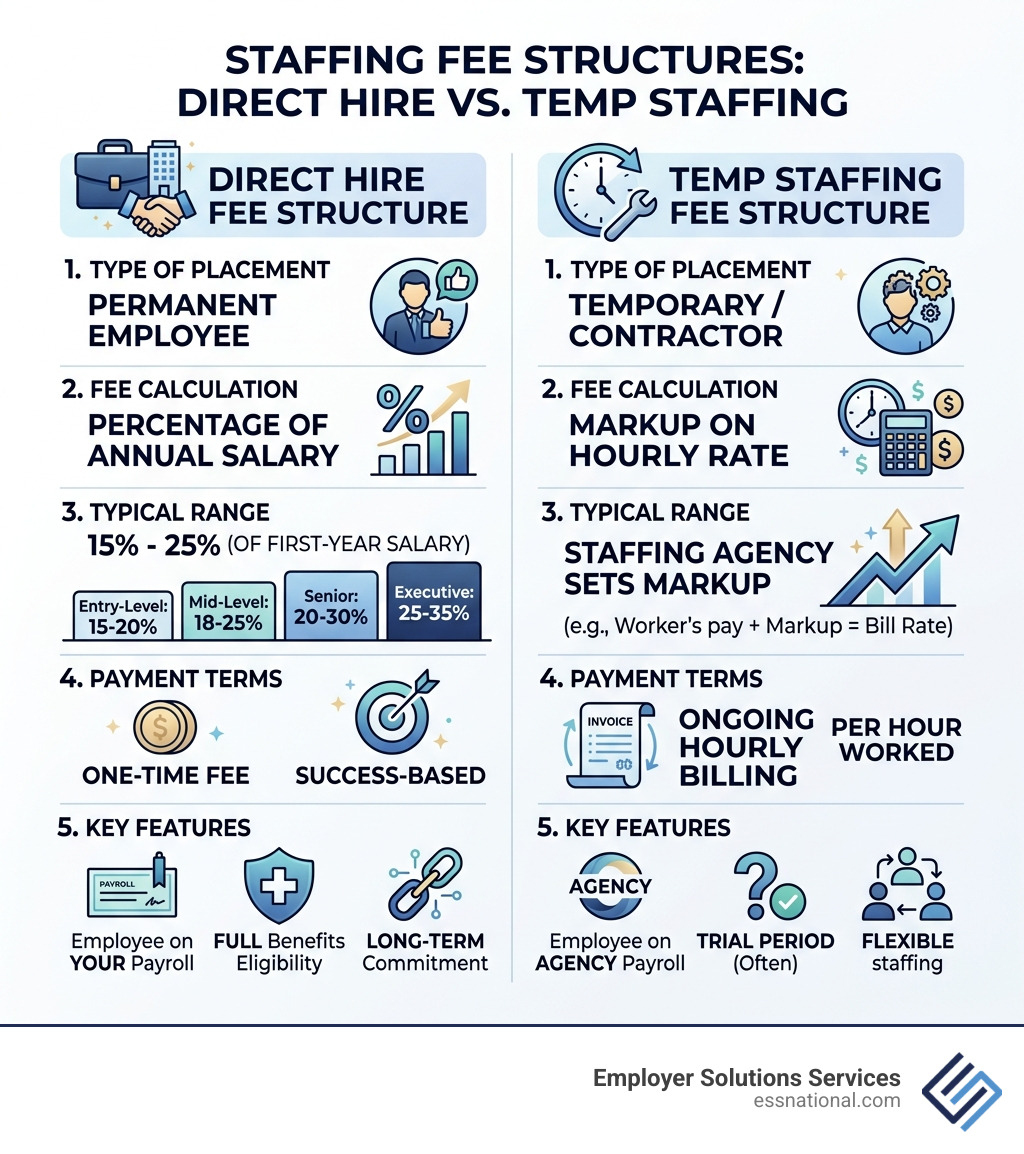
| Position Level | Typical Fee Range |
|---|---|
| Entry-level | 15% – 20% of first-year salary |
| Mid-level | 18% – 25% of first-year salary |
| Senior / Managerial | 20% – 30% of first-year salary |
| Executive / Specialized | 25% – 35% of first-year salary |
Most direct hire fees land between 15% and 25% of the candidate’s first-year base salary, with 20% being the most common rate across the industry. For a $100,000 salary, that means a one-time fee of $15,000 to $25,000 — paid only after a candidate is successfully placed.
Unlike temporary staffing, direct hire means the candidate goes straight onto your payroll from day one, with full benefits eligibility and no trial period required.
That one-time fee can feel like a big number at first glance. But when you factor in the cost of a vacant role, the hours your team spends screening resumes, and the risk of a bad hire — the math often looks very different.
This guide breaks down exactly what you’ll pay, what drives costs up or down, and how to make sure you’re getting real value for every dollar.
How Much Do Staffing Agencies Charge for Direct Hire?
When you partner with a staffing firm for a permanent placement, you aren’t paying for “hours worked” like you would with a temp. Instead, you are paying for the successful acquisition of a new team member. The majority of fees range between 15% and 25% of the hire’s first-year annual salary.
According to data from Staffing Industry Analysts (SIA), the most common benchmark is 20%, with 42% of firms reporting this as their standard rate. This is typically a one-time fee that covers the entire recruitment lifecycle: from drafting the job description and sourcing candidates to conducting initial interviews and background checks.
It is important to understand that this percentage is usually calculated based on the candidate’s “first-year compensation.” In most contracts, this refers to the base salary. However, some agreements may include guaranteed bonuses or commissions in that calculation. For example, if we place a Sales Manager with a $100,000 base salary at a 20% fee, the cost is $20,000. If that same manager has a guaranteed $20,000 sign-on bonus included in the “annual compensation” definition, the fee could rise to $24,000. Always check your contract to see how “salary” is defined!
How much do staffing agencies charge for direct hire by position level?
The complexity of the search dictates the price. Think of it like this: finding a reliable administrative assistant is a different “heavy lift” than finding a CFO with experience in international mergers.
- Entry-Level Positions: For roles with salaries between $40,000 and $60,000, fees often hover around 15% to 20%. These roles usually have a larger active candidate pool, making the search faster.
- Mid-Level Management: For professional roles (engineers, supervisors, mid-level accountants), expect 20% to 25%. These candidates are often “passive,” meaning they aren’t looking at job boards and need to be recruited away from their current roles.
- Senior Management & C-Suite: For executive searches, fees jump to 25% to 35%. These searches require deep networking, extensive vetting, and often several months of dedicated headhunting.
- Specialized Roles: High-demand technical roles—like a specialized diesel technician in Pennsylvania or a bilingual HR manager in Texas—often command higher percentages regardless of seniority because the talent scarcity is so high.
How much do staffing agencies charge for direct hire in specialized industries?
Industry market demand is a massive driver of cost. In our 30+ years of experience across states like Florida, Illinois, and New Jersey, we’ve seen that niche networks are the key to keeping costs manageable while ensuring quality.
- IT & Engineering: These are “candidate-driven” markets. Because there are more jobs than qualified people, recruiters spend more time on “outbound” sourcing. Fees here rarely dip below 20-25%.
- Healthcare: Compliance and licensing requirements add layers of verification. Specialized nursing or clinical roles often sit at the higher end of the fee spectrum.
- Skilled Trades: In hubs like Georgia or Nevada, finding certified HVAC techs or experienced warehouse managers is a challenge. Because these candidates aren’t usually sitting behind a computer, recruiters have to use “boots on the ground” networking, which justifies a 20% fee.
Understanding Contingency, Retainer, and Flat Fee Models
Not every agency bills the same way. Choosing the right model depends on how much risk you want to share with the agency and how “mission-critical” the role is.
| Model | How It Works | Best For |
|---|---|---|
| Contingency | No hire, no fee. You only pay when a candidate starts. | Mid-level, high-volume, or non-urgent roles. |
| Retained | You pay a portion upfront (deposit) to secure exclusive time. | Executive search or highly confidential roles. |
| Flat Fee | A set dollar amount (e.g., $5,000) regardless of salary. | High-volume entry-level roles or specific project hiring. |
Contingency Fees
This is the “pay-for-performance” model and the most common in the industry. It’s great for businesses because there is zero financial risk upfront. We do the work, find the talent, and you only pay if you decide they are the perfect fit.
Retained Search
For C-suite roles, a retained model is standard. You might pay one-third of the estimated fee upfront, one-third upon the presentation of a “shortlist” of vetted candidates, and the final third when the hire starts. This ensures the agency dedicates its top recruiters exclusively to your search.
Flat Fee Model
Sometimes used for volume hiring (e.g., “We need 10 warehouse leads in Illinois”), a flat fee provides predictable budgeting. Instead of a percentage, you pay a fixed amount per head. This is often more cost-effective if the roles have similar requirements.
Exclusive vs Non-Exclusive Agreements
When you sign an exclusive agreement, you promise to only use one agency for a specific role for a set period (usually 30 to 60 days). In exchange, the agency typically gives that search higher priority.
Why? Because the recruiter knows that if they find the right person, they will get paid. In a non-exclusive “race,” agencies might prioritize “easier” roles where they aren’t competing with three other firms. Exclusivity often leads to better candidate ownership and faster results because the partnership is deeper.
Factors That Drive Direct Placement Costs Up or Down

Several variables can shift your final invoice. Being aware of these can help you negotiate better terms or prepare your budget more accurately.
- Geographic Location: Hiring in high-cost-of-living areas like Massachusetts or Northern New Jersey often comes with higher base salaries, which naturally increases a percentage-based fee. Furthermore, some markets are just “tighter” than others, requiring more effort to source talent.
- Urgency: If you need a role filled “yesterday,” the agency has to drop other projects to focus on yours. This “rush” service can sometimes limit your ability to negotiate lower percentages.
- Search Difficulty: Are you looking for a “purple squirrel” (a candidate with a rare combination of skills)? The harder the search, the more you should expect to pay toward the 25-30% range.
- Passive Candidates: A huge part of the value we provide is reaching people who aren’t looking for jobs. Accessing this “hidden” talent pool takes more time than just posting an ad, which is reflected in the fee. To understand more about how this prevents turnover, check out our guide on how to Stop the Revolving Door with Direct Placement Staffing.
- Volume Discounts: If you are hiring five managers instead of one, most agencies (including us!) are willing to negotiate a lower percentage.
Hidden Costs and Contractual Terms
The “fee” isn’t the only thing in the contract. You need to look at the fine print to avoid surprises.
- Guarantee Periods: Most reputable agencies offer a 60- to 90-day guarantee. If the candidate leaves or is terminated for cause within this window, the agency will either find a replacement for free or provide a prorated refund.
- Payment Terms: Standard is “Net-30,” meaning you have 30 days from the candidate’s start date to pay the invoice. Some agencies offer discounts for “Net-10” payments.
- Non-Solicitation: This clause prevents you from hiring candidates the agency presented for other roles within your company for a set period (usually 12 months) without paying a fee.
- Deposits: While rare in contingency models, some agencies charge a small engagement fee ($1,000 – $5,000) for new clients or highly specialized searches to ensure the client is serious.
Frequently Asked Questions
Is using a staffing agency for direct hire worth the ROI?
Absolutely. While a $15,000 fee sounds high, compare it to the “hidden” costs of internal hiring. Between job board subscriptions, HR hours spent screening hundreds of unqualified resumes, and the lost productivity of a vacant seat (which can cost $1,900+ per week for a $100k role), the agency fee often pays for itself in time savings alone. Plus, a “bad hire” can cost 1.5x to 2x the annual salary in lost training and turnover costs. We help you get it right the first time.
What is the difference between direct hire and temp-to-hire fees?
In a direct hire, you pay a one-time percentage fee, and the worker is yours from day one. In a temp-to-hire arrangement, you pay an hourly “markup” (usually 25% to 60% over the worker’s pay rate). This markup covers payroll taxes, workers’ comp, and insurance. If you decide to hire the temp permanently before a set period (like 480 hours), you may have to pay a “conversion fee,” which is essentially a prorated direct hire fee.
What happens if a direct hire candidate leaves early?
This is where the Placement Guarantee kicks in. Most agencies offer a 90-day window. If the candidate quits on day 45, we typically restart the search at no additional cost to you. This mitigates the risk of your investment and ensures the agency is incentivized to find a long-term fit, not just a “quick body.”
Conclusion
Understanding how much do staffing agencies charge for direct hire is about more than just looking at a percentage—it’s about evaluating the total value of your time and the quality of your team. A 20% fee for a candidate who stays for five years and drives innovation is a far better investment than a “cheap” 10% fee for a candidate who leaves after three months.
When evaluating an agency, look beyond the price tag. Ask about their screening rigor, their experience in your specific industry, and their track record in your local market—whether that’s the bustling suburbs of Chicago or the industrial hubs of Nevada.
At Employer Solutions Services (ESS), we bring over 30 years of experience to the table, helping businesses across the East Coast, Midwest, and Southwest find the talent they need to thrive. We don’t just send resumes; we provide customized human resource solutions that fit your specific culture and goals.
Ready to find your next top performer? Explore Our Services today and let us take the headache out of your hiring process.