Why Payroll Services Matter for Your Business
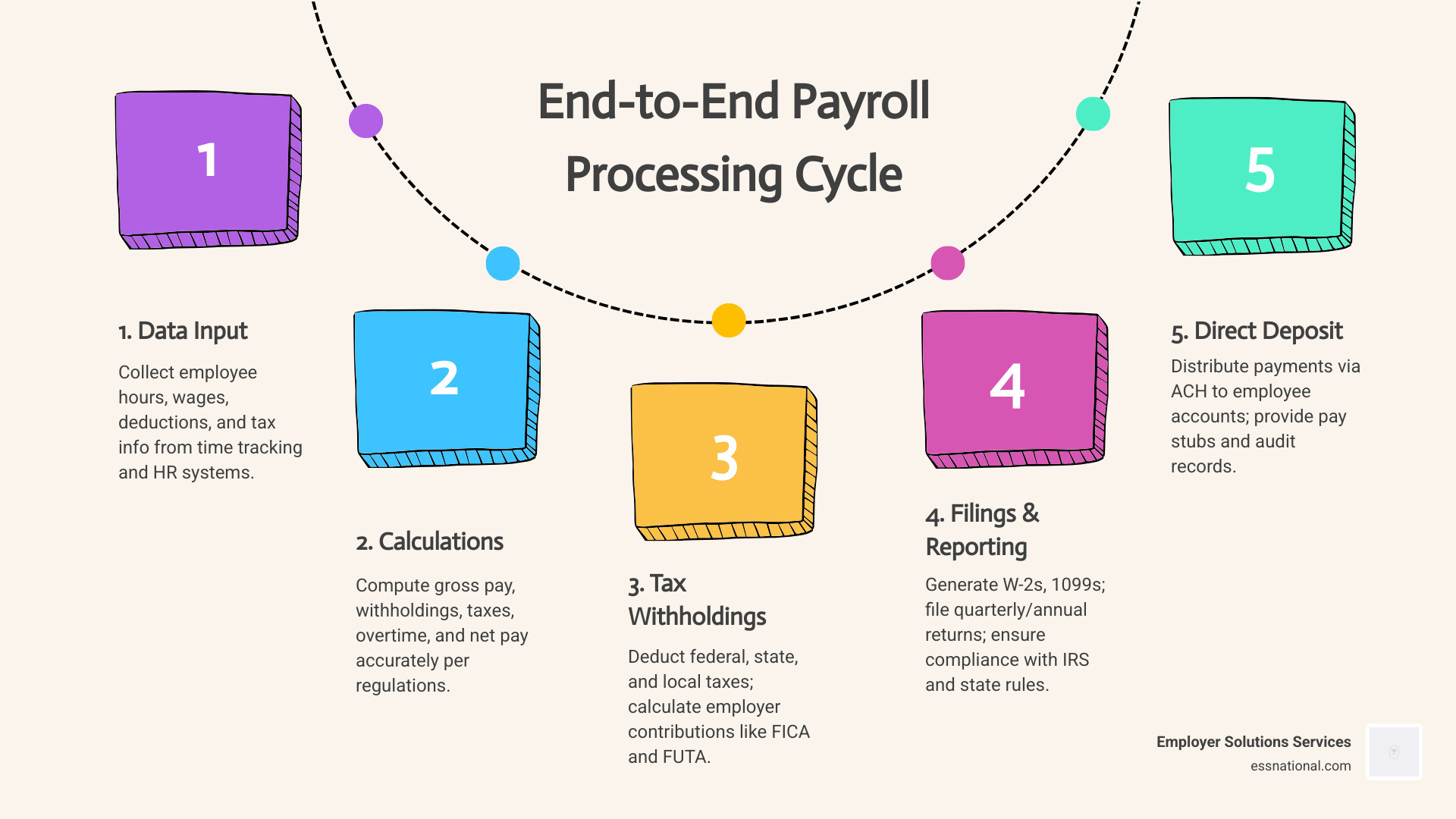
Payroll services are third-party solutions that handle employee compensation, tax withholdings, filings, and compliance on behalf of your business — so you don’t have to.
Running payroll in-house sounds simple. But it gets complicated fast.
Between calculating deductions, staying current on tax law, filing forms on time, and managing direct deposits — the administrative load adds up. And mistakes are costly. Penalties for payroll tax errors can hit hard, especially for growing businesses already stretched thin.
That’s why so many business owners outsource payroll. Professional providers manage the complex requirements of tax compliance and reporting for millions of businesses, providing a level of security that is difficult to achieve manually. This widespread adoption of outsourcing highlights how critical professional management is for modern operations.
For mid-sized business owners juggling workforce gaps and back-office bottlenecks, the right payroll service doesn’t just cut busywork. It improves accuracy, keeps you compliant, and helps your employees get paid on time — every time.
Understanding Different Types of Payroll Services

When we talk about payroll services, it isn’t a one-size-fits-all situation. Depending on whether you have a handful of local baristas in Florida or a sprawling manufacturing team across Georgia and Texas, your needs will vary wildly. Understanding the “flavor” of service you need is the first step toward reclaiming your Friday afternoons.
The Spectrum of Service
- Full-Service Payroll: This is the “hands-off” approach. These providers handle everything from calculating gross-to-net pay to filing your federal, state, and local taxes. If you want to sleep soundly knowing your W-2s and 1099s are handled, this is your lane.
- Contractor-Only Models: Perfect for the gig economy. If you don’t have W-2 employees but rely on a fleet of freelancers, these services focus on 1099-NEC reporting and direct deposits at a lower price point.
- Professional Employer Organizations (PEO): This is a co-employment model. A PEO becomes the “employer of record” for tax purposes, allowing small businesses to access enterprise-level benefits and shared liability.
- Employer of Record (EOR): Often used during payroll transfers or staffing transitions, an EOR handles the legal and administrative side of employment while you manage the day-to-day work.
Comparing Your Options
| Feature | DIY Software | Full-Service | PEO / EOR |
|---|---|---|---|
| Tax Filing | You click “submit” | They handle it | They are legally responsible |
| Liability | 100% Yours | Shared/Guaranteed | Shifted to Provider |
| Benefits Admin | Manual | Integrated | Group Buying Power |
| Best For | Micro-businesses | Small to Mid-sized | Rapidly scaling firms |
For many business owners, choosing the right structure isn’t just about administrative ease—it’s about the bottom line. For instance, Potential tax savings for S-Corp elections can be significant. Sole proprietors with over $40,000 in profit might see major self-employment tax savings by taking an S-Corp election, but this requires a robust payroll system to handle the mandatory reasonable salary payments and associated taxes correctly.
Full-Service Payroll Services for Small Business
Full-service payroll services act like a dedicated back-office team. We’ve seen how much stress automations can remove. A true full-service provider doesn’t just “do the math”; they manage the entire lifecycle of a paycheck.
Key components include:
- Automated Tax Filing: They calculate and pay federal, state, and local taxes. In states like Illinois or Massachusetts, where local tax rules can be finicky, this is a lifesaver.
- Direct Deposit & Garnishments: Ensuring funds hit bank accounts on time and managing court-ordered garnishments without manual entry errors.
- Year-End Reporting: Generating W-2s for employees and 1099-NEC forms for contractors automatically.
- Compliance Guarantees: Many top providers offer an accuracy guarantee. If they mess up the math and the IRS comes knocking, they foot the bill for the penalties.
Specialized Contractor-Only Payroll Services
The modern workforce is increasingly flexible. If your business in Nevada or Pennsylvania relies heavily on freelancers, you might not need a full HR suite. Contractor-only plans can be highly cost-effective, often charging a small fee per person paid. These services focus on:
- Gig Economy Support: Quick onboarding for new freelancers.
- Flexible Pay: Paying contractors on different schedules than your core team.
- Automated 1099s: No more scrambling in January to mail out forms.
Key Features and Benefits of Modern Payroll Solutions
Modern payroll services have evolved far beyond the “green visor” accounting of the past. Today, it’s about integration and data. When your payroll talks to your time-tracking software, magic happens (or at least, you stop getting headaches).
The Power of Automation
One of the biggest perks is the employee self-service portal. Instead of an employee texting you at 9 PM because they lost their pay stub, they can log in and download it themselves. They can also update their own addresses or bank info, which is a massive time-saver for you.
Research into self-employment tax savings and entity formation shows that as businesses grow, the complexity of managing “reasonable compensation” becomes a hurdle. Modern software makes this transparent and easy to track for audit purposes.
Integrated HR and Benefits Administration
Why have five different logins when you can have one? The best payroll services integrate:
- Health Insurance Sync: Deductions are taken out automatically based on the plan selected.
- 401(k) Contributions: Real-time syncing with retirement providers ensures you’re never behind on matching.
- Workers’ Compensation: Some providers offer “pay-as-you-go” workers’ comp. Instead of a giant upfront estimate, your premium is calculated based on each actual pay run. This keeps cash flow steady in states like New Jersey or Texas where premiums can be high.
- Onboarding Tools: Digital offer letters and e-signatures mean a new hire can be “in the system” before they even walk through the door.
Software Integrations and Reporting
If you use popular accounting software or a specific POS system for your retail shop, your payroll should “talk” to them.
- POS Connectivity: Import timecards, tips, and commissions directly. This is crucial for the food and beverage industry.
- Customizable Reports: You can run reports on labor costs by location, department, or even specific projects.
- General Ledger Mapping: Every penny spent on payroll is automatically categorized in your accounting software, making tax season a breeze for your CPA.
Navigating Costs and Pricing Models
Let’s talk money. You’re a business owner, so you know that “cheap” can often become “expensive” if it leads to errors. Most payroll services follow a two-part pricing model: a monthly base fee plus a per-employee fee.
Common Pricing Structures
- The Subscription Model: A flat monthly fee (ranging from $35 to $150+) plus $6 to $12 per employee.
- The All-Inclusive Model: Often used by PEOs, this might be a percentage of total payroll or a higher per-head fee that includes all HR and compliance tools.
- The “A-La-Carte” Model: You pay a base price for payroll and add on modules like benefits administration or time tracking as you grow.
Hidden Costs to Watch For:
- Setup Fees: Some providers charge a one-time fee (around $50-$100) to get your data into the system.
- Year-End Fees: Watch out for extra charges for filing W-2s and 1099s.
- Multi-State Surcharges: If you have employees in both Georgia and Illinois, some providers charge extra for filing in multiple states.
How to Seamlessly Transfer Your Payroll System
We know what you’re thinking: “Switching sounds like a nightmare.” But staying with a bad system is worse. Transferring your payroll services is actually a structured process that can be done with minimal friction if you follow the right steps.
The Transfer Roadmap
- Data Audit: Before moving, ensure your current records are clean. This includes employee addresses, Social Security numbers, and year-to-date earnings.
- Historical Migration: Your new provider will need your payroll history from the beginning of the calendar year to ensure tax limits (like FICA) are calculated correctly.
- Parallel Payroll Runs: For the first cycle, some businesses run their old and new systems side-by-side to ensure the numbers match perfectly.
- Employee Self-Onboarding: Modern systems allow employees to log in and verify their own data, which catches errors before the first check is cut.
At Employer Solutions Services, we’ve spent 30 years helping businesses through these transitions. Whether you’re moving from a spreadsheet or a legacy software, the goal is always the same: zero downtime and 100% accuracy.
Frequently Asked Questions about Payroll Management
How do payroll services handle multi-state tax compliance?
This is where professional payroll services really shine. If your business is based in Pennsylvania but you hire a remote worker in Texas, you suddenly have “nexus” in two states.
- Nexus Determination: The service identifies where you owe taxes.
- Reciprocity Agreements: In some regions, employees who live in one state but work in another have special tax rules. The software handles these automatically.
- Local Filings: States like Pennsylvania have complex local earned income taxes. A good provider stays updated on every tiny municipality’s requirements.
What is the difference between a payroll provider and an Employer of Record?
It comes down to who is the legal “boss” on paper.
- Payroll Provider: You are the employer. They are your tool. You own the tax ID and the liability.
- Employer of Record (EOR): They are the legal employer for tax purposes. They use their tax ID, provide the workers’ comp, and handle the administrative burden. You still manage the employee’s work, but the “back-office” risk sits with them.
How long does it take to set up and run the first payroll?
If you have your documents ready (EIN, bank info, employee W-4s), you can often get a basic system running in 3 to 5 business days. However, for complex mid-sized businesses with integrated benefits, we usually recommend a 2-week implementation window to allow for thorough testing and training.
Conclusion
Managing a workforce is hard enough without the constant shadow of tax deadlines and compliance audits. Whether you are a retail shop in Nevada or a multi-state manufacturing firm, choosing the right payroll services is one of the smartest moves you can make for your sanity and your bottom line.
At Employer Solutions Services, we bring over 30 years of experience to the table. We don’t just offer software; we provide comprehensive workforce management. From staffing and screened talent to back-office administration and payroll, we customize our programs to fit your specific industry needs across Florida, Georgia, Illinois, Massachusetts, Nevada, New Jersey, Pennsylvania, and Texas.
Ready to stop stressing over spreadsheets and start focusing on growth? We’re here to help you bridge the gap between “getting it done” and “getting it done right.”