
The Case for Permanent Staffing: Why Direct Placement Healthcare Workers Have the Edge
Direct placement healthcare workers are professionals hired permanently by a facility from day one — no temp period, no agency middleman, no uncertainty about whether the role will last.
If you’re a healthcare facility manager dealing with constant turnover and staffing gaps, here’s the short answer on what direct placement means for you:
Direct Hire Healthcare Staffing at a Glance:
| What You Want | What Direct Placement Delivers |
|---|---|
| Stable, long-term staff | Permanent employees from day one |
| Reduced admin burden | Agency handles screening, credentialing, background checks |
| Better retention | Workers with full benefits and career growth stay longer |
| Quality candidates | Pre-vetted from pools of 350K+ nurses and 120K+ physicians |
| International talent | Visa sponsorship and relocation support included |
The U.S. healthcare system is under serious pressure. Demand for registered nurses keeps climbing. Facilities are competing for the same shrinking pool of qualified professionals. Short-term fixes like temp staffing can patch the gap — but they rarely solve it.
Direct placement is a different approach entirely. Instead of cycling through contract workers, you build a permanent team. Workers get real job security and full benefits. Facilities get continuity of care and lower long-term costs.
It’s the stability play that benefits everyone involved.
Understanding the Direct Hire Model in Healthcare
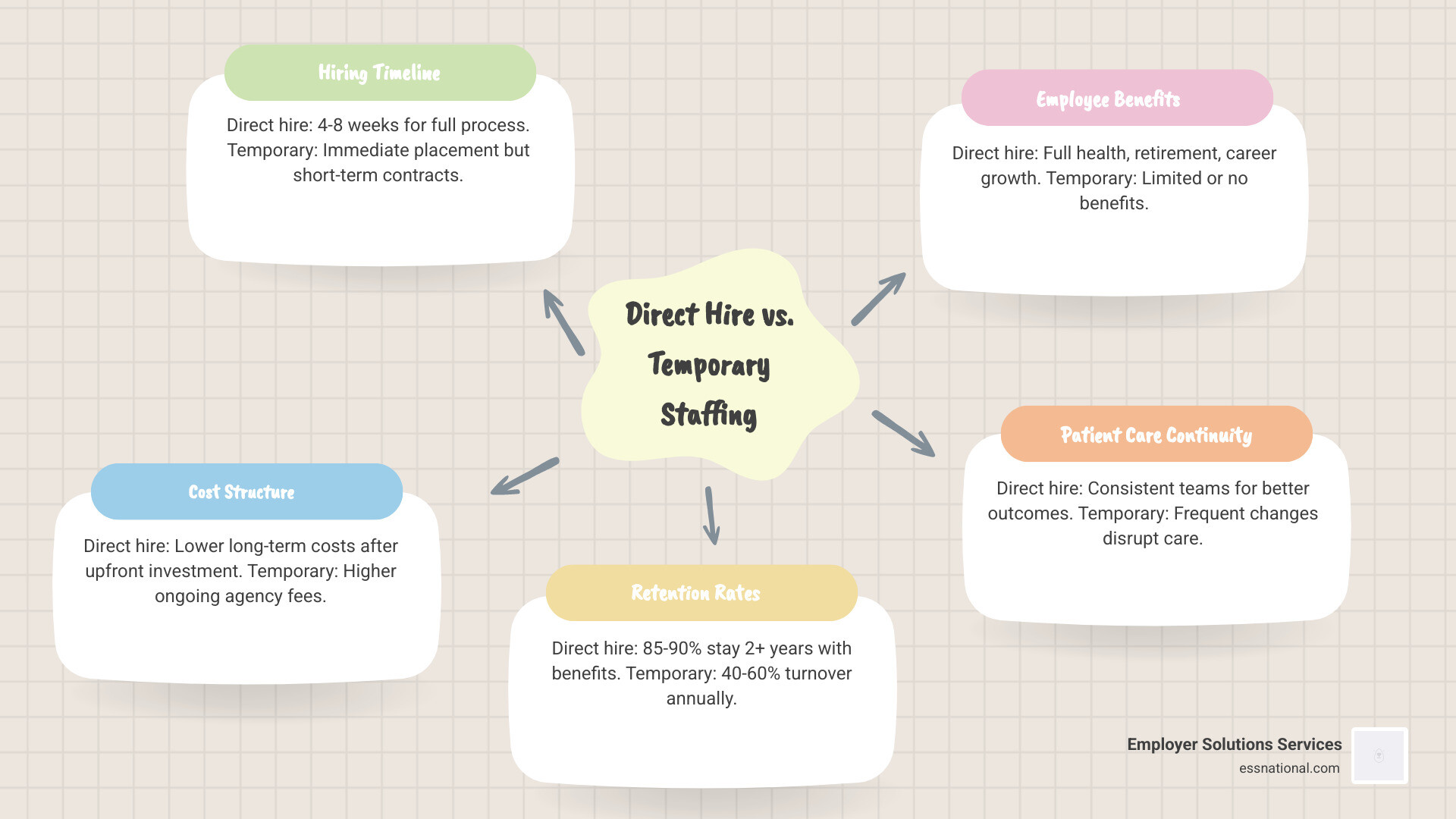
In healthcare recruitment, “direct hire” or “direct placement” is often referred to as permanent placement. Essentially, it is a recruitment service where an agency like ours finds, screens, and vets a candidate, but the healthcare facility hires that person directly onto their own payroll from the very first day.
This differs significantly from other models you might encounter in Florida, Texas, or Illinois. To help clarify the landscape, we’ve broken down the three most common staffing structures:
| Feature | Direct Hire (Permanent) | Temporary Staffing | Temp-to-Hire |
|---|---|---|---|
| Employer of Record | The Healthcare Facility | The Staffing Agency | Agency (initially), then Facility |
| Benefits & Pay | Full facility benefits from Day 1 | Provided by agency (if any) | Agency benefits during trial period |
| Commitment | Long-term/Indefinite | Short-term/Contract-based | Trial period followed by permanent offer |
| Ideal For | Building core teams and leadership | Covering vacations or seasonal surges | Evaluating “cultural fit” before committing |
When a facility utilizes direct placement healthcare workers, they are investing in the future. The worker isn’t a “guest” in the building; they are a stakeholder in the facility’s success. This model eliminates the “revolving door” feel that can sometimes plague units relying heavily on agency staffing.
The Strategic Value of direct placement healthcare workers for Modern Facilities
For healthcare administrators in Massachusetts, New Jersey, and Pennsylvania, the numbers tell a compelling story. The scale of available talent is massive, yet finding the right fit is the challenge. By leveraging a direct placement strategy, facilities gain access to a curated pipeline:
- 350,000+ RNs, LPNs, and CNAs ready for all care settings.
- 120,000+ Board-certified physicians across all specialties.
- 285,000+ Physical therapists, pharmacists, and technicians.
- 45,000+ Virtual care providers to extend reach beyond physical walls.
Retention and Continuity
One of the most striking statistics in the industry is the 90% retention or placement success rate often seen with dedicated direct hire programs. When a worker is placed directly, they are more likely to integrate into the facility’s culture. They build long-term relationships with patients, which is the cornerstone of high-quality care.
Cost-Efficiency
While there is often an upfront placement fee, direct hire is a massive cost-saver over time. You eliminate the high hourly markups associated with long-term agency contractors. Furthermore, you reduce the “hidden costs” of turnover—such as repeated orientation, training, and the administrative strain of constantly sourcing new travelers.
Why direct placement healthcare workers Prefer Permanent Roles
While some professionals enjoy the “nomadic” lifestyle of travel nursing, a significant portion of the workforce craves stability. For many, being one of the direct placement healthcare workers is the ultimate career goal.
Job Security and Financial Growth
Direct hire roles offer the same wages, benefits, and job security as existing staff from the moment the worker arrives. This includes access to 401(k) retirement plans, comprehensive health insurance, and life insurance. For those looking to plant roots in communities like Atlanta, GA, or Chicago, IL, a permanent contract is the key to qualifying for mortgages and planning a future.
Professional Development
Facilities are more likely to invest in the education of their permanent staff. This often includes:
- Tuition Assistance: Many hospitals offer to pay for advanced degrees (BSN to MSN, etc.).
- Specialized Certifications: Facilities often sponsor the costs for CCRN, CEN, or other specialty credentials.
- Career Ladders: Direct hires are eligible for promotions into management or clinical lead roles that are rarely open to temporary contractors.
For international professionals, the direct hire path provides a smoother transition and a much higher level of commitment from the employer, fostering a more stable environment for long-term career success.
The Recruitment Journey for direct placement healthcare workers
The path to a permanent role is more rigorous than a temporary assignment, but that rigor is exactly what ensures a “perfect fit” for both parties.
From Application to Onboarding: The Typical Process
We handle the heavy lifting of the recruitment cycle so facilities can focus on patient care. The journey typically follows these steps:
- Sourcing & Identification: Tapping into proprietary databases and nationwide talent pools.
- Pre-Screening: Evaluating experience, licenses, and initial “soft skill” alignment.
- Multi-Level Interviews: Coordinating interviews with HR and clinical department heads.
- Skills & Personality Testing: Ensuring the candidate has the technical proficiency and the temperament for the specific unit.
- Comprehensive Background Checks: This includes nationwide criminal searches, drug screening, and social security verification.
- Credentialing: Verifying every immunization, license, and certification.
Essential Qualifications and Credentialing Requirements
To qualify for these roles, candidates must meet stringent standards. For nurses, this includes passing the NCLEX registered nursing examination. Most direct hire positions require at least two years of clinical experience.
The talent pipeline is also becoming increasingly academic. We see a growing trend of highly educated applicants, with statistics showing:
- 5,300+ candidates with PhD/Post-doctorates.
- 12,000+ with Master’s degrees.
- 49,000+ with Bachelor’s degrees.
Common Roles and Specialties in Direct Placement
While RNs are the most frequently requested, direct placement healthcare workers span the entire medical spectrum:
- Physicians: From Anesthesiology and Cardiology to Hospitalists and ER specialists.
- Allied Health: Physical therapists, pharmacists, and lab technicians.
- Mid-Level Providers: Nurse Practitioners (NPs) and Physician Assistants (PAs).
- Executive Leadership: Clinical and non-clinical directors and C-suite roles.
- Virtual Care: 45,000+ providers ready for telehealth and remote monitoring.
International Recruitment and the Direct Hire Pathway
With the domestic nursing shortage reaching critical levels, international recruitment has become a vital lifeline for facilities in states like Nevada and Massachusetts.
Direct hire is widely considered the superior path for international workers. Unlike “sponsorship agencies” that might employ the nurse and “rent” them out, direct hire allows the hospital to act as both the sponsor and the employer. This creates a much stronger bond between the nurse and the facility.
The International Advantage:
- Visa Support: Expert guidance through EB-3, H-1B, and TN visa processes.
- Relocation Assistance: Helping nurses and their families move to the U.S. from over 100 countries.
- Licensure Support: Navigating the complex requirements of state boards of nursing.
- Cultural Integration: Providing community orientation and housing support to ensure the nurse feels at home.
Weighing the Options: Challenges and How to Apply
While we believe direct placement is the gold standard for stability, it is important to be realistic about the process.
Potential Drawbacks of the Direct Hire Model
The primary “challenge” of direct hire is the timeline. Because the screening and immigration (if applicable) processes are so thorough, it can take longer to get a permanent worker on the floor compared to a travel nurse who can start in 48 hours.
Additionally, some physicians prefer flexibility. In fact, more than 26 percent of physicians work locum tenens as a way to supplement their core income or pay down student loans. For these individuals, the “long-term commitment” of a direct hire role might feel restrictive.
How to Find and Secure Direct Placement Opportunities
For healthcare professionals looking for these roles, the key is to partner with a responsive staffing agency. You want a recruiter who takes a personal interest in your situation—someone who won’t stop until you are placed in your desired location with a competitive rate.
Modern staffing has also gone digital. Many agencies now offer mobile apps that allow you to browse exclusive jobs, upload credentials, and track your application in real-time.
Frequently Asked Questions about Direct Placement
What is the difference between direct hire and temp-to-hire?
In a direct hire scenario, you are the facility’s employee from day one. In temp-to-hire, you are technically an employee of the staffing agency for a set “trial period” (usually 90 days). If both you and the facility are happy at the end of that period, you transition to the facility’s payroll.
Do healthcare workers pay a fee to be placed in a direct hire role?
No. In the reputable staffing industry, the healthcare facility pays the recruitment fee. It should never cost a nurse, physician, or therapist money to find a job through an agency.
How long does the direct hire process typically take for international nurses?
While it varies by country and visa type, the typical international direct hire process—from initial interview to arriving in the U.S.—can take approximately two years. This timeline accounts for credentialing, NCLEX testing, and federal immigration processing.
Conclusion
At Employer Solutions Services (ESS), we understand that staffing isn’t just about filling a shift; it’s about building a team. With over 30 years of experience, we specialize in providing customized staffing programs that include temporary, temp-to-hire, and direct placement healthcare workers.
Whether you are a facility in Florida looking for a new Chief Nursing Officer or a physical therapist in Illinois looking for a permanent home, we handle the back-office administration, payroll, and rigorous screening to ensure a “perfect fit” every time.
Ready to find your next permanent team member or your dream career? Explore Our Services and let us put our three decades of expertise to work for you.