
What 30 Years of HR Expertise Actually Teaches You (And Why It Matters Now)
30 years HR expertise represents far more than time served — it’s the difference between reacting to workforce crises and anticipating them before they happen.
Here’s what decades of HR mastery delivers in practice:
- Deep compliance fluency — FMLA, ADA, OSHA, wage/hour laws, and evolving state regulations become second nature
- Strategic talent leadership — moving beyond hiring and firing to workforce planning, succession, and skills-based transformation
- Crisis navigation — from economic downturns to global mergers, long-tenured HR leaders have seen it all
- Ethical business practices — sustained accreditation and trust, verified by independent bodies over decades
- Customized solutions — not off-the-shelf policies, but strategies built for how your business actually works
For mid-sized businesses dealing with staffing gaps and back-office headaches, this depth of experience isn’t a luxury. It’s the foundation of stability.
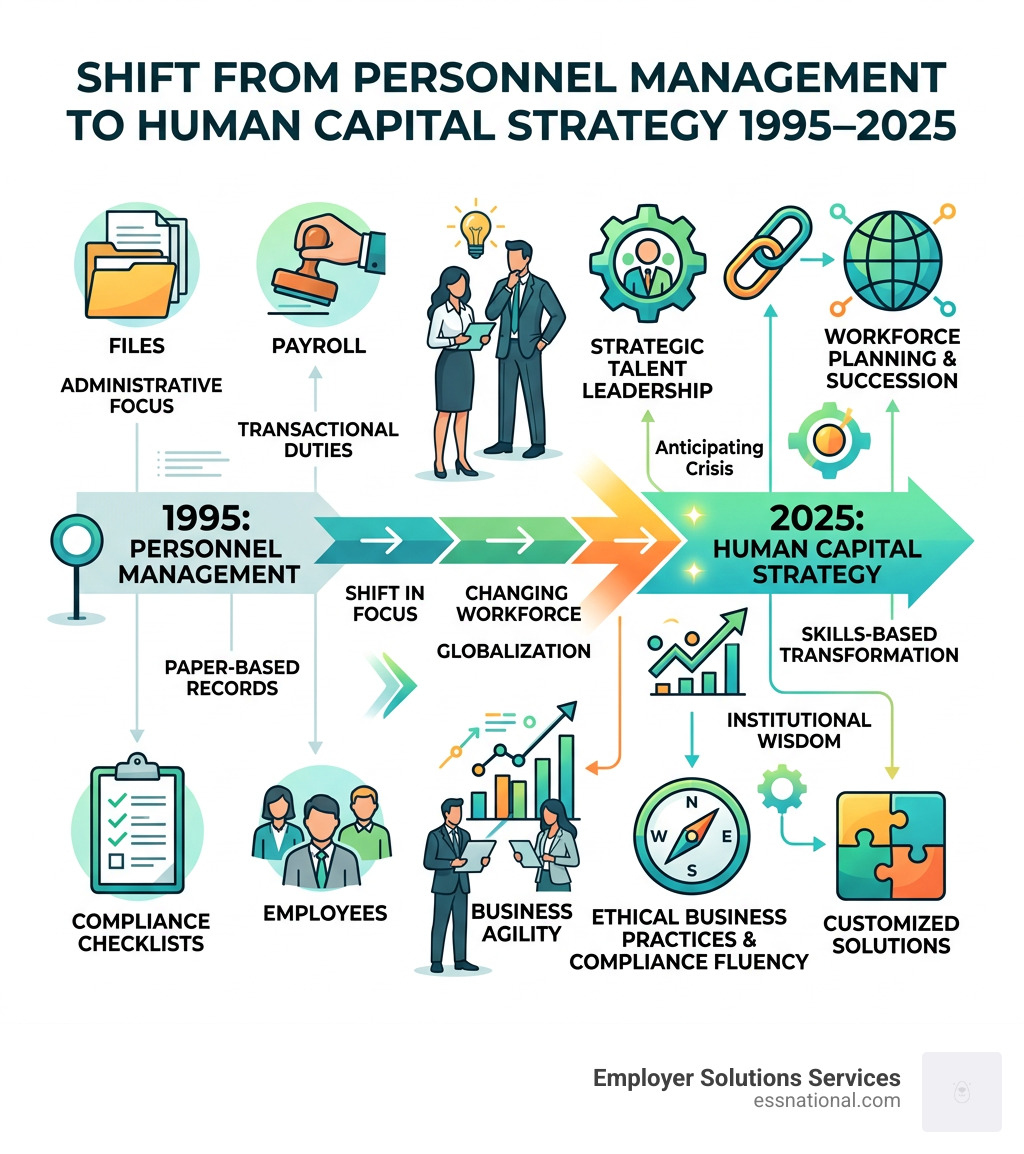
HR has changed dramatically since the mid-1990s. What started as largely administrative — processing paperwork, managing compliance checklists — has become one of the most strategically important functions in any organization. Leaders who have lived through that entire transformation carry knowledge that senior leadership simply cannot shortcut.
The shift wasn’t gradual. It was driven by waves of change: globalization, remote work, skills-based hiring, direct sourcing, and rapid regulatory evolution. HR professionals who navigated each of those waves built something rare — institutional wisdom that holds up under pressure.
This article brings together real-world insights from HR veterans, career data, and industry research to show what three decades in human resources actually looks like — and what it means for your business today.
The Evolution of 30 Years HR Expertise: From Compliance to Strategy
When we look back at the landscape of 1995, the “Human Resources” department was often still referred to as “Personnel.” The focus was almost entirely on administrative efficiency—getting the payroll out on time and ensuring files were locked in a cabinet. Fast forward to today, and 30 years HR expertise has evolved into a high-stakes game of business agility and risk management.
One of the most significant markers of this evolution is the rise of independent accreditation. For example, The Employer Services Assurance Corporation (ESAC) has provided a gold standard for the PEO industry since 1995. Sustaining this level of accreditation for 30 years is a massive milestone; it confirms a long-standing commitment to financial integrity, ethical business conduct, and regulatory compliance. In states like Florida, Illinois, and Texas, where regulatory environments can be complex, having a partner with this kind of verified longevity is critical.
True mastery in HR isn’t just about knowing the rules; it’s about ethical leadership. Experts with decades of experience understand that compliance isn’t a “check-the-box” activity—it’s about protecting the business’s most valuable asset: its people.
| Feature | Administrative HR (The Past) | Strategic HR Mastery (The Future) |
|---|---|---|
| Primary Focus | Record keeping & Payroll | Business Agility & Growth |
| Compliance | Reactive (fixing mistakes) | Proactive (risk mitigation) |
| Talent | Filling vacancies | Workforce transformation |
| Data Use | Basic reporting | Predictive analytics & Skills data |
| Leadership | Support function | Strategic partner to CEO/CFO |
Mastering Compliance and Policy with 30 Years HR Expertise
Navigating the alphabet soup of employment law—FMLA, ADA, OSHA—requires more than a law book; it requires the “scar tissue” that comes from handling thousands of real-world cases. Professionals like Renee West and Elga Lejarza, who each boast over 30 years of experience, demonstrate that high-level HR is about nuanced application.
Whether it’s managing complex FMLA/ADA case management or conducting impartial internal investigations into harassment or discrimination, veterans know how to protect a company while treating employees with dignity. This expertise extends to our services, where we help businesses in regions from New Jersey to Nevada develop employee handbooks that aren’t just legal documents, but cultural foundations.
Key areas where 30 years HR expertise shines include:
- Wage and Hour Laws: Navigating the thin line between exempt and non-exempt status to avoid costly back-pay lawsuits.
- Labor Relations: Managing union and non-union environments with equal proficiency.
- Policy Development: Creating customized strategies that reflect the specific needs of industries like manufacturing or professional services.
Navigating Complex Workforce Transformations
The modern workplace is undergoing a seismic shift toward “skills-based” models. Some global leaders, like those at EPAM Systems, have been operating as skills-based organizations for over 30 years. Instead of rigid job titles, they use work data to drive hiring, performance, and learning.
Experts like Sandra Loughlin and Michael D’Ambrose highlight how long-term HR leaders drive these transformations. D’Ambrose, for instance, has led massive organizational restructurings and CEO successions across Fortune 50 companies. This level of expertise allows an organization to remain agile during global mergers or economic pivots.
We also see the rise of “direct sourcing” and talent communities. Rather than reactively posting a job when someone leaves—a process that now takes a median of 42 days to fill—veteran HR leaders build sustainable pipelines. This proactive approach ensures that when a critical role opens, the talent is already “in hand.”
Career Paths and Credentials of Long-Term HR Leaders
How does one actually acquire 30 years HR expertise? It rarely follows a straight line. The career paths of today’s top consultants and CHROs are as diverse as the industries they serve.
Take Terry Welker, who spent 26 years in public safety before transitioning into full-time HR leadership. This background in investigation and public service provides a unique lens on organizational leadership and bias in hiring. Others, like John Dooney, have spent over two decades blending practitioner experience with deep research into HR metrics and international employee relations.
Education also plays a major role, with many veterans holding advanced degrees in Industrial/Organizational Psychology or Political Science. However, the “gold standard” for proving this expertise is often found in high-level certifications.
Commonly held credentials for 30-year veterans include:
- SHRM-SCP (Senior Certified Professional)
- SPHR (Senior Professional in Human Resources)
- GPHR (Global Professional in Human Resources)
These aren’t just letters after a name; they represent a commitment to continuous learning and recertification. For more on how we bring this level of professional mastery to our clients, visit our About Us page.

Lessons for the Next Generation: Building 30 Years HR Expertise
For those just starting out, the road to 30 years can seem daunting. Insights from real-world discussions on platforms like Reddit suggest that most professionals spend 3 to 7 years in generalist roles before landing their first management position.
However, “management” isn’t the only path to success. Some veterans with 20+ years of experience find immense fulfillment and high pay as “individual contributors” or high-level consultants, avoiding the stress of direct reports while still providing massive value.
Key lessons for emerging professionals:
- Beware of Title Inflation: A “Director” title at a small firm might involve less strategic work than a “Generalist” role at a major corporation. Focus on responsibilities, not just the business card.
- The Power of Internships: Real-world experience during college can accelerate your path to management significantly.
- Resilience is Key: Long-term HR success requires the ability to navigate “failing upward” and unexpected market shifts.
- Contract Work: Don’t shy away from high-level contract HR roles; they offer diverse experience and often higher hourly rates ($45–$65+/hr) than traditional roles.
Driving Client Success Through Sustained Professional Mastery
The ultimate proof of 30 years HR expertise is found in client outcomes. When a business partners with a seasoned HR provider, they aren’t just buying a software subscription; they are buying a shield and a springboard.
For example, transitioning from a legacy Pharmacy Benefits Manager (PBM) to a modern, transparent one can save employees hundreds of dollars a month in co-pays. A veteran HR leader knows how to initiate those tough conversations with brokers and CEOs to drive those savings.
Sustained expertise also allows for:
- Customized HR Strategies: Small and mid-sized businesses don’t need “big box” HR. They need policies that work for their specific headcount and industry.
- Financial Assurance: Partners with long-term ESAC accreditation provide a level of financial security that newer firms simply cannot match.
- Workforce Planning: Moving from “hiring for today” to “scaling for tomorrow” requires a deep understanding of market trends and labor force growth, which slowed significantly in 2024.
Frequently Asked Questions about HR Mastery
How many years of experience are typically needed for an HR management role?
While there is no hard rule, industry data and professional insights suggest a range of 3 to 7 years of generalist experience is common before stepping into a management role (such as a Benefits, Payroll, or Recruitment Manager). Some professionals accelerate this through intensive internships or by leveraging management experience from other fields, like retail or public safety.
What certifications are most common among 30-year HR veterans?
The most respected veterans typically hold senior-level certifications such as the SHRM-SCP or the SPHR. For those working with international teams, the GPHR is common. Many also start with the PHR or aPHR early in their careers. The hallmark of a true expert is consistent recertification, showing they have stayed current with changing laws and technologies.
Why is long-term HR expertise critical for navigating complex challenges?
Long-term expertise provides the “pattern recognition” necessary to solve complex problems. Whether it’s a PBM transition, a skills-based transformation, or navigating a global pandemic, veterans have the historical context to know what works and what doesn’t. This leads to better ethical leadership, more stable workforce planning, and higher talent retention.
Conclusion
At Employer Solutions Services, we believe that 30 years HR expertise is the bedrock of business success. We have spent decades honing our craft, providing staffing solutions (temporary, temp-to-hire, and direct-hire) and back-office administration like payroll services across a wide range of industries.
From the bustling markets of Florida and Texas to the industrial hubs of Illinois and Pennsylvania, we bring a customized approach to every client. Our deep bench of screened and trained talent, combined with our decades of “in the trenches” experience, allows us to handle the headaches of HR so you can focus on growing your business.
Don’t leave your company’s foundation to chance. Partner with our HR experts today and leverage the wisdom that only 30 years of excellence can provide.