
Finding the Right Staffing Agency in Massachusetts
If you’re looking for a staffing agency in Massachusetts, here’s a quick overview of what you need to know:
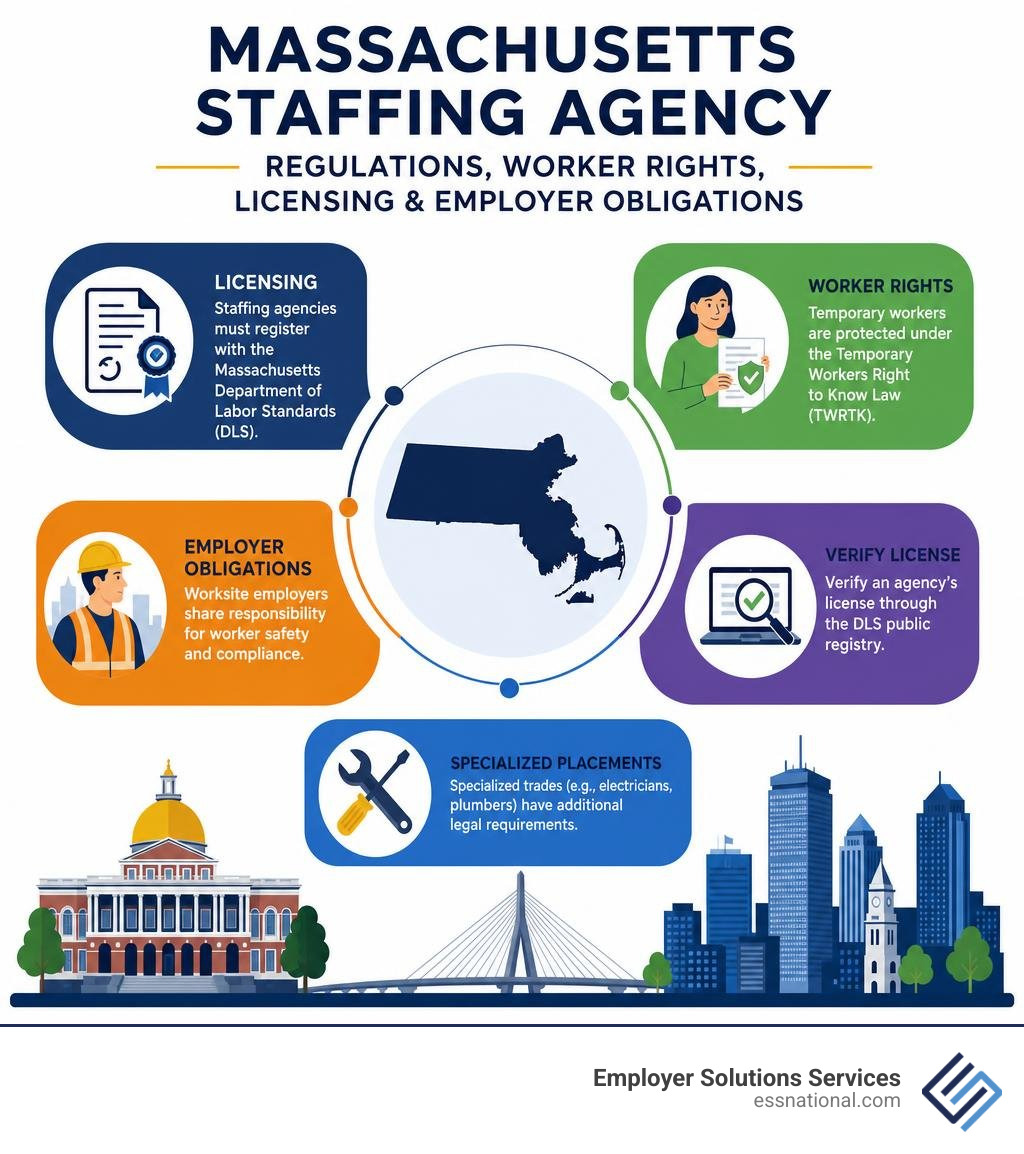
- Licensed agencies must register with the Massachusetts Department of Labor Standards (DLS).
- Temporary workers have protected rights under the Temporary Workers Right to Know Law (TWRTK).
- Worksite employers share responsibility for worker safety and compliance.
- Verification of an agency’s license is available through the DLS public registry.
- Specialized placements (electricians, plumbers) have additional legal requirements.
Finding reliable workers in Massachusetts isn’t easy heading into 2026. Workforce shortages are real, hiring is expensive, and managing payroll on top of everything else stretches most mid-sized businesses thin.
That’s exactly where staffing agencies come in — but not all of them operate the same way, and not all of them are operating legally.
Massachusetts has one of the more structured regulatory environments for staffing in the country. Agencies must be licensed or registered through the DLS. Temporary workers must receive written notice of their rights. And worksite employers carry more legal responsibility than many business owners realize.
Choosing the wrong agency can mean compliance headaches, liability exposure, and — worst of all — workers who aren’t properly screened or supported.
This guide breaks down the 7 best staffing solutions available in Massachusetts for 2026, what the law requires, and how to make a smart choice for your business.
How to Choose a Staffing Agency Massachusetts Businesses Trust
When searching for a staffing agency massachusetts businesses can rely on, compliance must be your top priority. Massachusetts does not treat staffing as an unregulated, wild-west industry. Instead, the Commonwealth monitors the sector closely through the Employment, Placement, and Staffing Agencies Program, which is administered directly by the Department of Labor Standards (DLS).
The primary role of the Employment, Placement, and Staffing Agencies Program is to protect the rights of workers placed by agencies, ensure fair and ethical business practices, and assist agencies in complying with state labor laws. This oversight helps maintain a level playing field so that reputable agencies are not undercut by bad actors who ignore wage, safety, and licensing rules.
For a business looking to partner with an agency, this regulatory oversight is actually a massive benefit. It gives you a clear mechanism to verify that your staffing partner is legitimate. The DLS maintains a public registry of licensed and registered employment and staffing agencies. Before you sign any contract, you can—and should—verify that the agency has an active, valid license or registration.
Working with an unlicensed agency is a major risk. If the state shuts down an unregistered agency for non-compliance, your pipeline of temporary labor could vanish overnight, leaving your production lines or office operations completely stranded.
If you are trying to navigate the local hiring market, finding a partner with physical roots and specialized compliance knowledge is key. You can learn more about finding physical branches and localized support in our guide on Finding Local Staffing Offices.
Licensing Requirements for a Staffing Agency Massachusetts Regulates
The state draws a legal distinction between “Employment Agencies” and “Placement Agencies” (which include temporary staffing agencies). Under the Employment Agency Law, the registration and licensing processes differ based on how the agency operates and who pays the fees:
- Employment Agencies: These are entities that charge a fee to either the applicant or the employer for permanent job placement. They must obtain a formal license from the DLS.
- Placement/Staffing Agencies: These are agencies that employ workers directly and place them on temporary assignments at client worksites (where the client pays the agency, and the agency pays the worker). These organizations must obtain a registration from the DLS.
To apply for or renew a license or registration in Massachusetts, an agency must submit a detailed application to the DLS. This process includes:
- Providing proof of workers’ compensation insurance.
- Submitting copies of the contracts and forms they intend to use with workers and employers.
- Paying the required state licensing or registration fees.
- Passing a background and compliance check to ensure no outstanding wage and hour or safety violations exist.
These licenses and registrations are not permanent; they must be renewed annually. This ensures that the DLS can continuously monitor compliance and confirm that the agency remains financially stable and legally compliant year after year.
Safety Guidelines for a Staffing Agency Massachusetts Workers Depend On
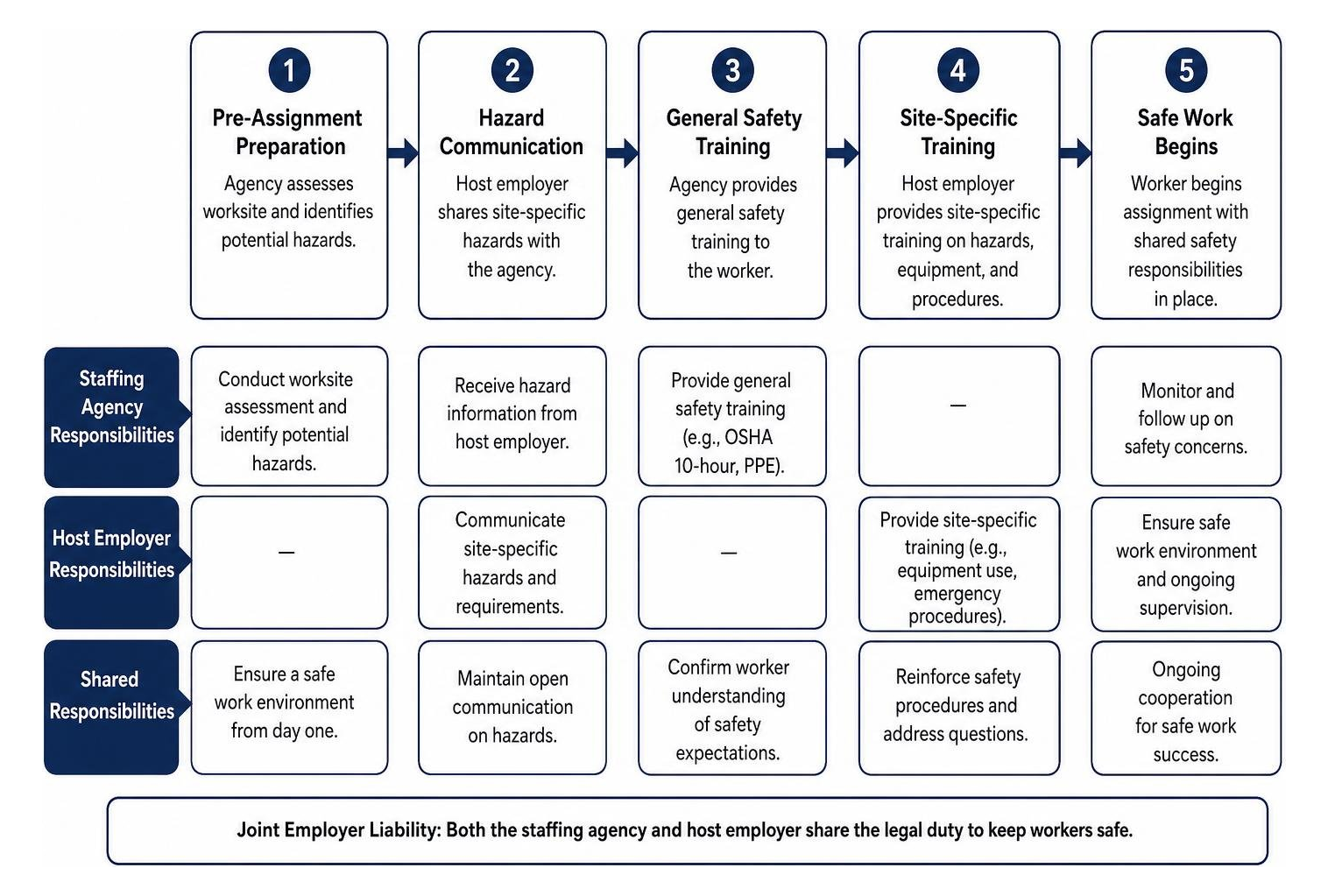
Employee safety is a shared responsibility, but in the staffing world, this concept is legally structured under “joint employer liability.” Both the staffing agency and the host (worksite) employer share the legal duty to keep workers safe.
The Occupational Safety and Health Administration (OSHA) and the Massachusetts DLS expect both parties to communicate and coordinate safety efforts. A staffing agency cannot simply send a worker to a site and assume the host employer has everything handled. Likewise, a host employer cannot assume the agency fully trained the worker on site-specific hazards.
The DLS provides a comprehensive Staffing Agency Safety and Health Guide to help agencies and employers navigate these waters. Key safety compliance measures include:
- Worksite Assessments: The staffing agency should conduct an initial walkthrough of the client’s facility to identify potential hazards before placing any workers.
- Hazard Communication: Host employers must inform the staffing agency of any hazardous chemicals, heavy machinery, or dangerous environments the workers will encounter.
- Safety Training: While the agency can provide general safety training (such as general OSHA 10-hour cards or basic PPE usage), the worksite employer must provide site-specific training (such as how to operate a specific machine or where the emergency exits are located).
To visualize how these responsibilities break down between the agency and your business, review the process flow below:
Legal Obligations and Worker Rights in Massachusetts
Massachusetts has some of the strongest worker protection laws in the United States. If you utilize temporary labor, you must understand the Employment Agency Law and, more specifically, the Temporary Workers Right to Know Law (TWRTK).
The TWRTK was designed to prevent the exploitation of temporary staff. It mandates that staffing agencies provide temporary employees with a written “Notice of Temporary Workers Rights” before they begin any job assignment. This notice must be provided in English and in the worker’s primary language, if the state has a translation available.
This notice must disclose critical details about the placement, including:
- The name, address, and contact information of the staffing agency, its workers’ comp carrier, and the worksite employer.
- The rate of pay, designated payday, and whether the job is eligible for overtime.
- A detailed description of the job duties, shift hours, and the anticipated duration of the assignment.
- Whether any specialized clothing, safety gear, or tools are required, and who is responsible for providing or paying for them.
- Details regarding transportation, meals, or other utilities if they are offered or required by the agency or host employer.
Furthermore, the law strictly regulates specialized placements. For example, when placing electrical or plumbing apprentices, staffing agencies must comply with strict licensing board ratios and oversight. Staffing agencies placing electricians or plumbers must verify that the workers hold active, valid credentials and that the host employer provides a licensed journeyman or master professional to supervise them directly.
If you are considering a transition model where temporary workers eventually join your permanent payroll, it is highly beneficial to work with an agency that understands these transition dynamics. Read more about finding the right transition partner in our resource on The Best Temp-to-Hire Employment Agencies Near You.
To help clarify how responsibilities are split under Massachusetts law, refer to the comparison table below:
| Temporary Worker Rights (TWRTK) | Worksite Employer Obligations |
|---|---|
| Right to receive a written job disclosure notice before starting work | Obligation to provide accurate job duty descriptions to the agency |
| Right to know the exact pay rate, overtime eligibility, and payday | Obligation to pay the agency timely and track hours accurately |
| Protection against excessive charges for transportation or meals | Obligation to provide a safe, hazard-free physical working environment |
| Right to work in an environment free from discrimination and harassment | Obligation to provide site-specific safety training and proper PPE |
Key Requirements for Worksite Employers
As a worksite employer in Massachusetts, you cannot treat temporary workers as “second-class” employees when it comes to safety and labor laws. Legally, they are your employees while they are operating on your premises.
To ensure complete compliance and avoid costly legal disputes, worksite employers must adhere to several key requirements:
- Equal Safety Standards: Temporary workers must be provided with the exact same level of safety protection, personal protective equipment (PPE), and hazard communication as your permanent staff.
- Accurate Time Tracking: You must maintain precise records of all hours worked by temporary staff. Under Massachusetts law, failing to pay overtime or miscalculating hours can result in treble (triple) damages and mandatory attorney fees if a wage claim is filed.
- Cooperative Training: You must document all site-specific safety training provided to temporary workers and share those records with the staffing agency to ensure both parties have proof of compliance.
- No Retaliation: Temporary workers have the legal right to report unsafe working conditions or wage discrepancies without fear of retaliation. If a worker raises a concern, you cannot simply ask the staffing agency to “send someone else” as a way to avoid addressing the issue.

By proactively managing these responsibilities, you protect your business from joint-employer liability lawsuits and ensure a productive, safe workplace. For a complete strategy on how to quickly scale your workforce while staying fully compliant, read our Ultimate Guide to Essential Staffing Solutions for Quick Hiring.
7 Best Staffing Agency Solutions in Massachusetts
When looking for a staffing agency massachusetts businesses can trust to deliver high-quality, compliant talent, you need solutions that fit your specific operational model. Here at Employer Solutions Services (ESS), we have spent over 30 years refining our customized staffing and HR programs.
Below are the 7 best staffing solutions we provide to help Massachusetts businesses scale efficiently in 2026, maintain strict regulatory compliance, and reduce administrative burdens.

1. Temp-to-Hire Staffing
This solution allows you to evaluate a candidate’s skills, work ethic, and cultural fit on the job before making a permanent hiring decision. It minimizes hiring risks and ensures that when you do make a job offer, it’s a guaranteed match.
2. Direct Hire Placement
When you need to fill critical, permanent, or highly specialized roles quickly, our professional recruiters handle the heavy lifting. We source, screen, and present only the top-tier talent, saving your internal HR team weeks of resume sorting. If you want to learn more about how to secure top-tier permanent talent, check out our guide on The Best Direct Hire Staffing Agency Near Me and Beyond.
3. Temporary Staffing
Ideal for seasonal surges, special projects, or covering medical leaves. We provide fully screened, qualified temporary workers who can step in and keep your operations moving without missing a beat, ensuring full compliance with the TWRTK law from day one.
4. Payroll Administration
Managing payroll, tax withholdings, and state-specific compliance in Massachusetts can be a full-time job. We handle all back-office payroll administration, ensuring your workers are paid accurately and on time, while you focus on running your business.
5. Customized Staffing Programs
Every business is unique. We don’t believe in cookie-cutter hiring strategies. We sit down with your leadership team to build customized staffing programs tailored to your specific shift structures, production targets, and budget constraints.
6. Screened and Trained Talent Solutions
We don’t just send warm bodies to your worksite. Our rigorous screening process includes thorough background checks, reference verifications, and skills assessments. We ensure our talent is prepared and trained to hit the ground running safely.
7. Back-Office Administration Support
From managing workers’ compensation claims to administering benefits and tracking compliance documentation, our comprehensive back-office support takes the administrative weight off your shoulders, protecting you from costly compliance mistakes.
Frequently Asked Questions about Massachusetts Staffing Regulations
How do I verify if a Massachusetts staffing agency is licensed?
You can verify an agency’s status by accessing the public registry maintained by the Department of Labor Standards (DLS) on the official Mass.gov website. The DLS regularly updates this list of licensed and registered employment and staffing agencies. If an agency cannot provide their DLS license or registration number, they are not operating legally in the state.
What is the Temporary Workers Right to Know Law?
The Temporary Workers Right to Know Law (TWRTK) is a Massachusetts state law that protects temporary workers. It requires staffing agencies to provide workers with a written notice containing critical details about their job assignment (including pay rates, hours, job duties, and safety requirements) before the assignment begins.
How can I contact the Department of Labor Standards (DLS)?
You can contact the DLS Employment, Placement, and Staffing Agencies Program directly for assistance:
- Phone: (617) 626-6975
- Online: Visit the official Mass.gov portal for the Department of Labor Standards.
- Office Address: 19 Staniford Street, 2nd Floor, Boston, MA 02114.
Conclusion
Navigating the workforce landscape in Massachusetts requires a careful balance of speed, talent quality, and strict regulatory compliance. Between the Temporary Workers Right to Know Law, DLS licensing requirements, and joint OSHA safety liabilities, worksite employers face a lot of potential pitfalls.
Partnering with an experienced, compliant staffing provider is the easiest way to protect your business while securing the talent you need. At Employer Solutions Services (ESS), we bring over 30 years of industry experience, fully customized staffing programs, rigorously screened and trained talent, and comprehensive back-office payroll administration to the table.
Let us handle the compliance and recruitment headaches so you can focus on growing your business. Explore how we can support your business by visiting our Employer Solutions Services page today.